

Samarkand, Uzbekistan | A three-day regional Climate Literacy Training for Heritage Professionals has concluded in Samarkand, Uzbekistan, equipping conservation experts from across Central Asia with the knowledge and practical tools needed to address the growing impacts of climate change on cultural heritage. Organised from 1–3 July 2026 by the ICOMOS Climate Action Working Group (CAWG) in collaboration with regional and international partners, the programme brought together 21 heritage professionals from Kazakhstan, Kyrgyzstan, Tajikistan, Turkmenistan, and Uzbekistan.
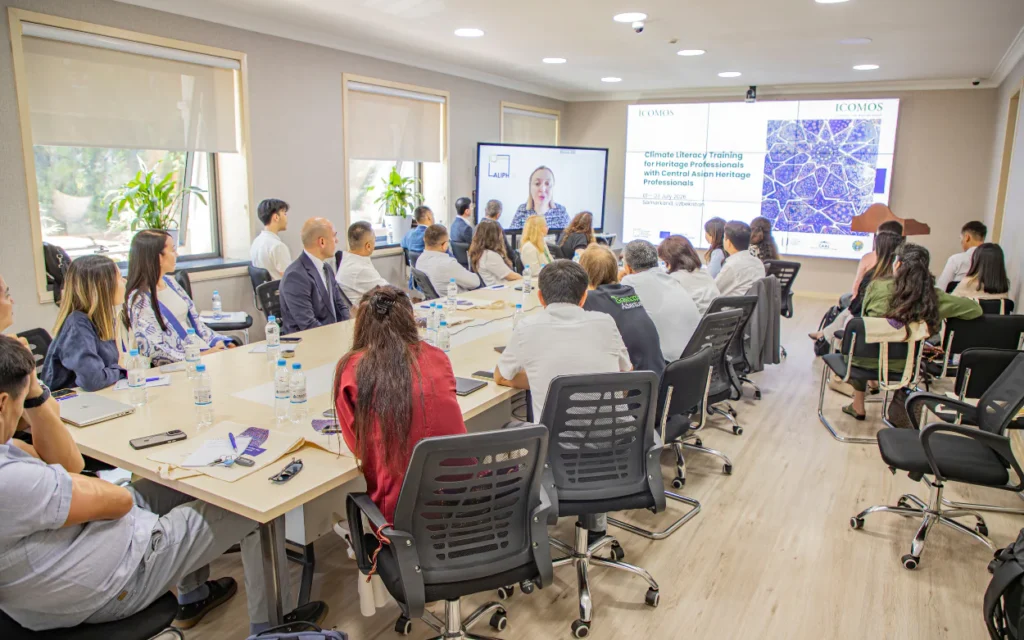
The initiative was designed to strengthen climate literacy within the heritage sector by combining scientific understanding with practical conservation strategies. As climate change increasingly threatens both tangible and intangible cultural heritage across Central Asia, participants explored methods to integrate climate resilience into heritage management, conservation planning, and decision-making processes.
The training commenced with addresses from representatives of ICOMOS, ALIPH, the National Commission of the Republic of Uzbekistan for UNESCO, the Cultural Heritage Agency of Uzbekistan, the International Institute for Central Asian Studies (IICAS), and the Central Asian Archaeological Landscapes (CAAL) project. Expert-led sessions by members of the ICOMOS Climate Action Working Group introduced participants to climate science, the relationship between climate change and heritage conservation, carbon emissions, and sector-specific mitigation measures.
On the second day, the programme shifted its focus from theory to implementation. Participants examined approaches to embedding climate adaptation and resilience into conservation projects and took part in a Train-the-Trainer module that prepared them to deliver climate literacy programmes within their own institutions and communities.
The final day featured a specialised session on digital documentation conducted by Gai Jorayev of ICOMOS UK and the CAAL project, highlighting the role of digital technologies in preserving cultural heritage. Participants also visited some of Samarkand’s most renowned heritage sites, including Registan Square, Bibi-Khanym Mosque, Shakhi-Zinda Architectural Complex, and the Afrosiab Museum, providing an opportunity to connect classroom learning with real-world heritage conservation challenges.
According to ICOMOS, the training materials have been adapted specifically for Central Asian climate conditions and heritage contexts. To ensure wider regional impact, the complete course materials will be translated into Russian, Uzbek, Kazakh, Kyrgyz, Tajik, and Turkmen, enabling broader dissemination and long-term capacity building throughout the region.
Supported by ALIPH and the European Union, the programme aims to foster stronger regional collaboration while empowering heritage professionals to integrate climate considerations into conservation practice, share knowledge within their organisations, and promote climate-informed decision-making for the protection of Central Asia’s cultural heritage.
Source: ICOMOS Climate Action Working Group / International Institute for Central Asian Studies (IICAS).
Also Read: UIA Launches 2026 Guidebook for the 2030 Agenda at World Congress of Architects in Barcelona
Join our WhatsApp Channel for fastest updates: Join now