

New Delhi | The long-delayed restoration of Delhi’s iconic Gole Market, one of the capital’s earliest planned commercial buildings, continues to face setbacks nearly two decades after the project was first approved. Originally scheduled for completion before the 2010 Commonwealth Games, the conservation project is now expected to be completed by September 2026, according to officials.
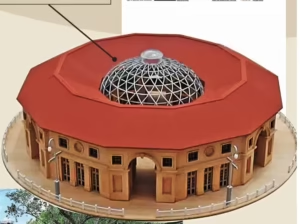
Constructed in 1921 as a circular marketplace serving government employees in the newly built imperial capital, the Grade-II heritage structure was envisioned as a museum celebrating Delhi’s history and the evolution of the New Delhi Municipal Council (NDMC). The restoration proposal received administrative approval in 2006 with an initial budget of ₹6.3 crore, later revised to ₹7.7 crore in 2009. However, the project became entangled in relocation disputes, legal challenges, repeated revisions and escalating costs.
The building was declared unsafe in 2007, prompting the relocation of traders. Several shopkeepers challenged the decision in court, delaying the project for nearly six years. Although the Delhi High Court ruled in favour of NDMC in 2013, some traders remained until 2016, extending the timeline further. Over the years, project estimates increased from ₹18.1 crore to ₹20.9 crore, while a later ₹26.7 crore proposal, which included a pedestrian subway, was also revised before implementation.
Construction gained momentum only after a site inspection by then Lieutenant Governor V.K. Saxena in June 2022, followed by approvals from the Delhi Urban Art Commission and the Heritage Conservation Committee. Physical restoration finally commenced in October 2023. Officials currently estimate that nearly 45% of the work has been completed, although significant structural and finishing work remains.
The restored complex is planned to feature a glass-covered central courtyard, exhibition galleries, an art gallery, cafeteria, souvenir shop, multimedia room, office spaces, elevators, fire safety systems, HVAC services and a pedestrian subway connecting visitors safely across the busy roundabout. The project’s thematic focus has also evolved over time—from an NDMC museum to broader exhibitions on Delhi’s history, and at one stage even a museum dedicated to women achievers.
For former traders, however, the prolonged restoration has had lasting economic consequences. Merchant representatives say the once-popular market, known for its restaurants and convenient accessibility, witnessed a sharp decline in business following litigation and prolonged barricading. Many shops remain closed, while nearby businesses continue to face challenges from construction dust and reduced footfall.
NDMC Vice-Chairperson Kuljeet Chahal attributed the delays to contractor-related issues, procedural approvals and changes in the project’s scope. He stated that the inclusion of an art gallery expanded the project’s vision beyond the original museum proposal and expressed confidence that the restoration would be completed soon. Once the dome strengthening and structural conservation are finished, officials expect the landmark to regain its architectural prominence in the heart of New Delhi. TOI
Join our WhatsApp Channel for fastest updates: Join now