New Delhi | The All India Council for Technical Education has confirmed that 58 engineering colleges and technical institutions across India underwent progressive closure during the 2025–26 academic year, citing reasons such as declining student enrolment, inadequate faculty strength, and non-compliance with infrastructure and regulatory requirements. Existing students enrolled in these institutions will, however, be allowed to complete their academic programmes.
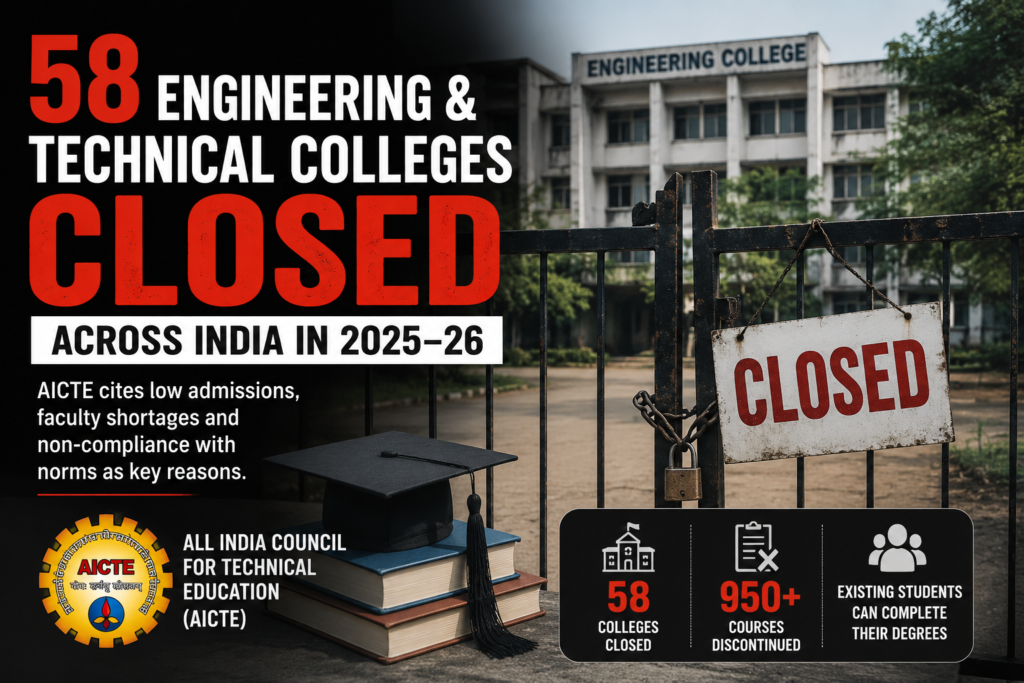
According to AICTE officials, progressive closure prevents institutions from admitting new first-year students while permitting currently enrolled students to continue until graduation. The regulatory body differentiates this process from complete closure, where courses are terminated entirely and students are transferred to other approved institutions.
Among the affected states, Uttar Pradesh and Maharashtra recorded the highest number of closures with 12 institutions each, followed by Madhya Pradesh (8). Telangana and Punjab each witnessed four closures, while Andhra Pradesh and Rajasthan recorded three closures each. Two institutions each were closed in Gujarat, Karnataka, and Tamil Nadu, whereas Haryana, Odisha, Uttarakhand, and West Bengal reported one closure each. Of the 58 institutions, only three were government-aided, while the remaining colleges were privately managed.
The AICTE also stated that more than 950 technical and engineering courses across the country were discontinued during the same academic year. These closures form part of the council’s ongoing efforts to improve the quality and sustainability of technical education by ensuring institutions meet prescribed academic, faculty, and infrastructure standards.
The closures highlight continuing challenges within India’s engineering education sector, where several institutions have struggled with falling admissions, changing industry demands, and maintaining regulatory compliance. As AICTE continues to rationalise the technical education landscape, greater emphasis is expected on quality assurance, institutional viability, and alignment of academic programmes with emerging workforce requirements. ET
Also Read: India Today Rankings 2026: Top 5 Architecture Colleges in India Announced
Join our WhatsApp Channel for fastest updates: Join now