New Delhi: Union Minister for Environment, Forest and Climate Change Bhupender Yadav chaired a high-level meeting with Delhi Chief Minister Rekha Gupta to review the implementation of the city’s Air Pollution Mitigation Action Plan and finalise additional measures ahead of the winter pollution season.
The meeting brought together senior officials from the Ministry of Environment, Forest and Climate Change and the Government of NCT of Delhi, along with representatives from CAQM, CPCB, DPCC, MCD, NDMC, DDA, Delhi Transport Department, Delhi Metro, Delhi Police and PWD. The discussions focused on measures already undertaken, progress on the ground and interventions required before and during winter.
Jan Bhagidari at 37 Pollution Hotspots
Yadav directed that Jan Bhagidari events be organised at Delhi’s 37 identified pollution hotspots by October 10, with actionable measures identified for each location and their implementation closely monitored. Public representatives will visit the hotspots along with relevant stakeholders to assess mitigation measures on the ground.
The meeting also stressed coordinated action across the NCR to address pollution linked to agricultural activities. Action plans for NCR areas are to be finalised before October 10, alongside stronger coordination among agencies and greater citizen awareness.
Delhi’s Winter Strategy Covers Multiple Pollution Sources
Chief Minister Rekha Gupta emphasised stronger coordination among enforcement and traffic-management agencies and greater use of technology, including cameras at construction sites to monitor compliance. She also highlighted technological solutions for reducing emissions from cremation grounds and increasing awareness about electric cremation facilities.
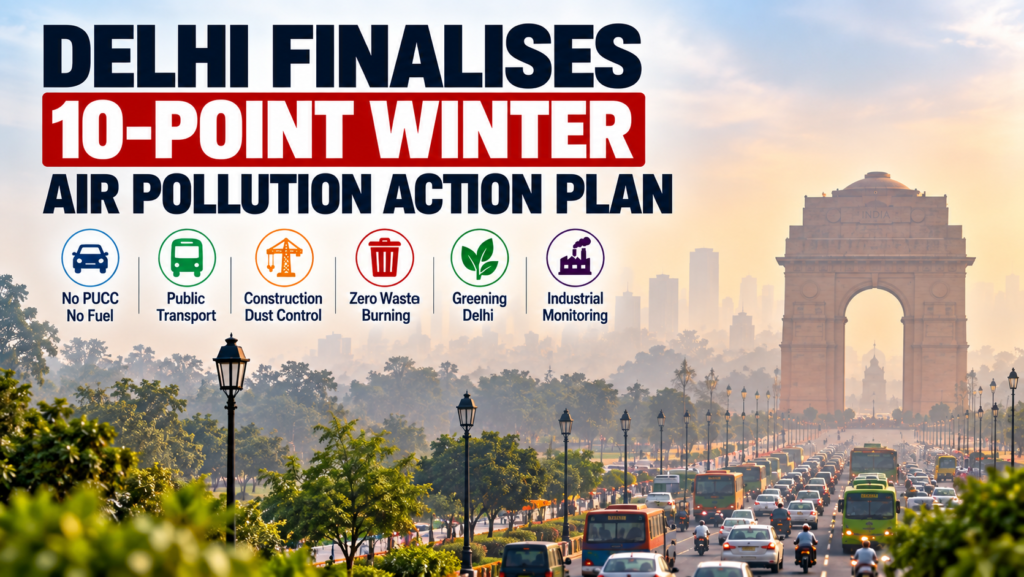
The outcome-oriented winter strategy will intensify action against vehicular emissions, road and construction dust, waste and biomass burning, industrial emissions, and pollution and traffic hotspots, while promoting public transport and greening. RWAs, market associations, industries, citizens and public representatives are being brought into the campaign as active partners.
Ten Key Measures Announced
1. ‘No PUCC, No Fuel’ Campaign
The policy will be implemented in mission mode through awareness and enforcement at all 500 ANPR-enabled fuel stations, with action against defaulting pumps.
2. Public Transport and Last-Mile Connectivity
A campaign to promote the Delhi Metro Sarthi App will run from October 1–10, including download camps with RWAs and public representatives. The meeting noted last-mile connectivity at all 228 Metro stations and a Delhi bus fleet of 6,840, including 5,088 e-buses.
3. Hotspot Action Plan
Regular field visits involving public representatives, officials, RWAs, traders and traffic police will be undertaken. The government reported that 42 hotspots have already been rectified, with eight more targeted by October. One-way traffic and decongestion trials are also planned at selected locations.
4. Road Redevelopment and Dust Control
A total of 1,193 km of road redevelopment has been completed, with the remaining work targeted for completion by November 15. End-to-end footpath paving and walkability will also be prioritised, while complaints are to be resolved within 72 hours under the stated SOP.
5. Zero Tolerance for Open Waste Burning
The strategy includes ward-level monitoring, stronger market waste collection, enforcement of the Solid Waste Management Rules, 2026, and a city-wide ‘Zero Burning’ pledge campaign. Monitoring teams are to be deployed by October 15. The number of MRSMs has increased from 76 last year to 98, according to the Delhi Government.
6. Greening of Brown Areas
The Delhi Government reported 71 lakh plantations and greening of 433 out of 434 acres of identified brown areas.
7. Construction and Demolition Dust Management
Registration on the Malba App is proposed as a mandatory condition for building-plan sanction. A ban on dust-generating demolition and outdoor civil construction activities will apply from November 1 to January 31, with a complete construction and demolition ban from December 10 to January 20.
8. Advance Winter Protocol
Measures include restrictions on polluting vehicles, doubled parking charges, staggered office timings and 50% work-from-home arrangements. From November 1, 2026, entry of vehicles registered outside Delhi and below BS-VI emission standards will be restricted, except CNG and EV vehicles.
9. EV Outreach and Parivartan Yojana
The meeting called for promotion of EV Policy 2026, increased incentives for scrapping old vehicles and a mission-mode registration drive under the Parivartan Scheme. Jan Bhagidari camps will be organised during October-November.
10. Industrial Pollution Control
Industrial enforcement will be strengthened through an AI-enabled Command and Control Centre, an increase in monitoring stations from 47 to 60, and deployment of 334 enforcement teams. Daily AQI bulletins, grievance redressal and coordinated NCR-level airshed action will also be strengthened.
The meeting concluded with an emphasis on time-bound implementation, inter-agency coordination and public participation as Delhi prepares for the winter pollution season.
Also Read: Ghaziabad Pollution: UPPCB Identifies 9 Hotspots for Winter 2026–27
Join our WhatsApp Channel for fastest updates: Join now