

Ahmedabad, Gujarat | The Ahmedabad Municipal Corporation (AMC) has set a Guinness World Record for the largest Miyawaki plantation completed in one hour. The record was achieved on 12 July 2026 at Bhadaj, located in the Gandhinagar Lok Sabha Constituency, where 3.61 lakh (361,000) saplings were planted within a single hour.
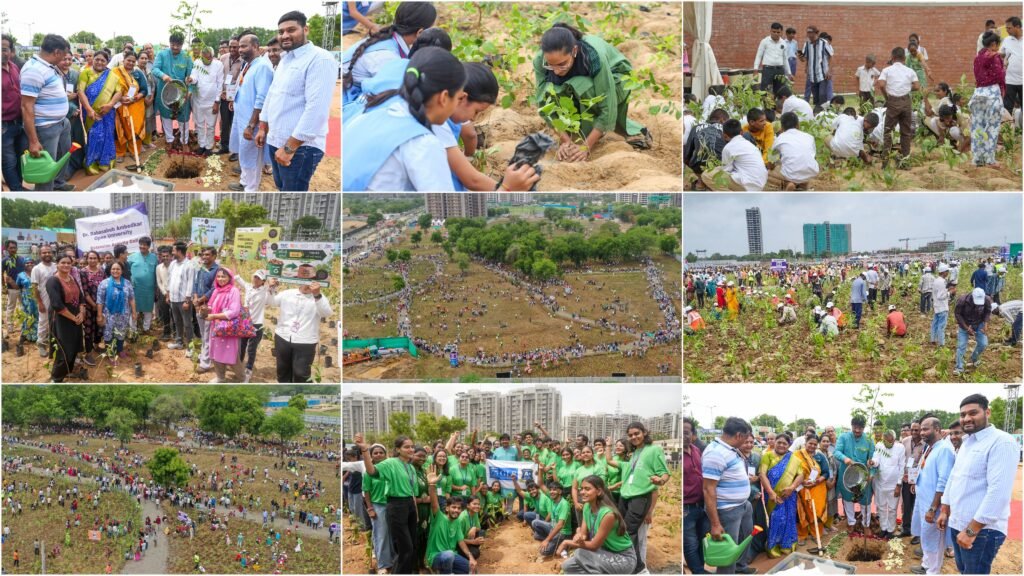
According to the official Guinness World Records Certificate, the achievement recognizes AMC for creating the world’s largest Miyawaki plantation in one hour. The record was established through the collective efforts of approximately 25,000 volunteers, including students, government officials, environmental groups, and citizens, who participated in the massive plantation drive.
The plantation campaign was conducted under the ‘Ek Ped Maa Ke Naam’ initiative, which encourages citizens to plant trees in honour of their mothers while promoting environmental stewardship. The event witnessed the participation of Union Home Minister Amit Shah, who planted a sapling and praised the collective effort. In his message shared on social media, he congratulated the people of Gandhinagar and Ahmedabad Municipal Corporation, describing the achievement as a significant milestone towards environmental conservation and acknowledging the dedication of thousands of volunteers.
The plantation employed the Miyawaki method, a scientifically developed afforestation technique pioneered by Japanese botanist Akira Miyawaki. The method involves planting diverse native species at high density, enabling forests to grow much faster than conventional plantations while enhancing biodiversity, improving air quality, and increasing carbon sequestration. Miyawaki forests are increasingly being adopted by Indian cities to restore degraded urban land and strengthen climate resilience.
The large-scale plantation at Bhadaj is expected to contribute to Gujarat’s urban green cover, support ecological restoration, and serve as a model for community-driven environmental initiatives. Besides creating a new world record, the campaign reinforces the growing emphasis on nature-based solutions to address climate change, urban heat islands, and biodiversity loss.
The achievement also highlights how coordinated participation by government agencies, educational institutions, civil society organisations, and local communities can successfully execute large-scale environmental projects within a limited timeframe. As Indian cities continue to expand, such urban afforestation efforts are becoming increasingly important for creating healthier and more sustainable urban environments.
Join our WhatsApp Channel for fastest updates: Join now