

The Ministry of Road Transport and Highways has proposed a series of reforms to the existing Rent-a-Cab framework, aiming to simplify licensing procedures, encourage new businesses, expand rental options and strengthen passenger safety across the country.
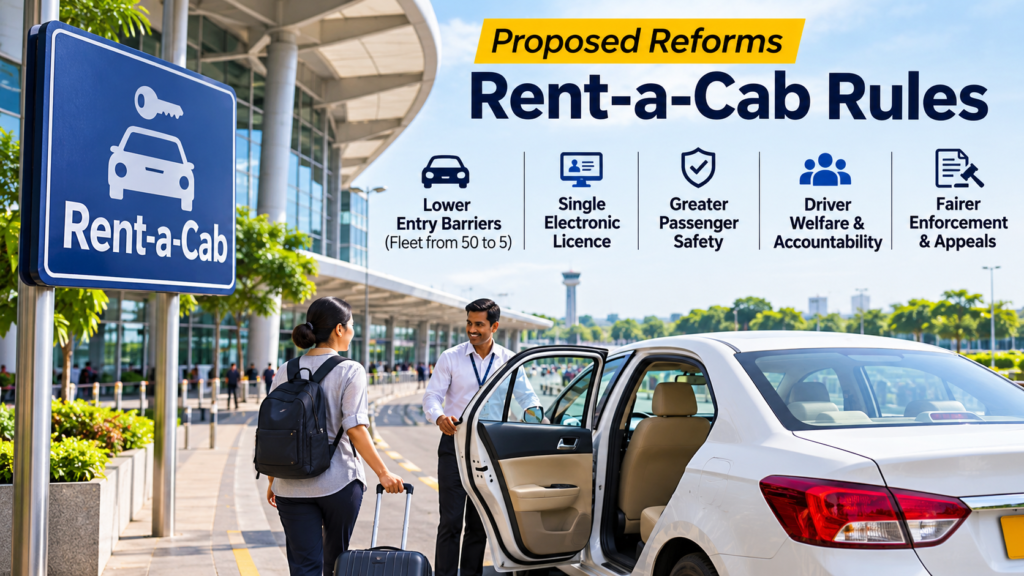
According to the Ministry’s announcement dated November 12, 2026, the proposed reforms seek to improve the ease of doing business while ensuring better passenger services through simplified regulatory requirements, digital processes and enhanced accountability.
Lower Entry Barriers for Cab Operators
One of the major proposed changes is the reduction in the minimum fleet requirement from 50 vehicles to just five. Operators would also be permitted to provide rental cabs either with or without drivers, offering greater flexibility to customers and businesses. The requirement for operators to establish branches in five tourist cities has also been proposed for removal. However, operators would need to maintain at least two cabs at each approved place of operation.
Single Electronic Licence to Simplify Operations
The proposed framework introduces a single electronic licence valid across the respective State or Union Territory, replacing the existing requirement for separate main and branch licences. The licensing fee would also be uniform across the State or UT. Approved operational locations could include airports, railway stations and bus terminals, potentially improving accessibility and convenience for passengers.
To ensure faster regulatory processes, the Ministry has proposed a 60-day timeline for granting and renewing licences. Additionally, applications for adding or removing vehicles or places of operation would be covered by a 30-day deemed-approval mechanism. Electronic VAHAN registers and automatic data retrieval are also proposed to reduce paperwork and simplify compliance.
Enhanced Passenger Safety and Grievance Support
Passenger safety and service quality form another important component of the proposed reforms. Rental cabs would be required to have location-tracking systems and first-aid kits, while child restraint systems would be optional.
Operators would also be required to maintain a website and provide 24-hour grievance redressal support. Provisions for emergency repairs and towing services are intended to improve assistance during unforeseen situations and enhance the overall passenger experience.
Driver Welfare and Operator Accountability
The proposed framework also addresses driver welfare and accountability. Drivers provided by operators would be required to undergo police verification, while their welfare would be covered under the Code on Social Security, 2020.
Furthermore, specified serious offences involving a cab or an operator-provided driver could lead to a reduction in the operator’s licence validity, introducing additional accountability within the sector.
Fairer Enforcement and Appeal Mechanism
To ensure a balanced regulatory approach, the proposed reforms introduce opportunities for operators to rectify non-material violations before suspension or revocation of licences is considered. An appellate mechanism, including electronic hearings, is also proposed to make the enforcement and appeal process more accessible.
Towards a More Accessible Rental Mobility Sector
The proposed reforms are expected to benefit multiple stakeholders, including passengers, rental operators, drivers and State and UT transport authorities. By reducing entry barriers, simplifying licensing and strengthening passenger support systems, the framework aims to encourage smaller businesses, create employment opportunities and improve the availability of rental mobility services.
The implementation would involve oversight by State and UT authorities, supported by electronic licensing systems and VAHAN records.
If implemented, the proposed changes could represent an important step towards a more flexible, accessible and passenger-focused rental mobility ecosystem in India.
Join our WhatsApp Channel for fastest updates: Join now