

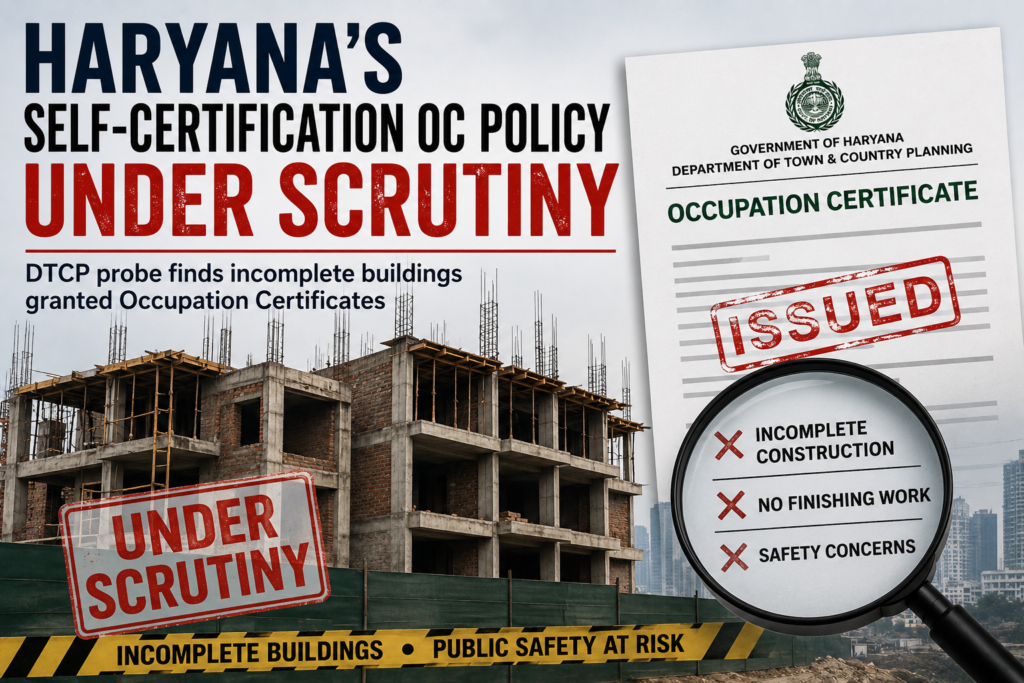
Haryana’s self-certification policy for issuing Occupation Certificates (OCs) has come under renewed scrutiny after a joint investigation by the Chief Minister’s Flying Squad and the Department of Town and Country Planning (DTCP) reportedly uncovered multiple instances of incomplete buildings being certified as fit for occupation. The findings have triggered departmental action and reignited debate over the effectiveness of the state’s approval mechanism.
Introduced in November 2022, the self-certification framework authorises empanelled architects to inspect residential buildings, certify compliance with the Haryana Building Code, 2017, and issue Occupation Certificates directly through an online portal. Under the system, only a limited number of applications are selected for random physical inspections by the department, while the majority rely on the architect’s certification.
According to the investigation, inspections across licensed colonies in Gurugram found several buildings that had already received Occupation Certificates despite being incomplete. Officials observed structures still under construction, with some lacking plastering and basic finishing work even though official records indicated that construction had been completed. Following these findings, show-cause notices have been issued to several architects, and departmental proceedings have been initiated. The inquiry into additional suspected violations remains ongoing.
Before the introduction of the self-certification regime, the approval process involved multiple stages of departmental verification. Architects submitted applications to the DTCP, followed by site inspections conducted by junior engineers, verification by assistant town planners, scrutiny of fee payments by the accounts branch, and final approval from the District Town Planner before an Occupation Certificate was issued.
The reported irregularities have raised concerns among residents and professionals regarding the credibility of Occupation Certificates, which are widely regarded as proof that a building complies with approved plans and is safe for occupation. Questions are now being raised about whether the existing framework provides sufficient oversight and accountability while maintaining the objective of faster approvals.
The matter is also expected to reach the judiciary. According to the report, a petition is being prepared before the Punjab and Haryana High Court seeking either withdrawal of the current self-certification policy or significant reforms, including mandatory physical verification of completed buildings and clearly defined accountability for certifying architects.
The outcome of the ongoing departmental inquiry is expected to determine whether further disciplinary and legal action will be initiated. The case has also prompted a broader discussion on balancing ease of approvals with regulatory oversight, public safety and professional accountability within Haryana’s urban development framework.
Join our WhatsApp Channel for fastest updates: Join now