

The New Delhi Municipal Council (NDMC) has initiated a comprehensive road safety upgrade across Lutyens’ Delhi, announcing the installation of 7,338 solar-powered pavement markers aimed at improving nighttime visibility and traffic guidance. The project, estimated at ₹1.74 crore, is expected to be completed within a two-month timeframe.
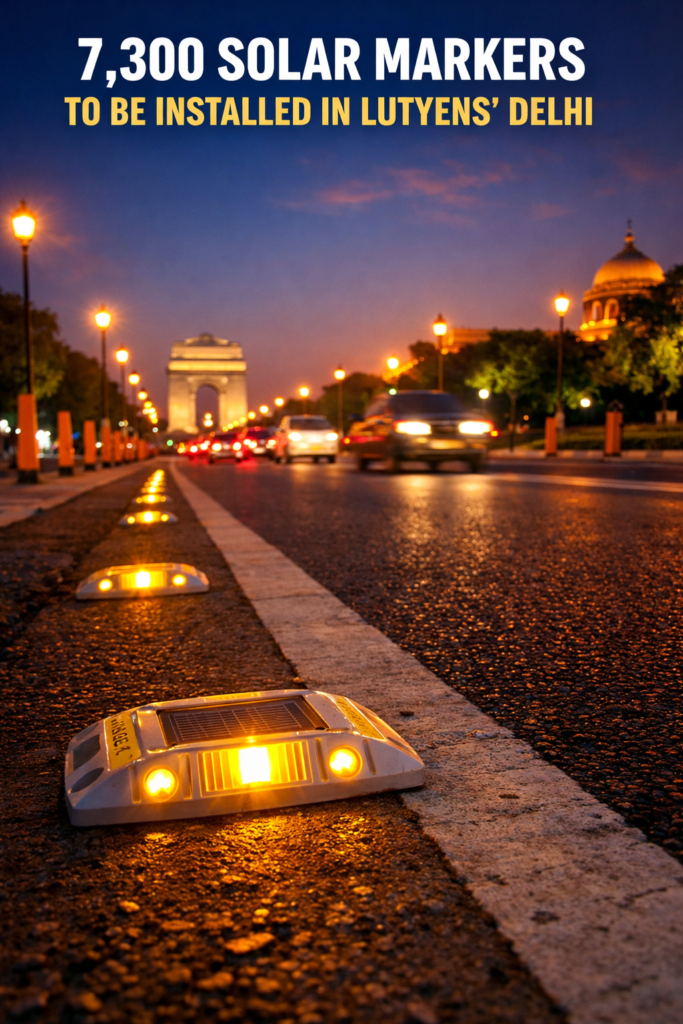
This large-scale intervention will cover all 79 avenue roads under NDMC’s jurisdiction, targeting critical stretches where nighttime driving conditions have historically posed safety challenges. Installation work is set to begin on key corridors such as Sardar Patel Marg and Baba Kharak Singh Marg, both of which experience significant vehicular movement.
The solar pavement markers, also referred to as solar studs, are designed using high-impact polycarbonate material and equipped with LED self-illumination systems. These markers can withstand loads of up to 20,000 kg, making them suitable for high-traffic urban roads. With a blinking frequency of 1 Hz and a visibility range of up to 500 metres, the devices are expected to provide clear lane demarcation even under low-light or adverse weather conditions.
In terms of durability, each marker has an operational lifespan of approximately 100,000 hours. The solar-powered system is supported by a battery backup capable of maintaining illumination for up to three days without sunlight, ensuring uninterrupted functionality. Notably, the installation process will avoid traditional nailing methods to prevent damage to road surfaces, instead using epoxy resin-based adhesives for secure placement.
In addition to the primary installation, NDMC has allocated ₹47 lakh for supplementary safety measures, including urban delineators, flexible median markers, and additional solar markers on select stretches. These interventions are intended to enhance road edge definition and median visibility.
The project follows a detailed survey conducted by the Central Road Research Institute, which identified widespread issues such as surface cracks, weathering, and structural distress across several roads. The current initiative is part of a broader infrastructure improvement strategy aimed at ensuring safer and more resilient urban mobility in the national capital.
Also read : NSUT Admissions 2026–27 Open: JEE, CUET, GATE, CAT Based Entry for UG & PG Programs