

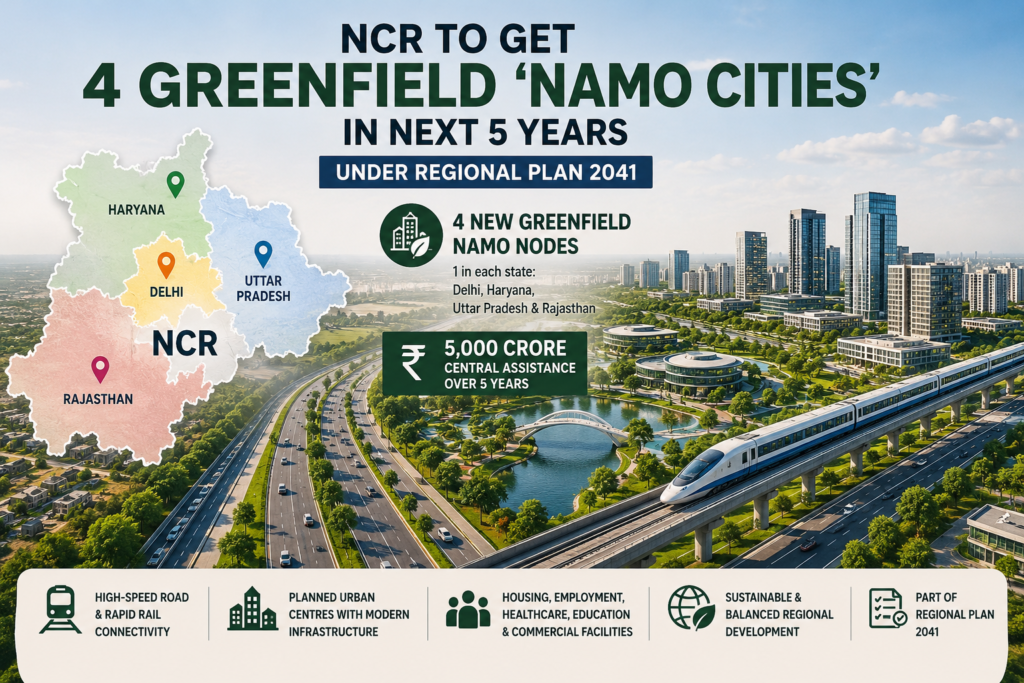
New Delhi: In a significant move aimed at accommodating the National Capital Region’s rapidly growing population, the NCR Planning Board (NCRPB) has approved the development of four greenfield urban centres, referred to as “Namo Cities” or “Namo Nodes,” across the NCR. One city will be developed in each of the participating states—Delhi, Haryana, Uttar Pradesh, and Rajasthan—with central assistance of ₹5,000 crore over the next five years.
The decision was taken during the 43rd meeting of the NCR Planning Board chaired by Union Minister for Housing and Urban Affairs Manohar Lal. The meeting was attended by Delhi Chief Minister Rekha Gupta, Haryana Chief Minister Nayab Singh Saini, Uttar Pradesh Urban Development Minister A.K. Sharma, and Rajasthan Urban Development Minister Jhabar Singh Kharra. The proposals form part of the forthcoming Regional Plan 2041, which aims to guide the future growth and development of the NCR.
According to the minister, each state will submit three potential locations, out of which one proposal will be selected through a competitive challenge process. These new urban nodes are envisioned as integrated cities connected through high-speed transport infrastructure, including expressways and rapid rail networks, while offering housing, employment opportunities, healthcare, education, and commercial facilities.
Uttar Pradesh has reportedly proposed the Noida–Dadri–Jewar–Bulandshahr corridor as potential locations for one of the new cities, while Rajasthan is expected to submit its proposals shortly.
The initiative comes amid projections that the NCR population could reach nearly 150 million by 2041, with urban residents accounting for approximately 67 percent of the total population. To manage this growth, the board also agreed to divide the NCR into four planning zones, including Delhi, Central NCR, Highway Corridor Zones, and Transit-Oriented Development (TOD) areas. Officials described the proposed Central NCR as a future “golden ring of opportunity” for regional development.
Importantly, the NCRPB clarified that the existing NCR boundary of 55,083 sq km will remain unchanged. Earlier proposals to remove certain districts from the NCR have been dropped, with the board opting instead for a more localized and graded approach to environmental and mobility restrictions.
Delhi Chief Minister Rekha Gupta emphasized the need for coordinated action among NCR states to ensure balanced development, improved infrastructure, and a better quality of life for residents across the region.
Also Read: NCR Plan 2041 Proposes Elevated Road Parallel to Delhi’s Outer Ring Road to Ease Traffic Congestion
Join our WhatsApp Channel for fastest updates: Join now