

New Delhi | The Cabinet Committee on Economic Affairs (CCEA), chaired by Prime Minister Narendra Modi, has approved the construction of a 6-lane road tunnel connecting Dwarka Expressway (NH-248BB) with Nelson Mandela Marg in Vasant Kunj. The project, to be implemented by the National Highways Authority of India (NHAI), will be developed under the Hybrid Annuity Mode (HAM) at an estimated cost of ₹6,969.67 crore.
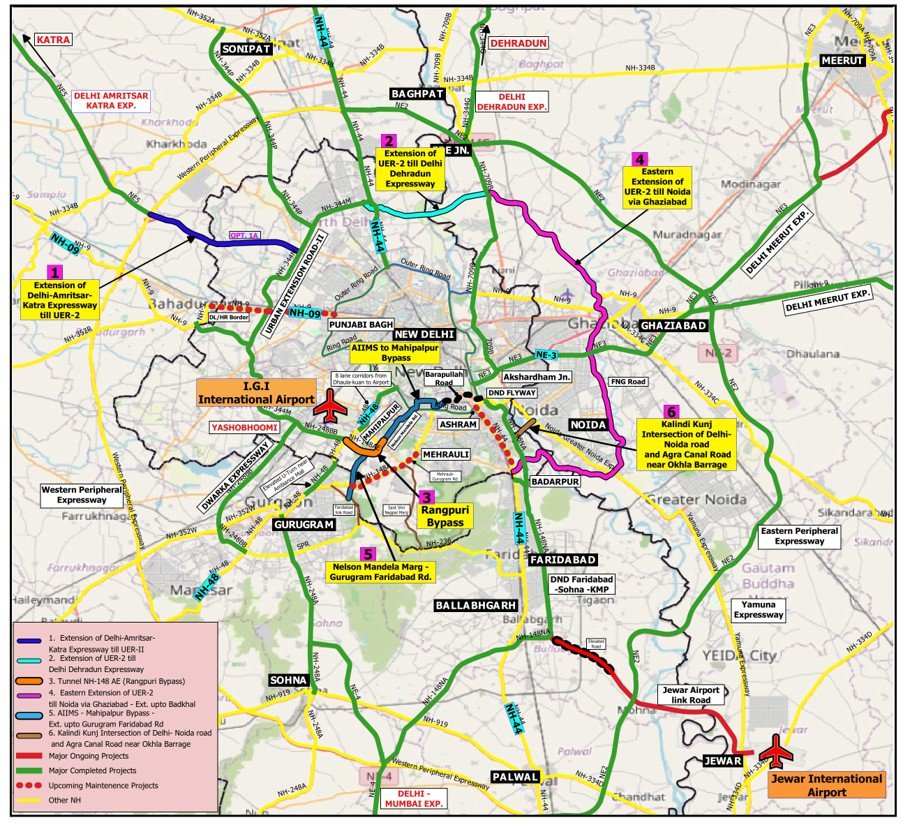
The proposed corridor will have a total length of 8.1 km, including a 6.3 km main carriageway featuring a 3.14 km twin-tube tunnel built using the Tunnel Boring Machine (TBM) method beneath the Southern Ridge. The alignment will originate from the Shiv Murti Interchange on Dwarka Expressway and terminate before the intersection of Nelson Mandela Marg and Mahipalpur-Chhatarpur Road.
The project is designed to significantly improve connectivity between West and South Delhi, linking the Urban Extension Road-II (UER-II)/Dwarka Expressway corridor with Vasant Kunj. It is expected to benefit commuters travelling from Gurugram, Dwarka, Indira Gandhi International Airport, and West Delhi towards South Delhi while reducing congestion and travel time.
To enhance traffic movement at key intersections, the project also includes a 1.8 km elevated corridor along Nelson Mandela Marg, an additional flyover towards Mahipalpur, and an elevated U-turn for vehicles travelling towards Chhatarpur. According to the government, these interventions will improve connectivity with the proposed AIIMS–Mahipalpur elevated corridor, further linking the tunnel with the Barapullah elevated road and providing seamless access to East Delhi, Ghaziabad and Noida.
The remaining components of the 8.1 km corridor include 0.98 km tunnel approach ramps, 0.554 km approach with retaining walls, 2.556 km elevated section, and 0.87 km at-grade road.
Apart from improving regional mobility, the government estimates the project will generate approximately 7.54 lakh person-days of direct employment and 9.80 lakh person-days of indirect employment, while stimulating economic activity along the corridor.
Once completed, the tunnel is expected to become a key missing link in Delhi’s expanding network of expressways, offering faster and more efficient connectivity across the National Capital Region (NCR).
Source: Press Information Bureau (PIB), Ministry of Road Transport & Highways, Government of India.
Join our WhatsApp Channel for fastest updates: Join now