

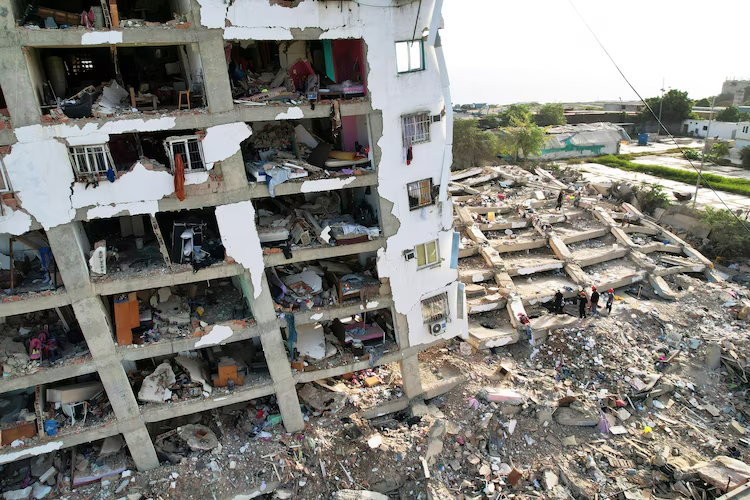
For four days, beneath the shattered concrete of Venezuela’s coastal communities, rescue workers searched relentlessly for signs of life. Against overwhelming odds, a father and his son were pulled alive from the rubble—an extraordinary moment of hope amid one of the country’s deadliest earthquakes in more than a century. The twin earthquakes, measuring 7.2 and 7.5 in magnitude, struck within seconds of each other, flattening neighbourhoods, crippling infrastructure, displacing thousands of families and triggering a massive international humanitarian response. Even as rescue teams continued their race against time, aftershocks reminded survivors that the disaster was far from over.
The tragedy in Venezuela is not an isolated headline. It joins a growing catalogue of global crises—earthquakes, catastrophic floods, prolonged heatwaves, wildfires, droughts and armed conflicts—that have unfolded with alarming frequency over recent years. Individually, these events have different scientific and political causes. Collectively, however, they reveal a world facing multiple risks simultaneously, where natural hazards and human-made disasters increasingly overlap and magnify one another.
This raises an uncomfortable question—not whether nature is sending humanity a warning, but whether humanity has ignored every warning nature has already given.
Earthquakes are products of tectonic forces that have shaped our planet for millions of years. They are not caused by wars, politics or climate change. Yet the scale of destruction they produce is profoundly influenced by human decisions. Buildings collapse because of poor construction, weak enforcement of seismic standards, uncontrolled urbanisation and decades of neglect. Floods become catastrophes when wetlands disappear beneath concrete. Heatwaves become deadly when cities replace trees with asphalt. Disasters become humanitarian crises when governance fails before the first emergency siren sounds.
The twenty-first century is witnessing something unprecedented—not necessarily stronger natural hazards, but increasingly vulnerable societies. Urban populations have expanded rapidly, informal settlements have spread across unstable slopes and floodplains, ageing infrastructure struggles to cope with modern demands, and climate change is intensifying many weather-related extremes. Meanwhile, wars continue to destroy cities that took generations to build, displacing millions and diverting resources from resilience to reconstruction.
Modern cities now face what experts describe as compound risks—multiple crises occurring together or in quick succession. An earthquake can sever electricity, disrupt water supplies, cripple hospitals and paralyse transport. If political instability, economic hardship or conflict already exists, recovery becomes exponentially more difficult. The recent catastrophe in Venezuela illustrates how disaster resilience depends not only on the force of nature but also on the strength of institutions, infrastructure and preparedness.
This is perhaps the defining challenge of our era. Cities can no longer be designed merely for efficiency or economic growth. They must be planned to survive uncertainty. Every master plan should account for seismic safety, climate resilience, ecological restoration, emergency logistics and social equity. Parks, wetlands and urban forests should be viewed as critical infrastructure, just as essential as highways or metro systems. Hospitals, schools and public buildings must remain operational during disasters, not become casualties themselves.
History teaches that civilizations rarely disappear because of a single catastrophic event. More often, they weaken when repeated shocks expose long-standing structural failures. The future will not belong to the cities with the tallest skylines or the fastest economic growth. It will belong to the cities that invest in resilience before the next crisis arrives.
Perhaps the real warning is not the earthquake itself.
It is the silence that follows—when the headlines fade, rebuilding slows, lessons are forgotten and another vulnerable city waits unknowingly for its turn.
The earth will continue to move. Storms will continue to form. Rivers will continue to reclaim their floodplains. Whether these natural processes become human tragedies depends not on nature, but on the choices we make today.
Also Read: Gaudí’s Vision Soars Higher: Sagrada Família Unveils World’s Tallest Church Tower
Join our WhatsApp Channel for fastest updates: Join now