

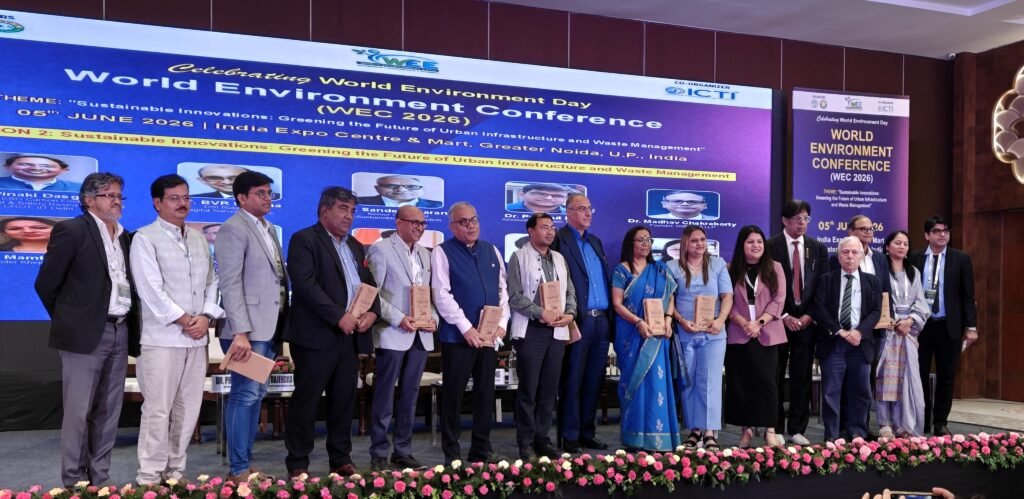
World Environment Day 2026, the World Environment Conference (WEC 2026) brought together experts from academia, industry, architecture, sustainability, urban planning, and social organizations at India Expo Centre & Mart, Greater Noida. The session titled “Sustainable Innovations: Greening the Future of Urban Infrastructure and Waste Management” witnessed an engaging panel discussion moderated by Mr. Pinaki Dasgupta, Environment & Safety Research Scholar, CRDT, IIT Delhi. The discussion focused on air quality management, sustainable construction, biodegradable materials, citizen participation, circular economy practices, and the role of innovation in achieving environmental sustainability.
The distinguished panel included Mr. BVR Sharma, Mr. Sandeep Narang, Dr. Prodyut Dhar, Dr. Madhav Chakraborty, Smt. Mamta Bishnoi, Ar. Bimal Kachroo, Ar. Rajendra Kumar, Dr. Kala Iyer, and Ms. Garima Jindal.
Data-Driven Environmental Policies and Air Quality Management
Opening the discussion, Mr. Sandeep Narang, Senior Consultant – Sustainable Construction, emphasized the importance of scientific data in environmental policymaking. Speaking from his experience in the construction sector, he highlighted the need for continuous monitoring of air quality at project sites.
“Data is extremely important. Before blaming any sector, we must measure and understand the actual sources of pollution. Monitoring and evidence-based interventions are the key to effective environmental policies.”
Mr. Narang stressed that PM2.5 and PM10 emissions generated during construction activities can be controlled through proper engineering solutions and better monitoring systems. He also pointed out the need to build technical capacity among professionals responsible for environmental compliance.
Sustainability Must Begin at the Design Stage
Responding to a question on integrating sustainability into business and construction projects, Ms. Garima Jindal, Head of Design and Assistant Vice President at Indiabulls Estates, explained that sustainability should become part of a project’s DNA from the earliest design phase.
“Sustainability has to be an integral part of every project. It must begin at the design stage and continue through execution and long-term operations.”
She emphasized collaboration among architects, consultants, developers, and management teams to ensure sustainable outcomes. According to her, sustainability is not an expense but a long-term value creation strategy.
“We have broken the myth that sustainability is costly. Sustainability is not an expense; it is value creation for today, tomorrow, and the future.”
Ms. Jindal also advocated the use of local materials, energy-efficient planning, and lifecycle-based thinking to improve project performance while reducing environmental impact.
Research, Innovation and Biodegradable Alternatives
Dr. Prodyut Dhar, Associate Professor at IIT BHU, discussed the role of research institutions in developing environmentally friendly alternatives to conventional materials. He highlighted ongoing work on biodegradable plastics and biomass-based products.
“Every individual has a responsibility to reduce emissions and carbon footprints. Research and technology can help create sustainable alternatives, but adoption by industry and society is equally important.”
Dr. Dhar explained how agricultural waste such as rice straw and other biomass resources can be converted into biodegradable products, creating economic opportunities while reducing pollution caused by crop residue burning.
Behavioural Change is as Important as Technology
Offering a social perspective, Dr. Kala Iyer, President, Rotary Club New Delhi One and noted filmmaker, emphasized that technology alone cannot solve environmental challenges.
“If we do not change our behaviour as individuals, no amount of technology will help us win this fight for the environment.”
Drawing from her experience in environmental awareness campaigns and documentary filmmaking, she stressed the importance of citizen participation, recycling initiatives, and responsible consumption habits.
“Development and technology are important, but every citizen must contribute through everyday actions. Real change begins at home.”
She highlighted successful examples of waste segregation and recycling initiatives, stressing that environmental stewardship must become a way of life.
Citizen Participation and Incentive-Based Sustainability
Ar. Rajendra Kumar, Founder and Principal Architect, spoke about the importance of public participation in urban sustainability and policymaking.
“Policies become successful only when citizens actively engage with them. Sustainability must create visible social and economic value for people.”
He cited international examples where waste is viewed as a resource and argued that environmental initiatives should also provide measurable benefits to encourage broader participation.
“When sustainability generates tangible benefits, people and institutions are more willing to adopt it.”
The architect stressed the importance of evidence-based decision-making, realistic assumptions, and stronger citizen engagement in urban governance.
Sustainability Beyond Compliance
The discussion further explored how sustainability should be viewed as a fundamental responsibility rather than merely a compliance requirement. Several speakers highlighted the need for lifecycle assessment, circular economy approaches, green ratings, resource efficiency, and environmentally conscious urban development. The panel agreed that governments, industry, researchers, designers, and citizens must work collectively to achieve long-term environmental goals.
Key Quotes from the Session
Mr. Sandeep Narang
“Monitoring and data-driven interventions are essential for improving air quality.”
Ms. Garima Jindal
“Sustainability is not an expense; it is value creation for today, tomorrow and the future.”
Dr. Prodyut Dhar
“Every individual has a responsibility to reduce emissions and carbon footprints.”
Dr. Kala Iyer
“If we do not change our behaviour as individuals, no amount of technology will help.”
Ar. Rajendra Kumar
“Policies become effective only when citizens actively participate in sustainability.”
TheAPN attended this event in person. The coverage distils the principal ideas and deliberations for the benefit of a wider public audience.
Also Read: WUF13 Opens in Baku with Global Focus on Housing Crisis and Urban Resilience
Join our WhatsApp Channel for fastest updates: Join now