

Major Push Towards River Rejuvenation and Pollution Abatement Under Namami Gange Programme
The National Mission for Clean Ganga (NMCG) has recorded significant progress in expanding sewage treatment infrastructure and improving river water quality across the Ganga basin during the financial year 2025–26. According to an official release by the Ministry of Jal Shakti, the mission added a cumulative 538.03 million litres per day (MLD) of treatment capacity through 18 major projects spanning Uttar Pradesh, Uttarakhand, Jharkhand, West Bengal, and Bihar.
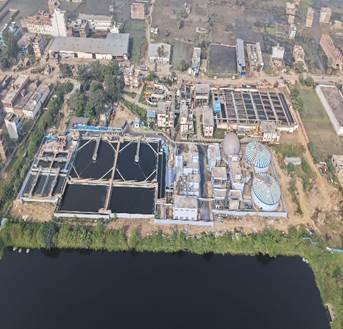
This expansion reflects a strong and sustained effort to address pollution hotspots while strengthening urban wastewater management systems in key riverine cities.
Uttar Pradesh Leads with Large-Scale Infrastructure Expansion
Uttar Pradesh emerged as the leading contributor, with multiple high-impact projects implemented across cities such as Varanasi, Prayagraj, Agra, Moradabad, Vrindavan, and Shuklaganj.
A major highlight includes the 55 MLD Sewage Treatment Plant (STP) in the Assi–BHU area of Varanasi, which recorded the highest capacity addition among all projects. In Prayagraj, a large-scale intervention involving interception and diversion of 13 drains along with augmentation of the Salori STP added 43 MLD capacity at a sanctioned cost of ₹331.75 crore.
Agra alone contributed a significant 166 MLD capacity, supported by multiple STPs, while Moradabad and Vrindavan added 25 MLD and 13 MLD respectively. These projects, many executed under the Hybrid Annuity Model (HAM), demonstrate a comprehensive, multi-city approach to river rejuvenation.
Steady Progress Across Uttarakhand and Jharkhand
In Uttarakhand, infrastructure upgrades were undertaken across Udham Singh Nagar, Dehradun, Haridwar, and Muni ki Reti. Key additions include:
- 10.3 MLD in Udham Singh Nagar addressing polluted river stretches
- 15 MLD at Sapera Basti in Dehradun
- Decentralized interventions across pilgrimage towns contributing smaller but critical capacities
Meanwhile, Jharkhand recorded progress through the completion of the Phusro STP project, adding 14 MLD capacity with an investment of ₹61.05 crore.
West Bengal and Bihar Strengthen Lower Ganga Basin Infrastructure
West Bengal saw substantial advancements with projects in Maheshtala, Jangipur, Chakdah, and North Barrackpore. The Maheshtala STP (35 MLD) emerged as a key contributor, supported by investments of nearly ₹287 crore. Additional capacities of 13 MLD (Jangipur) and 15 MLD (Chakdah) further strengthened pollution control in the lower Ganga basin.
In Bihar, projects across Digha, Kankarbagh, and Bhagalpur added 30 MLD, 35 MLD, and 22.5 MLD respectively, addressing critical urban wastewater challenges and improving river health.
Digital Monitoring Systems Enhance Transparency and Efficiency
To improve real-time monitoring and accountability, NMCG has introduced advanced digital tools under the Namami Gange Programme.
The newly launched Drain Dashboard enables authorities to track drains discharging into the Ganga, monitor diversion systems, and identify pollution risks in real time. Additionally, the Ganga Pulse Public Portal provides live operational data from STPs across five states, including key parameters such as pH, Biochemical Oxygen Demand (BOD), and Total Suspended Solids (TSS).
This data-driven approach ensures better compliance, transparency, and performance tracking of wastewater treatment infrastructure.
Towards a Cleaner and Resilient Ganga Basin
The achievements of FY 2025–26 highlight a strategic, regionally balanced implementation framework aimed at long-term river rejuvenation. With continued investments of nearly ₹4700 crore and a strong pipeline of ongoing projects, NMCG is steadily advancing towards its vision of a cleaner and healthier Ganga.
Beyond immediate environmental gains, the expanded infrastructure also builds resilience to accommodate future urban growth along the river basin, reinforcing sustainable water management practices across northern and eastern India.
Also Read: MCD Plans ₹2,939 Crore Waste Management Overhaul Across Delhi Zones
Join our WhatsApp Channel for fastest updates: Join now