

Majuli, Assam | A groundbreaking scientific study has reconstructed nearly 4,000 years of climate and vegetation history of Majuli Island in Assam, offering valuable insights into climate adaptation and flood resilience for vulnerable riverine communities. The research focuses on Majuli, recognized as the world’s largest inhabited river island and a significant cultural centre of Neo-Vaishnavite heritage.
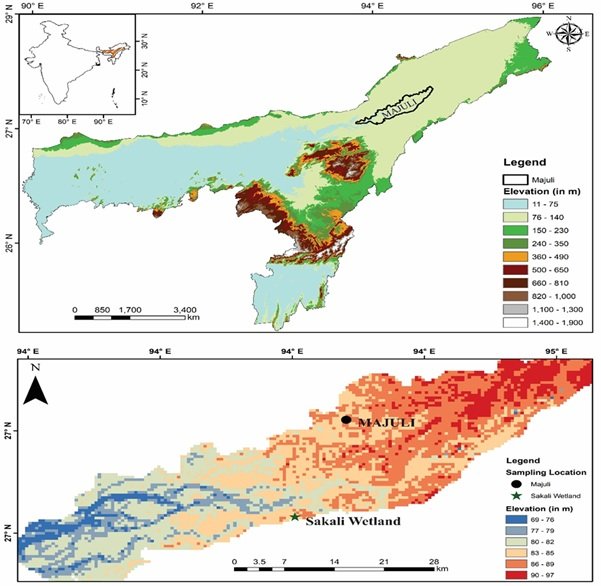
Conducted by scientists from the Birbal Sahni Institute of Palaeosciences (BSIP), Lucknow, the study analyzed a 150-centimetre sediment core collected from the Sakali Wetland on the island. By combining fossil pollen analysis with grain-size studies, researchers reconstructed environmental conditions dating back around 4,040 years, creating the first comprehensive palaeoecological record for Majuli.
The findings reveal that between 4040 and 2260 years before present, the region experienced warm and humid conditions with dense forest cover, demonstrating resilience during the global 4.2 ka climatic event. Later periods witnessed fluctuating monsoon intensity and changing flood regimes. A relatively wetter phase occurred between 1100 and 500 years ago, corresponding to the Medieval Climatic Anomaly, while the last 500 years showed declining temperatures and rainfall associated with the Little Ice Age.
Researchers also identified increasing hydrodynamic instability in the Brahmaputra river system over time. The study highlights how vegetation, climate, flooding, and river processes have interacted across millennia, shaping the island’s ecological landscape. These findings can support flood management, biodiversity conservation, wetland restoration, and sustainable land-use planning in the Brahmaputra basin.
Published in the journal Review of Palaeobotany and Palynology, the research provides a scientific foundation for climate adaptation strategies and policymaking aimed at reducing the impacts of recurrent flooding and land erosion on communities living in river island ecosystems.
Also Read: Uttarakhand’s Valley of Flowers Opens to Tourists for 2026 Season
Join our WhatsApp Channel for fastest updates: Join now