


Rabindranath Tagore once said, “The earth has enough for everyone’s need, but not for everyone’s greed.” This statement strikes at the core of our understanding of what it means to be civilized. In a world that prides itself on progress and development, one must question if human civilization is genuinely a mark of advancement or merely a mask for unrestrained consumption and exploitation.
Human civilization has been associated with technological progress, economic development, and cultural refinement for centuries. Yet, these markers of civilization often come at a grave cost to our environment. Forests are felled for timber and agriculture, the Mining Mafia are adding fuel to the fire, and rivers are polluted rampantly with municipal waste, also in the name of religion. Oceans are polluted with plastics and crude mining and species are driven to extinction for commercial gains. The rise of industrialization has undoubtedly enhanced human comfort and convenience, but it has also intensified the exploitation of natural resources. The consequence is a damaged planet, a warming climate, and the depletion of ecosystems that took millennia to form. The very idea of civilization, which was meant to signify harmony and collective progress, has become synonymous with environmental degradation and unsustainable growth.
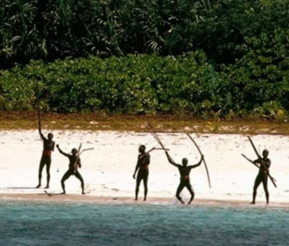
In contrast, the primitive inhabitants of isolated places like the Sentinel Islands in the Andaman Sea present an alternative perspective on what it means to be civilized. These indigenous tribes have lived for thousands of years without harming their environment, maintaining a sustainable way of life that honors the delicate balance of nature. They refuse contact with the outside world, violently repelling any attempt to intrude on their isolation. The Sentinel Islanders’ hostility towards outsiders, including a fatal attack on an American missionary in 2018, has been widely condemned as brutal and uncivilized. But is it truly so?
To judge the Sentinel Islanders by the standards of “civilization” is to ignore the context of their actions. For them, protecting their territory and way of life is an existential necessity. The Sentinel Islanders have seen the devastation brought upon other indigenous communities who opened their doors to the so-called “civilized” world. Disease, exploitation, and cultural erasure are just a few of the consequences. Their resistance is a form of preservation, not only of their culture but of their environment, which they have safeguarded for centuries.
Modern society often deems itself morally superior, yet it routinely kills animals for sport, food, and resources, often far beyond necessity. Even when it comes to human conflict, nations go to war under the guise of protection, politics, or resources, leading to untold suffering. If self-defense and the preservation of one’s way of life justify violence for modern states, why should it be different for indigenous tribes?
In a world driven by consumption, the Sentinel Islanders challenge us to rethink the concept of civilization. Their commitment to safeguarding their environment—by any means necessary—reveals a form of wisdom that modern society has largely lost. Our relentless pursuit of material wealth, often termed “progress,” has obscured the understanding that true civilization should encompass not just technological and economic advancement, but also the ability to live in harmony with our planet.
Tagore’s words remind us that the Earth has abundant resources to sustain humanity’s needs, yet our civilization’s greed has led to its depletion. Perhaps it is not the Sentinel Islanders who are uncivilized, but those who, in the name of civilization, consume far beyond their needs, often at the expense of the planet and its most vulnerable inhabitants. True civilization should be measured not by what we take from the Earth, but by what we preserve for future generations.
About Author
Ar. Hiranmay Biswas is a senior Group A Gazetted Officer in the Government of NCT of Delhi with more than 27 years of experience in technical education and public administration. Selected through UPSC as a faculty in 1999, he has served in academic and administrative leadership roles, contributing to Architectural and environmental education, institutional development, and quality assurance. His professional interests include higher education policy, governance, Architectural education, and faculty development. He is also an avid reader of history, global affairs, and environmental issues, with a strong commitment to academic excellence and public service.
Among his many publications the notable contribution is the book “Architecture and Town Planning”.
Join our WhatsApp Channel for fastest updates: Join now