

Rome: India highlighted its progress in forest and landscape restoration and reaffirmed its commitment to sustainable forest management, climate action and resilient forest ecosystems at the 28th Session of the FAO Committee on Forestry (COFO 28) being held in Rome from September 28 to October 2, 2026.
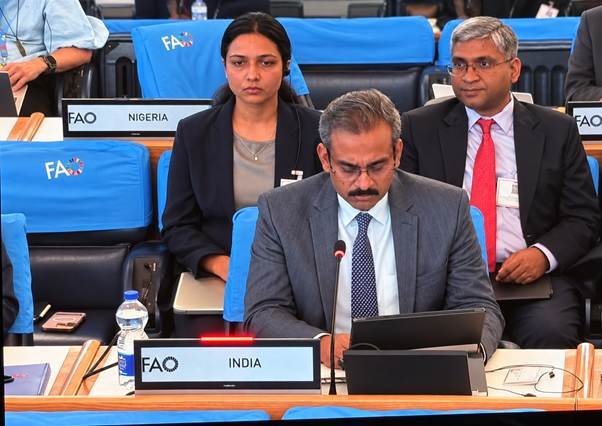
In its statement at the session, India welcomed the Food and Agriculture Organization’s focus on Forest and Landscape Restoration, stressing that sustainable forest management can provide an integrated framework for landscape-level restoration while responding to national circumstances and the needs of local communities.
India highlighted that its forest and tree cover stands at 82.74 million hectares, representing 25.17% of the country’s geographical area. According to the statement, the FAO Global Forest Resources Assessment 2025 ranks India ninth globally in forest area and third in net annual forest area gain. India also reported creating an additional carbon sink of 2.29 billion tonnes of CO₂ equivalent by 2021, while raising its ambition to create an additional carbon sink of 3.5–4.0 billion tonnes by 2035, compared with 2005 levels.
Under its commitment to the Bonn Challenge, India aims to restore 26 million hectares of degraded and deforested land by 2030, with 21.76 million hectares already brought under restoration. The country also showcased the Aravalli Green Wall, under which approximately 6.45 million hectares of degraded land have been identified for restoration. In coastal areas, the MISHTI initiative is supporting mangrove restoration, climate resilience and local livelihoods. India further noted that the number of Ramsar Sites has reached 101.
Another initiative highlighted was Ek Ped Maa Ke Naam – Plant4Mother, described as a whole-of-government and whole-of-society initiative under which more than 3.5 billion saplings have been planted. India called for international cooperation to move beyond global commitments towards country-driven implementation, capacity building, technology transfer and measurable outcomes.
India also emphasised the need for sustainable financing, particularly for developing countries, and encouraged stronger access to climate, biodiversity and blended finance for long-term restoration programmes. It called for greater coherence among FAO’s forestry work, the Global Forest Goals and other international forest-related processes, alongside enhanced South-South and triangular cooperation.
The country further reaffirmed its commitment to working with FAO and Member States on the proposed UN Decade for Afforestation and Reforestation in line with Sustainable Forest Management, 2027–2036, with the objective of connecting ecosystem restoration with resilient, productive and inclusive forest landscapes.
Join our WhatsApp Channel for fastest updates: Join now