

India’s National Highway network is increasingly being developed with a focus on environmental sustainability, climate resilience and resource-efficient construction. More than 3.61 crore saplings have been planted across approximately 1.32 lakh km of National Highways during the last five years, alongside the adoption of recycled materials, satellite-based monitoring and indigenous bio-bitumen technology.
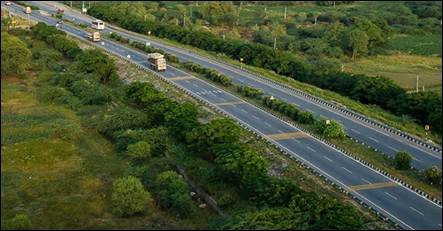
India’s National Highway network has expanded by nearly 61%, rising from 91,287 km in 2014 to 1,46,572 km by March 2026. With this expansion, highway development is increasingly being linked with plantation, biodiversity conservation and environmentally responsible construction practices.
Green Highways Policy Strengthens Plantation Efforts
The Green Highways (Plantation, Transplantation, Beautification and Maintenance) Policy, 2015 provides the framework for greening the National Highway network. The policy seeks to reduce air pollution and dust, control soil erosion along embankments, moderate the effects of wind and solar radiation, and generate employment opportunities for local communities. Plantation activities involve Self Help Groups, private agencies, State Forest Departments, Forest Corporations and contractors, with monitoring through a dedicated Plantation Cell.
The approach has expanded beyond simply planting trees. As of July 2026, more than 3.61 crore saplings had been planted, while drone and satellite-based monitoring is being used alongside field inspections. Miyawaki plantations have also been introduced, while compensatory afforestation and tree transplantation are undertaken where tree removal is required for highway projects.
The Miyawaki technique, described in the backgrounder as a dense plantation method suitable for space-constrained areas, involves closely planting trees and shrubs to establish forest-like ecosystems in a shorter period.
Survival Rate Becomes a Key Performance Measure
NHAI’s September 2026 guidelines further strengthen the plantation requirements. Plantation works can qualify for provisional completion certification only when at least 80% of the available Right of Way earmarked for plantation is covered, while planted saplings must have a minimum 90% survival rate at inspection. The same survival benchmark applies during the Operations and Maintenance period, with provisions for replacing plants that do not survive.
The Green Highways Excellence Awards, instituted by NHAI in 2025, also place emphasis on plantation survival, species diversity, native species, site-specific planning and protection measures. The 2026 awards recognised projects including the Chilakaluripet Bypass on NH-16 in Andhra Pradesh, the Hyderabad–Yadgiri section of NH-163 and the Jamtha Clover Leaf Oxygen Bird Park on NH-44 in Nagpur.
Satellite Monitoring Introduces Scientific Assessment
A significant development is the National Highways Green Cover Index (NH-GCI) 2025–26, prepared in collaboration with the National Remote Sensing Centre (NRSC) of ISRO. The first annual report provides a quantitative assessment of green cover within the Right of Way along National Highways.
The assessment covers nearly 30,000 km of National Highways across 24 states under the Operations and Maintenance phase and uses observations taken before and after the monsoon. The satellite-based system establishes a baseline for monitoring roadside plantations and helps identify areas requiring targeted intervention.
Bio-Bitumen Opens a New Route for Resource-Efficient Roads
Sustainability efforts are also extending to road-building materials. In January 2026, technology for producing bio-bitumen through pyrolysis of farm residue was transferred by CSIR-Central Road Research Institute (CSIR-CRRI), New Delhi, and CSIR-Indian Institute of Petroleum (CSIR-IIP), Dehradun.
The process uses post-harvest rice straw to produce bio-oil through pyrolysis, which is then blended with conventional bitumen. A 100-metre trial stretch using bio-bitumen has been laid on the Jorabat–Shillong Expressway (NH-40) in Meghalaya, demonstrating its feasibility. The technology is also intended to support farm-residue management.
Other resource-efficient materials being used in highway construction include fly ash, pond ash, Reclaimed Asphalt Pavement (RAP), Construction and Demolition waste, recycled aggregates, plastic waste, slag and crumb rubber.
Highways as Ecological Corridors
The green highway approach is also being linked with biodiversity and community participation. Along identified stretches of the Delhi–Amritsar–Katra Expressway, “Trees for Bees” pollinator corridors are being developed using flowering and locally suitable species to provide nectar and pollen across seasons.
Andhra Pradesh has also reported sustained plantation activity, with around 18 lakh seedlings planted between 2010 and 2025 through avenue and median plantations. For 2026–27, a further 3.86 lakh saplings have been targeted, while around 3,200 saplings were planted across the state on World Environment Day 2026 under the “Ek Ped Maa Ke Naam” initiative.
The initiatives indicate a broader shift in highway development—from treating greenery as roadside landscaping to integrating plantation, biodiversity, scientific monitoring and alternative construction materials into infrastructure planning. The PIB backgrounder positions this transition within wider national priorities around climate action, self-reliance and sustainable infrastructure.
Also Read: NHAI Issues New Guidelines to Make High-Speed National Highways Safer, Greener and Future-Ready
Join our WhatsApp Channel for fastest updates: Join now