

The Government of the National Capital Territory (NCT) of Delhi’s recent circular directing stricter scrutiny of General Power of Attorney (GPA) registrations marks a significant shift in the administration of property transactions. While the circular is presented as an administrative measure to prevent revenue leakage and ensure compliance with the Registration Act, 1908, and the Indian Stamp Act, 1899, its implications extend far beyond stamp duty collection. It raises fundamental questions about property rights, urban governance, and the future of Delhi’s unauthorised colonies.
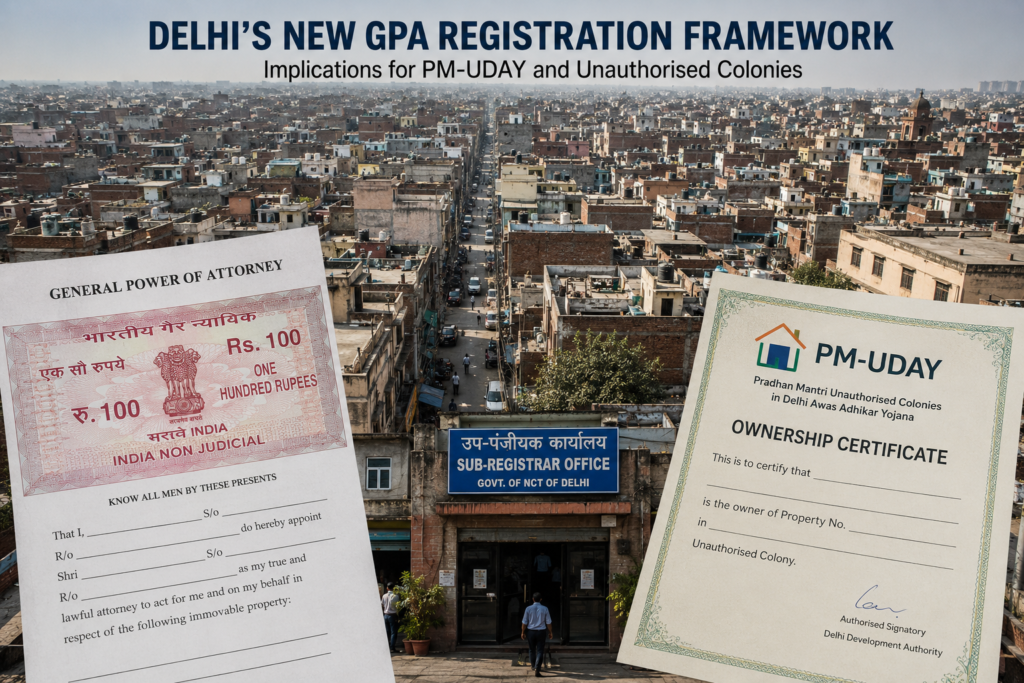
The timing of the circular is particularly significant. Nearly seven years after the launch of the Pradhan Mantri Unauthorised Colonies in Delhi Awas Adhikar Yojana (PM-UDAY), which sought to provide legal ownership rights to residents of unauthorised colonies, the government is tightening scrutiny over one of the most commonly used instruments for informal property transactions. The critical question is whether this move complements the objectives of PM-UDAY or inadvertently creates new barriers for the very residents the scheme was designed to benefit.
The Historical Failure of Formal Urban Planning
Delhi’s unauthorised colonies are not merely the result of illegal construction; they are the outcome of decades of inadequate urban planning and insufficient affordable housing. As the city’s population expanded, formal housing supply failed to meet demand. The gap between planned development and housing needs created an informal land market where GPA transactions became the accepted mode of property transfer.
For decades, governments tacitly tolerated these practices. Utility connections, electoral rolls, roads, schools, and civic facilities gradually reached these colonies, effectively recognising their existence while withholding legal ownership. This contradiction created an informal city operating alongside the formal one.
The widespread use of GPA documents was therefore not simply an attempt to evade law but a response to the absence of accessible legal alternatives.
Why the Circular Matters
The circular directs Sub-Registrars to scrutinise every GPA relating to immovable property and identify whether it contains elements that resemble a sale transaction, such as payment of consideration, transfer of possession, irrevocable authority, or rights to sell or permanently transfer property. If these elements exist, the document must be referred to the Collector of Stamps for adjudication before registration.
From a legal perspective, the directive aligns with the Supreme Court’s ruling in Suraj Lamp & Industries Pvt. Ltd. v. State of Haryana (2011), which clarified that GPA transactions cannot substitute for registered sale deeds. Administratively, it also seeks to prevent loss of government revenue through underpayment of stamp duty.
However, legality and practicality do not always converge in complex urban environments.
The Missing Link Between PM-UDAY and Registration Reform
The PM-UDAY scheme acknowledged the historical reality that millions of Delhi residents purchased properties through GPA, Agreement to Sell, possession letters, and similar documents. It accepted these documents as evidence while granting ownership rights.
The new circular, however, adopts a stricter approach towards future GPA registrations without clearly explaining how these changes interact with the objectives of PM-UDAY.
This creates uncertainty for property owners who are yet to complete the PM-UDAY process. Many residents may question whether their existing documentation remains sufficient or whether future transactions will become more complicated.
Without detailed public guidance, the reform risks creating confusion rather than confidence.
Revenue Protection Versus Property Accessibility
One of the government’s stated objectives is to safeguard revenue by ensuring that transactions resembling conveyances attract appropriate stamp duty. From a fiscal perspective, this objective is entirely justified.
Yet property registration is not solely a revenue exercise; it is also a tool for promoting secure ownership, investment, and orderly urban development.
If stricter scrutiny results in prolonged adjudication, increased compliance costs, or procedural uncertainty, it could discourage formal registration rather than encourage it.
For economically weaker households, higher transaction costs may reinforce dependence on informal arrangements, defeating the very purpose of the reform.
Implications for the Real Estate Market
The circular is likely to influence Delhi’s informal property market in several ways.
Property consultants may increasingly advise buyers to seek fully documented ownership, while banks may become more cautious in evaluating GPA-based properties that have not yet transitioned into legally recognised ownership.
This could widen the value gap between PM-UDAY-certified properties and those that remain outside the formal system.
Although such differentiation may strengthen the formal market over time, it could temporarily reduce liquidity in areas where documentation remains incomplete.
Administrative Capacity Will Determine Success
A critical concern is whether the institutional framework is adequately prepared to implement the circular efficiently.
The document requires the Collector of Stamps to issue a speaking order within thirty days, with an extension of up to three months in exceptional circumstances.
In principle, this timeline appears reasonable.
In practice, however, Delhi’s registration offices already face substantial workloads. If referrals increase significantly without corresponding administrative capacity, delays could become inevitable.
Lengthy adjudication would increase uncertainty in property transactions and diminish public confidence in the registration process.
Planning Reform Must Go Beyond Documentation
Legal ownership is only one component of urban transformation.
Many unauthorised colonies continue to face inadequate drainage, poor road connectivity, limited public spaces, deficient sewerage systems, and weak social infrastructure.
A property owner may possess a legally recognised document yet continue to live in an area lacking basic urban services.
Therefore, documentation reforms should be accompanied by infrastructure investment, neighbourhood redevelopment, and integrated planning.
Otherwise, legal ownership risks becoming an administrative achievement without delivering meaningful improvements in quality of life.
The Need for Policy Coordination
The circular also highlights the fragmented nature of urban governance in Delhi.
The Revenue Department administers registration, the Delhi Development Authority implements PM-UDAY, municipal bodies provide civic infrastructure, and multiple agencies oversee utilities and land management.
Without coordinated implementation, residents may encounter overlapping procedures, inconsistent interpretations, and administrative duplication.
A unified digital property database integrating registration records, PM-UDAY ownership certificates, municipal property records, and land information systems could substantially reduce these challenges.
A Necessary Reform That Requires Careful Execution
From a governance perspective, the circular is both necessary and overdue. It seeks to uphold legal principles, improve transparency, and protect public revenue. Few would dispute these objectives.
However, successful urban policy must also recognise historical realities. Millions of Delhi residents did not choose informal documentation to circumvent the law; they relied on it because formal housing and legal property transfer mechanisms were inaccessible.
Policies aimed at formalisation must therefore be accompanied by administrative simplicity, public awareness, affordable compliance, and institutional efficiency.
The new GPA scrutiny framework should not be viewed merely as a registration reform. It represents another stage in Delhi’s long transition from an informal property regime towards a transparent and legally accountable urban land administration system.
Whether it strengthens PM-UDAY or complicates it will depend less on the wording of the circular than on its implementation. If applied with efficiency, clarity, and sensitivity to the realities of unauthorised colonies, it can reinforce legal certainty and strengthen public confidence. If implementation becomes cumbersome or inconsistent, it risks creating new obstacles for residents still navigating the path from informal tenure to recognised ownership.
The lesson is clear: property rights reform cannot succeed in isolation. It must be integrated with housing policy, infrastructure development, institutional coordination, and inclusive urban planning. Only then can Delhi move beyond legal regularisation towards genuine urban transformation.
Source: Government of NCT of Delhi, Revenue Department, Stamp & Registration Branch, Circular on “Scrutiny and Registration of General Powers of Attorney (GPAs) relating to immovable properties and referral to Collector of Stamps for adjudication”, dated 7 July 2026.
Join our WhatsApp Channel for fastest updates: Join now