

Planning Begins with Understanding the Issues and Diagnosing Them
In the previous parts of TheAPN’s exclusive conversation, A.K. Jain discussed Delhi’s planning history, the evolution of its Master Plans, informal settlements, unauthorised colonies, rehabilitation and the challenges of implementation. In this concluding part, he reflects on the future of Delhi, the role of technology, institutional reform, lessons from the World Urban Forum, the importance of lifelong learning and the evolution of the Delhi Metro. This final part brings together his thoughts on how Delhi’s planning approach needs to evolve with changing times.
TheAPN: Tell us about your latest books. How many books have you published?
A.K. Jain: Around 40. One of my books is Climate Resilient Green and Low Carbon Built Environment. It was published in 2023 by Springer, and the foreword was written by Charles Christopher Benninger. It deals with how our cities can be more sustainable, green and low carbon. For this the architects, and planners have to be more responsible towards the environment.
Another book is Mapping Delhi’s Past, Present, and Future, which includes some rare maps of Delhi that are not in the public domain. While working in DDA, I found these maps prepared by the Delhi Improvement Trust during 1937 – 1957 lying almost forgotten in a trunk. I realised that these were valuable planning maps and should be preserved for posterity. Some of these maps, include Karol Bagh, Old city, South Extension, North Extension, Western Extension, Darya Ganj, Asaf Ali Road Scheme, etc. In its 15 chapters, the book covers historic Delhi, Imperial Delhi, villages, resettlement schemes, greens, the Ridge, environment, heritage conservation and the future of Delhi.
My Latest book is Dreams and Design – A Lifelong Learning in Architecture and Planning. The book in its 18 Chapters records my learning, experiences and insights. since 1964 when I entered for B. Arch study. It is a saga of a humble public servant walking on a tight rope balancing between professional integrity, economic austerity, political hyperactivity and delivery. It is about team work, acknowledging the contribution of my colleagues, mentors, administrators, engineers, co-professionals in private sector, educational and other organizations, media and political leadership. The book attempts to bring forth the tremendous scope of creative work in the public sector.
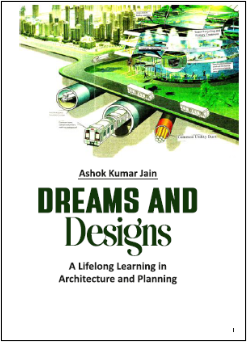
Also Read: Dreams and Designs – Lifelong Learning in Architecture and Planning
TheAPN: Please share your World Urban Forum experience and your UN-Habitat work.
A.K. Jain: The World Urban Forum held in Baku, Azerbaijan (May 2026) was very diverse with around 600 sessions and participation of the professionals, governments, NGOs, business groups and real-estate sector. It was impossible to attend everything, so I chose my own niche. I presented a paper on slum rehabilitation and informal settlements in Delhi, including the projects such as Kalkaji and Kathputli.
When we talk about the informal settlements, several factors are important. First is accessibility, second is affordability, and third is acceptability. These have deep relationship with culture, work and livelihoods. Women and children should also feel safer.
Informal settlements include not only slums but also unauthorised colonies, which are a peculiar form of housing in Delhi. These should not be looked merely as the or illegal settlements. Public resources have already gone into these places through labour, building materials and other investments. The question is how these resources can be channelled into planning through options such as supports-infill, upgradation, redevelopment, reblocking and relocation. We need to conserve the resources already embedded in informal settlements which house a significant part of Delhi’s population. At the same time, we must address their risks and negative aspects, such as structural and fire safety and infrastructure services. The “as is where is” approach is particularly problematic because Delhi is in Earthquake Zone 4, and a major earthquake could cause buildings to collapse and lead to significant loss of life. We therefore have to bring informal settlements into the mainstream while improving their safety. This was also part of discussion in Baku, World Urban Forum As a member of HS-Net (UN Habitat) during 2007-11. I was involved with the preparation of global reports on human settlements, viz. planning sustainable cities (2010), cities and climate change (2011), and the planning and design for sustainable urban mobility (2013). These reports underline the urban challenges and identify examples of good practices. These reports recommend how to develop more sustainable urban areas, housing, services and transport through improved planning and designing.
TheAPN: Looking at the development taking place in Delhi—from Central Vista and private development to high-rise buildings, changing densities and the emerging skyline—what is your assessment?
A.K. Jain: Lot of water has flowed down the river Yamuna since the establishment of the Delhi Development Authority and the MCD in 1957. We have to assess whether they have achieved their intended objectives? If they did not, then we have to change their institutional structures.
The regional planning framework also needs to be reconsidered. The NCR Planning Board covers an enormous area of 55,083 square kilometers. Can such a large area with population exceeding many countries, really be planned effectively under one structure?
We need to consider the City Region approach based on actual commuting distances. At present, different Local Governments and development authorities operate independently, with their own planning and legal systems, which should be brought into a unified framework of governance, legislation and planning. I have no reservation in saying that DDA and NCRPB should be restructured so as to embark on unified City Region approach.
Planners cannot simply say that air pollution is somebody else’s responsibility. This is institutional escapism. There should be a unified command and control centre for Delhi Region i.e. Central NCR.
There will obviously be political and organizational obstacles. It is easy to say, but implementation is difficult. However, the first step is to review the performance of the institutions created in 1957 onwards, assess their achievements and shortcomings, and determine how those can be addressed.
TheAPN: Government is increasingly giving projects to institutions and planning schools. Is this the right approach, with academic institutions undertaking research while the government handles practical implementation?
A.K. Jain: Partnering of the Development Authorities and Municipal Bodies with academic institutions may benefits both sides, as it happens in medical profession. During the early stages in 1950s and 1960s, planning was the DDA and government-centric, who controlled the land, finances, housing, transport and everything else. That is no longer the situation. Accordingly, for preparing MPD-2021, we gave more space to the, academics and the private sector. I was really impressed by the expertise outside the government. There were many highly knowledgeable people with practical experience working in the private sector, who were involved in the 12 sub-groups of Delhi Master Plan-2021. They also have the resources but need enabling support of the government, together with ease of regulations and simple rules. This also needs a radical change in the attitude and behavior if the officials, looking at the private sector as partners and not as the profit chasers.
TheAPN: Is the planning of the Metro connected with the Master Plan and DDA?
A.K. Jain: Very much. The Delhi Metro has a long story. The Delhi Master Plan-2001 (notified in 1990) recognized that Delhi needs a rail-based public transport system as the buses were catering only 40–45 per cent of trips and traffic jams were growing with an explosive growth of private vehicles. The concepts of LRT and Metro were considered and discussed with the GNCTD, MOHUA, Delhi Transport Corporation and the Railways. However, some transport experts argued that it would fail, being financially unviable and the inability of the common passengers to pay the projected fares. Keeping in view these observations, the financial structure was worked out, broadly one-third of capital cost from the government, one-third from the GNTCD/DDA and one-third by the Delhi metro, through fare-box collections and property development. This meant that the passenger fares would be only one-fifth of the commercially calculated fares.
The concept was accepted by the relevant authorities and the JICA for funding. Eventually the project was approved and the DMRC was established in 1998.
Another major issue was of obtaining land and numerous clearances, including PWD, L&DO, MCD, NDMC, Railways, DDA, the Revenue Department, etc. To obviate such a hurdle a provision was made in the Metro Act/ regulations that for a project approved by the Govt. of India and the DMRC Board, there would not be a requirement for separate NOCs from individual departments. This provision was very helpful.
Delhi metro moved forward and first metro line was inaugurated by the Prime Minister Atal Bihari Vajpayee on 26 December,2002. Planning has to anticipate these problems and nip them in the bud.
TheAPN: Name one planning reform Delhi cannot delay.
A.K. Jain: Urban informatics is extremely important for planning reforms. We need to look at CAD, CAM, integrated digital planning, digital twins, land information systems, digital mapping, GIS, GPS and big-data analytics. Technology can also support public participation, land management, energy management, smart mobility and intelligent community management. Smartphones and Smart Poles as digital systems can help monitor air pollution and other urban conditions. If we do not plan with new technologies, we will be out of place.
We also need to think about land pooling, digital ledgers, blockchain, urban heat mitigation, green energy, water conservation, rejuvenation of the Yamuna, green infrastructure and intelligent utilities. The 15-minute city is another concept. Paris and Barcelona are experimenting with it, but Shahjahanabad was already a 15-minute city. We also need to think about pedestrian safety, universal access and non-motorized mobility.
TheAPN: Which international city should Delhi learn from?
A.K. Jain: There is no ideal city. We can pick up good things from different cities. Kyoto and Tokyo have a strong culture of conservation China, Japan, Korea, Singapore, Dubai (UAE), etc. engage the best planners and architects to plan their cities and to design their buildings. From China, we can learn about sponge cities. From Venice, we can think of water-ways and canals. They could potentially address both transportation and drainage. Existing water bodies, canals, and major drains like Supplementary Drain, Najafgarh Drain, Kushak Nalla, etc., could be developed as green corridors and waterways.
TheAPN: Which urban project in Delhi do you personally admire?
A.K. Jain: I admire the rehabilitation colonies and resettlement projects, because they provide good answers through low-cost, rapid and participatory development. The public built their own houses rather than standardised housing of the government or a developer. As planners we should ask whether a project meets its social and economic obligations.
TheAPN: What is one planning decision you would reconsider?
A.K. Jain: Delhi’s in-situ slum rehabilitation policy was prepared in 2004, which was incorporated into the Master Plan. Delhi is a vast city with an unending growth of slums, squatters and illegal colonies. We need to widen the approach with multiple options, including relocation, reblocking and redevelopment.
Instead of relying entirely on PPP, we need greater community participation, especially when dealing with poorer communities.
TheAPN: What is one skill every young planner should develop?
A.K. Jain: Lifelong learning. My experience is that once people enter a job, they close their books and their minds. They stop learning. Planning is a lifelong learning process.
TheAPN: What is one book every planning or design student should read?
A.K. Jain: More than textbooks, we learn by looking, listening and working. When I joined Delhi School of Planning and Architecture in 1969, there was a culture of inviting experts and celebrities like Dr. Manmohan Singh (who later became the Prime Minister), Buckminster Fuller and many others known for fusion of academics and practice. This raised the level of learning.
Dr. Manmohan Singh at that time was a professor at the Delhi School of Economics. In his opening lecture, he explained that the purpose of town planning goes beyond improving traffic, providing housing, eliminating slums or increasing green areas. You have to go to the root. If a city cannot provide jobs or economic improvement for its people, then planning has little value.
The students were asked to read a book and brief to the class its crux in 10 minutes. This not only helped to learn from each other, but widened the horizons of young minds. I remember having read the iconic books by Jane Jacobs’ (The Death and Life of Great American Cities), Ayn Rand’s (Atlas Shrugged), Kevin Lynch, John Turner, Charles Abrahms, Garett Eckbo, Lewis Mumford, Paul Spreiregen, Khushwant Singh (Delhi), Ian McHarg. John Simonds, Amos Rapoport, and many others. These books also helped to develop communication and thinking skills. Everything depends on thinking. This helped in my work with the government, where you often deal with the people, elected public representatives, Chief Minister, Lieutenant Governor or an administrator. If you cannot convey your idea simply and clearly, even an elaborate plan or design fails to get approval.
TheAPN: What message would you like to share with professionals, students, policymakers and citizens who will shape the future of our cities?
A.K. Jain: As the world changes, planning also has to change. If we are not aware of what is happening in the field of science, technology, finances, computing and AI, we will fall behind. We have to keep updating and learning. Planning begins with learning about the issues correctly and their diagnosis. Only after that the reflective observations, analysis, planning options and proposals emerge. Further, these have to pass through the administrative, financial, legal and regulatory screening.
TheAPN Concludes
With this, TheAPN concludes its insightful conversation with A.K. Jain. Across the series, he has reflected on Delhi’s planning history, informal settlements, rehabilitation, governance, technology, institutional reform and the future of urban planning. His emphasis on learning continuously, understanding problems before proposing solutions and bringing practical experience into policymaking offers a pathway for budding planners, architects and students in evolving a total package of performance.
TheAPN sincerely thanks A.K. Jain for giving us his time and for sharing his experiences, professional insights and candid views on Delhi and urban planning. We also thank our readers for following this exclusive interview hope this conversation contributes to a deeper and more informed dialogue on the future of Delhi and Indian cities.
Read the complete concluding part of the interview with A.K. Jain in TheAPN.
Part 1: From Shahjahanabad to the Master Plan: A.K. Jain Reflects on the Evolution of Delhi’s Urban Planning
Join our WhatsApp Channel for fastest updates: Join now