Varanasi: The Varuna River corridor in Varanasi is set to become a major axis of urban mobility with the development of the ₹10,998-crore, 43.218-km Varuna Elevated Corridor. Approved by the Union Cabinet in July, the project aims to strengthen connectivity, ease congestion and support the city’s expanding cultural, tourism, educational and economic activities.
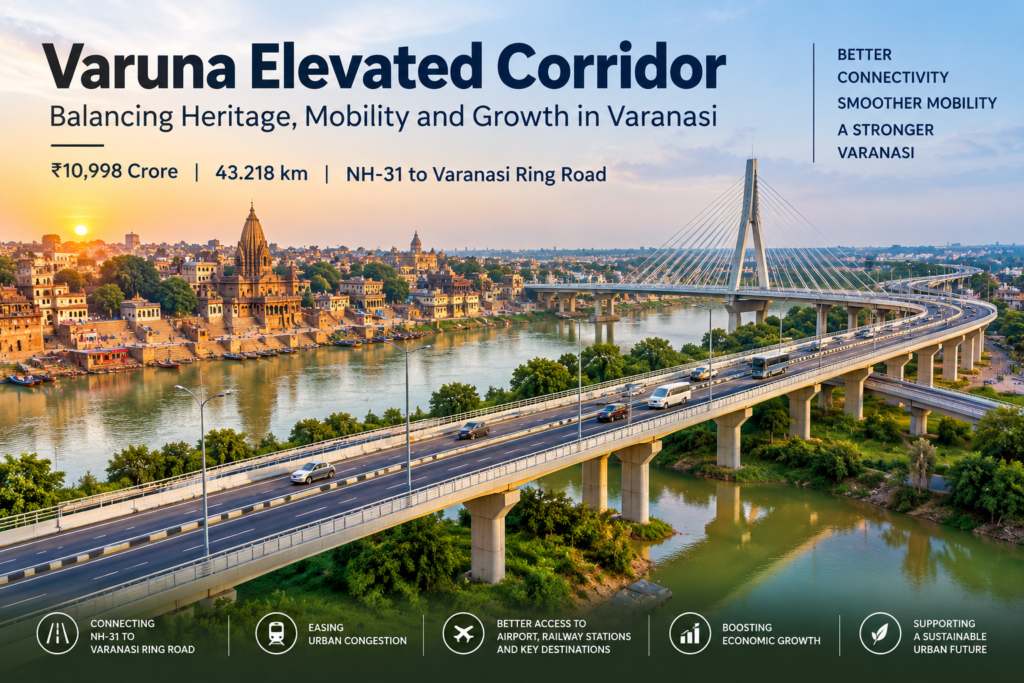
The corridor will connect NH-31 with the Varanasi Ring Road, running along the Varuna River and providing an alternative high-capacity route through the city. The project will be developed by the National Highways Authority of India (NHAI) under the Ministry of Road Transport & Highways and will predominantly comprise a 6/4-lane elevated corridor, supported by flyovers, loops, ramps and service roads.
The project also includes an iconic cable-stayed bridge and an extradosed foot over bridge-cum-major bridge, adding significant bridge infrastructure to the corridor.
Improving Varanasi’s Urban Connectivity
The Varuna Elevated Corridor forms part of the Varanasi Decongestion Plan, which seeks to improve movement between major highways, railway stations, the airport and important urban destinations.
The corridor is expected to improve access to Varanasi Airport, Varanasi Cantonment, Varanasi City Railway Station, Kashi Railway Station and Deen Dayal Upadhyaya Junction, while also strengthening connectivity to Ramnagar Port and areas along the Varuna corridor.
Designed for speeds of 80–100 kmph, the project is expected to reduce travel time between NH-31 and Kashi Railway Station from approximately 40 minutes to nearly 20 minutes. The proposed improvement is intended to support more predictable journeys, lower vehicle operating costs and improve the movement of passengers and freight.
Supporting Tourism, Pilgrimage and Education
Varanasi’s role as a major centre of faith, culture, education and tourism makes urban mobility particularly important. The additional road capacity is expected to facilitate access to major destinations such as the ghats, Kashi Vishwanath Corridor and Kashi Vishwanath Temple.
During festivals and peak pilgrimage periods, when visitor movement increases substantially, the additional capacity is expected to help distribute traffic more efficiently and reduce pressure on existing urban corridors.
The project will also improve connectivity to educational institutions, including Sampurnanand Sanskrit University, supporting easier movement between educational centres and residential areas.
Strengthening Regional Logistics and Economic Activity
Beyond urban mobility, the corridor is expected to reinforce Varanasi’s position as a regional logistics and economic centre. Aligned with the PM Gati Shakti National Master Plan, it will improve access to the Chandauli Socio-Economic Zone, Chandauli Social Node and six major logistics nodes.
Improved integration between national highways, railway infrastructure and freight corridors is expected to facilitate the movement of agricultural produce, industrial goods, construction materials and minerals between Varanasi, Chandauli and surrounding regions.
The project is therefore positioned not only as a decongestion measure but also as infrastructure supporting wider regional economic activity and connectivity across eastern Uttar Pradesh.
Elevated Mobility Along a Historic Urban Corridor
One of the defining features of the project is its predominantly elevated alignment. In a densely built-up and historically significant city, the elevated corridor is intended to add transport capacity while limiting the requirement for extensive road widening through existing neighbourhoods.
Strategically planned loops, ramps and service roads will support a continuous mobility spine for through and regional traffic, potentially separating longer-distance movement from local traffic.
According to the PIB, the project includes ₹4,565.33 crore for civil construction and ₹934.91 crore for land acquisition.
The corridor is also expected to address congestion at major urban locations including Varanasi Junction, Phulwaria and Chaukaghat, where local, commercial and through traffic currently compete for limited road capacity.
Another significant expected improvement is the connection between Varanasi Junction and Lal Bahadur Shastri International Airport, with travel time projected to fall from nearly one hour to around 20 minutes.
As Varanasi continues to develop as a cultural, tourism, educational, logistics and economic hub, the Varuna Elevated Corridor represents a major intervention in the city’s mobility infrastructure. Its success will ultimately depend not only on additional road capacity but also on how effectively the new infrastructure integrates with the city’s existing neighbourhoods, public transport, heritage areas and local movement patterns.
Also Read: A.K. Jain on Delhi’s Future, Urban Planning, Technology & Reform
Join our WhatsApp Channel for fastest updates: Join now