

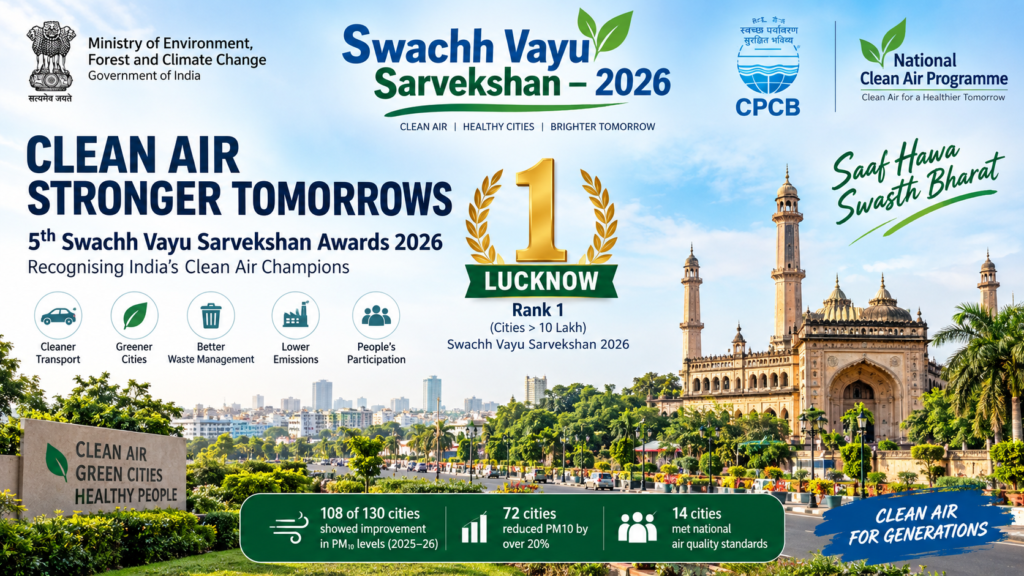
The Ministry of Environment, Forest and Climate Change (MoEFCC) conferred the 5th Swachh Vayu Sarvekshan Awards 2026 on the best-performing cities and wards across the country during Swachh Vayu Diwas 2026, held on the International Day of Clean Air for Blue Skies. The ministry also released a Compendium of Best Management Practices under the National Clean Air Programme (NCAP), highlighting measures that can be replicated by other cities and State Pollution Control Boards.
The event was presided over by Justice Prakash Shrivastava, Chairperson of the National Green Tribunal (NGT), who emphasised that clean air is a fundamental requirement and can be achieved through effective planning and implementation at the ground level. He also underlined the importance of urban and rural local bodies as frontline institutions in implementing air-quality measures and called for pollution prevention at source, adoption of new technologies and a whole-of-society approach.
According to the ministry, the Swachh Vayu Sarvekshan framework, introduced in 2022–23, assesses cities on measures covering road-dust control, solid waste management, vehicular emissions, industrial pollution, construction and demolition (C&D) waste management, emissions from DG sets and commercial establishments, and information, education and communication (IEC) activities. The 2026 assessment covered 130 NCAP cities, grouped according to population size.
Lucknow Leads the Million-Plus Category
In Category I, comprising cities with populations above 10 lakh, Lucknow secured the first rank with a score of 198, followed by Indore with 197 and Jabalpur with 195. Bhopal and Agra jointly occupied the fourth position with scores of 192, while Surat ranked fifth with 191.
Other leading cities included Raipur, Thane, Chandigarh, Rajkot, Ahmedabad, Vijayawada, Ghaziabad and Navi Mumbai. Delhi recorded a score of 172 and ranked 21st in the category.
In Category II, covering cities with populations between 3 lakh and 10 lakh, Rourkela topped the ranking with a score of 198.5, followed by Firozabad and Guntur. In Category III, for cities with populations below 3 lakh, Kalinga Nagar ranked first with 198.5, followed by Angul and Talcher.
Ward-Level Performance Recognised
The survey also recognised high-performing wards across different population categories. Among wards with populations above 30,000, Lucknow Zone 4 Ward 70 ranked first, followed by Bhopal BMC Ward 60 and Nashik NMC Ward 7.
For wards with populations between 10,000 and 30,000, Bhubaneswar BMC Ward 36 and Ward 30 jointly secured the top position, while Vijayawada Ward 60 ranked second and Allahabad Ward 31 third. In the category of wards with populations below 10,000, Rourkela RMC Ward 13 ranked first, followed by Nalgonda Ward 16 and Nagaon Ward 8.
The survey’s ranking process involved self-assessment by cities, approval by State-level Monitoring Committees, evaluation by the Central Pollution Control Board (CPCB), field verification by independent committees and selection of the best-performing cities.
NCAP Reports Progress in PM10 Reduction
The Swachh Vayu Diwas programme also highlighted progress under the National Clean Air Programme, which currently covers 130 cities across 24 States and Union Territories. A performance-linked grant of ₹16,425 crore has been provided to NCAP cities as critical gap funding for implementing air-pollution mitigation measures.
The ministry reported that during 2025–26, compared with PM10 levels in FY 2017–18, 108 of the 130 cities recorded improvement. Among them, 72 cities achieved reductions of more than 20 per cent, while 26 cities recorded reductions exceeding 40 per cent. Further, 14 cities met the National Ambient Air Quality Standards (NAAQS).
Secretary (EFCC) Tanmay Kumar said that NCAP provides cities with a framework to develop their own clean-air strategies, while the PRANA portal tracks air-quality management parameters across the 130 NCAP cities. He stressed that air-pollution control is a continuous programme requiring citizen participation and encouraged cities to transform air-quality management into a jan-bhagidari movement.
Compendium Highlights Replicable Urban Practices
The newly released Compendium of Best Management Practices under NCAP documents successful measures implemented by cities and State Pollution Control Boards/Committees. Its focus areas include road-dust control, vehicular pollution, industrial pollution, solid waste and C&D waste management, open-burning control, greening, technology applications and public outreach.
The ministry said the documented practices are intended to help other cities and pollution-control agencies replicate successful approaches and strengthen local air-quality management.
The 5th Swachh Vayu Sarvekshan therefore places greater emphasis on measurable city-level action, local-body implementation and replicable solutions, linking air-quality improvement with urban management and citizen participation.
Also Read: Delhi’s First International Ice-Skating Stadium Awaits DUAC Approval Over Documentation Gaps
Join our WhatsApp Channel for fastest updates: Join now