

For a few extraordinary days each year, streets become gathering spaces, pandals become temporary landmarks and waterfronts become ceremonial destinations. Ganesh Utsav demonstrates how deeply culture can reshape the functioning of an Indian city—but it also raises difficult questions about mobility, waste, water bodies, noise and the future of sustainable urban celebrations.
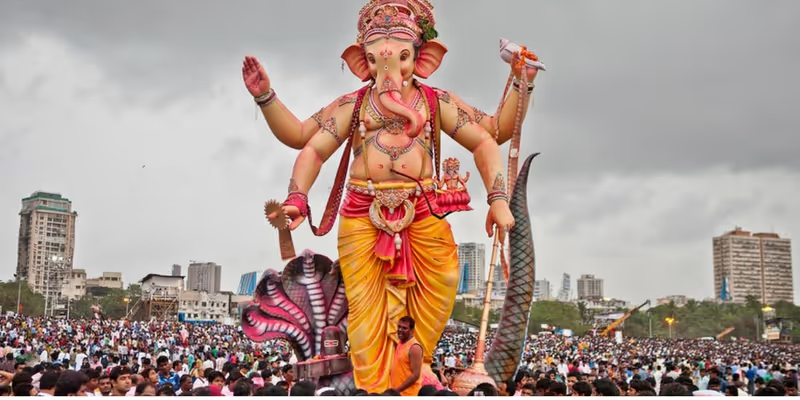
Every city has two maps. One is drawn by planners—with roads, land-use zones, transport corridors, parks and infrastructure. The other is created by its people through memory, faith, festivals and everyday use of public space. During Ganesh Utsav, the second map becomes remarkably visible.
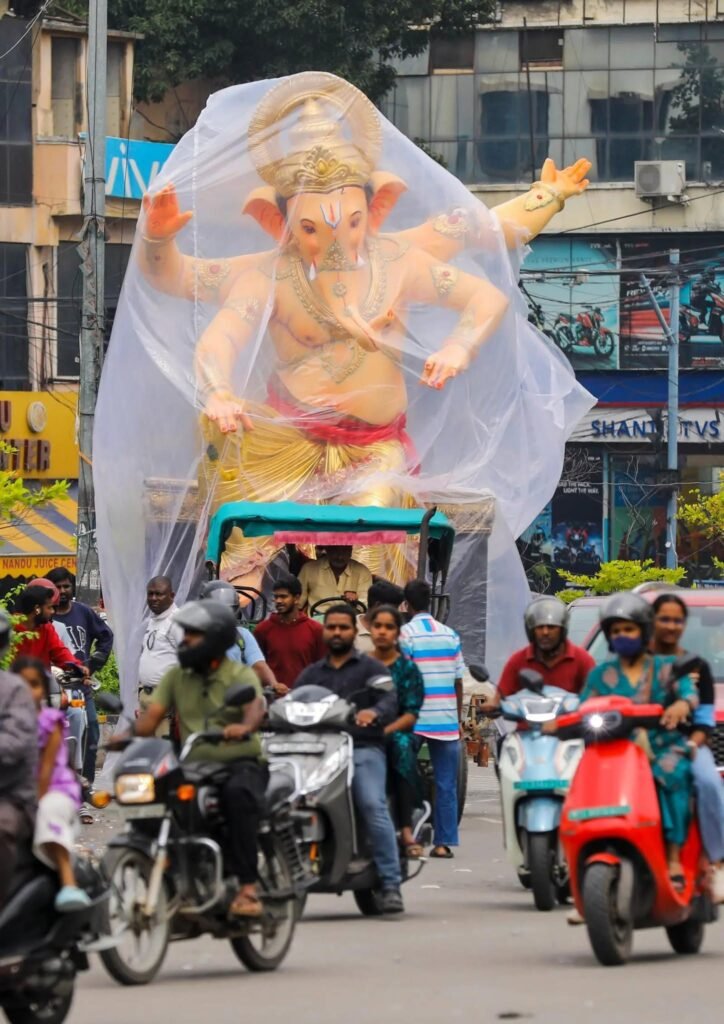
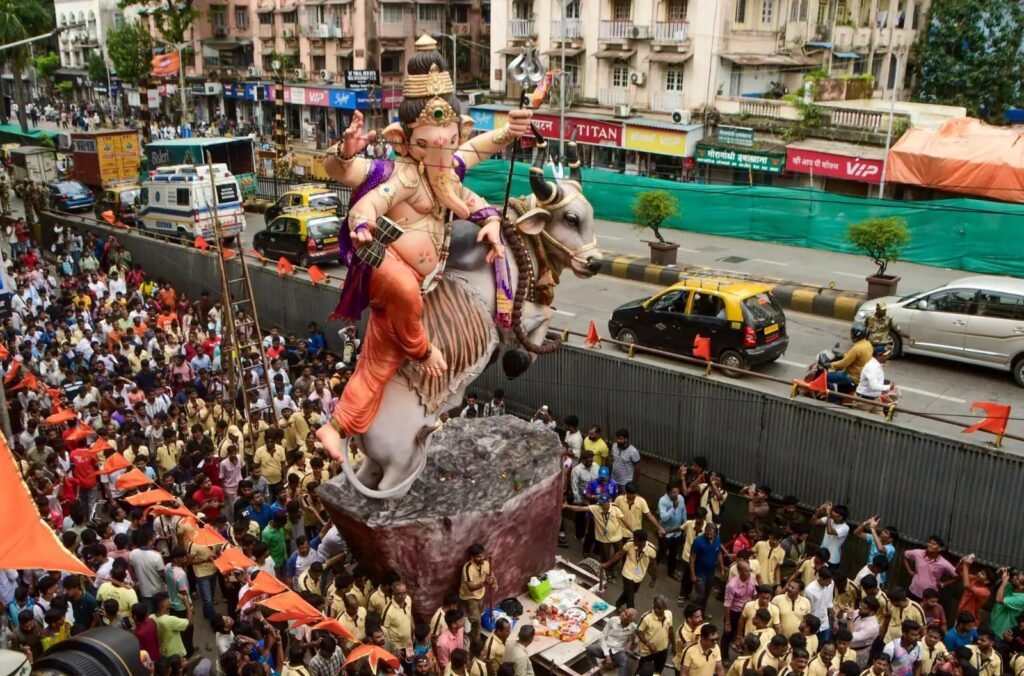
Across cities such as Mumbai, Pune, Hyderabad and Bengaluru, the arrival of Lord Ganesha temporarily changes the rhythm of urban life. Streets become procession routes, neighbourhood junctions turn into community spaces, open grounds accommodate pandals and lakes or seafronts become destinations for immersion. What appears to be a religious festival is simultaneously one of India’s largest recurring experiments in temporary urbanism.
The public character of Ganeshotsav has a particularly important association with Maharashtra. In the late nineteenth century, Lokmanya Bal Gangadhar Tilak helped popularise community celebrations of Ganesh Chaturthi, transforming what was largely a domestic religious observance into a platform for collective participation. Over time, the public Ganesh pandal became not only a place of worship but also a space for cultural programmes, neighbourhood interaction and civic identity.
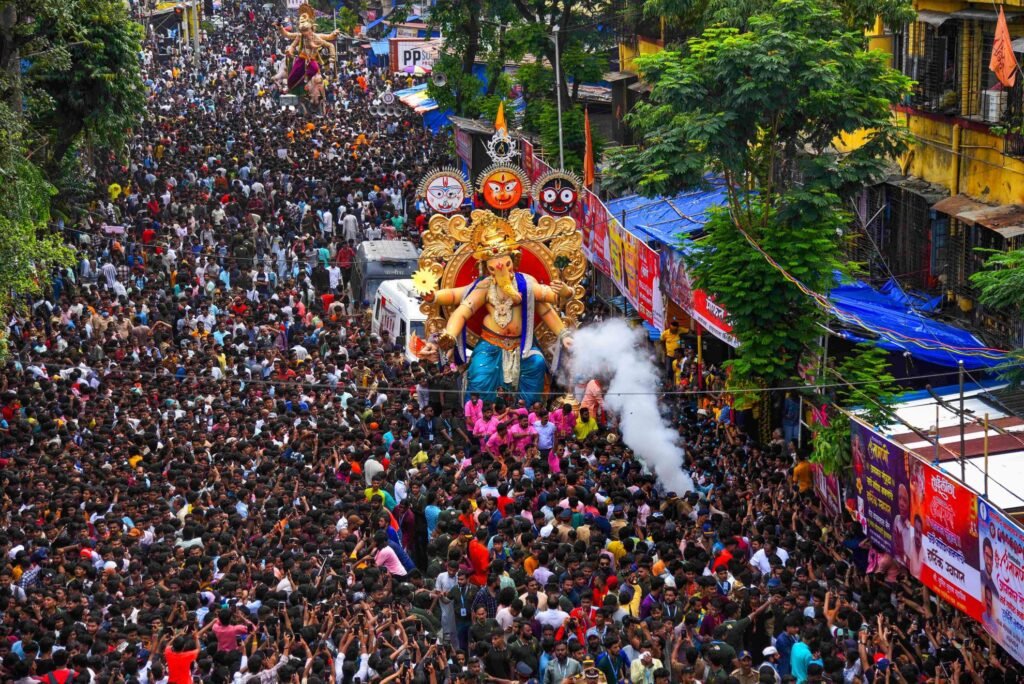
Today, nowhere is this relationship between festival and city more visible than Mumbai. According to the Ministry of Tourism’s Incredible India platform, around 150,000 Ganesh idols are immersed annually in Mumbai. Behind that figure lies an enormous temporary urban operation involving procession routes, traffic diversions, police deployment, sanitation, emergency services, lighting, waste collection and immersion facilities. Mumbai during Ganeshotsav offers an intriguing lesson: streets are not merely channels for vehicles. During the festival, roads that ordinarily prioritise movement become places for walking, gathering, performance and collective expression. Neighbourhoods acquire temporary landmarks through pandals, while major immersion routes connect residential communities with the city’s waterfront. In effect, citizens temporarily redesign the city.
Pune offers another dimension. Its historic association with public Ganeshotsav and its dense traditional neighbourhoods demonstrate how cultural events interact with older urban fabrics. Narrow streets and compact neighbourhoods provide intimacy and identity, but large crowds also place substantial pressure on limited road space. The same morphology that makes a historic precinct culturally distinctive can make crowd movement, emergency access and traffic management difficult.
Hyderabad presents a different urban challenge—the relationship between the festival and the city’s water infrastructure. Hussain Sagar has long been one of the most prominent destinations for Ganesh immersion. In preparations for the 2024 festival, the Telangana Government stated that approximately 1.5 lakh idols had been installed within the Outer Ring Road area during the previous year. Authorities discussed distributing immersion activity among Hussain Sagar and other water bodies in order to reduce pressure on the lake.
This highlights a fundamental planning question: How much cultural activity can an urban ecological asset sustainably accommodate? The question becomes particularly important because the traditional philosophy of Ganesh Visarjan is remarkably compatible with ecological thinking. An idol formed from natural clay returns to the natural environment after worship. But modern materials have complicated this relationship.
The Central Pollution Control Board’s idol-immersion guidelines identify concerns associated with materials such as Plaster of Paris, synthetic paints and non-biodegradable decorations. The guidelines promote natural materials, environmentally safer colours, designated immersion arrangements and appropriate handling of ritual waste. The environmental contradiction is therefore not inherent to Visarjan itself. It emerges from the materials and scale of contemporary celebration.
Maharashtra’s experience illustrates why monitoring matters. The Maharashtra Pollution Control Board conducts water-quality monitoring around Ganesh festival periods, examining parameters including dissolved oxygen, biochemical oxygen demand, chemical oxygen demand, turbidity and suspended solids. Such monitoring allows environmental impact to be discussed through evidence rather than assumption.
Water is only one dimension. Noise is another. Drums, music and processions are deeply embedded in the festival’s public character, yet very high sound levels can affect residential neighbourhoods and sensitive areas. MPCB’s festival monitoring has documented high peak noise levels at some locations; historical monitoring in Mumbai, for example, recorded maximum levels exceeding 100 dB(A) at certain monitored sites. The challenge for urban governance is therefore not to eliminate cultural expression, but to reconcile celebration with public-health and neighbourhood considerations.
Traffic presents an equally visible challenge. Major processions can alter movement across entire districts. Roads close, buses are diverted, parking is restricted and pedestrians occupy carriageways. Municipal corporations, traffic police, fire services, utilities and health departments must coordinate simultaneously. Yet congestion tells only half the story.
Ganesh Utsav also reveals an extraordinary ability of Indian communities to create social infrastructure. Residents who may otherwise have little interaction work together to organise pandals, cultural programmes, food distribution and neighbourhood activities. Children participate alongside older generations; artisans and performers find audiences; volunteers manage queues and community services. The festival produces something that formal planning often struggles to manufacture—a powerful sense of belonging.
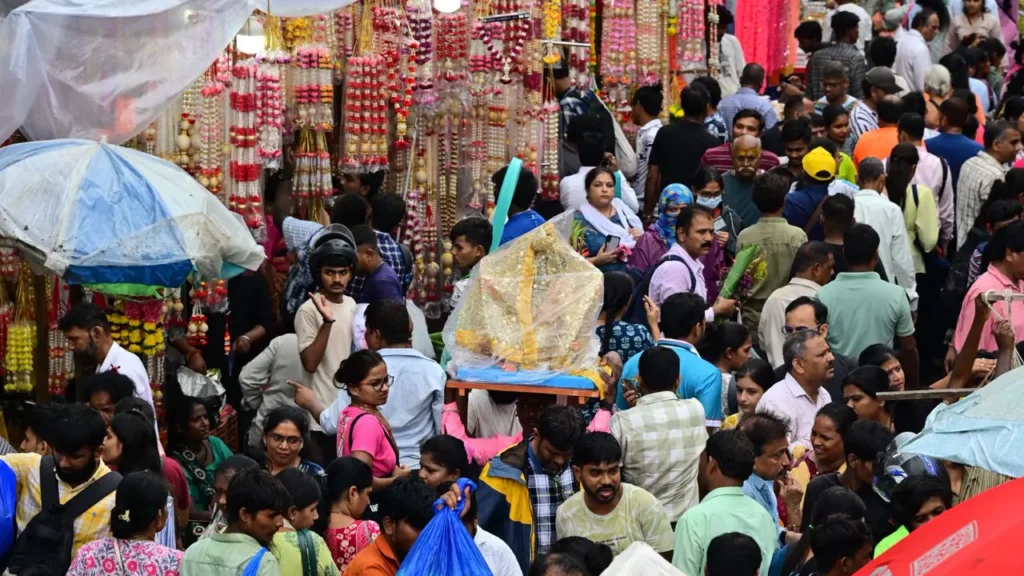
There is an economic city within this cultural city as well. Idol sculptors, clay suppliers, decorators, flower sellers, electricians, fabricators, lighting specialists, transport workers, caterers, sweet shops, photographers and numerous small vendors participate in a seasonal economy surrounding the festival. The economic benefits therefore extend well beyond major organisers to neighbourhood-scale enterprises and informal livelihoods.
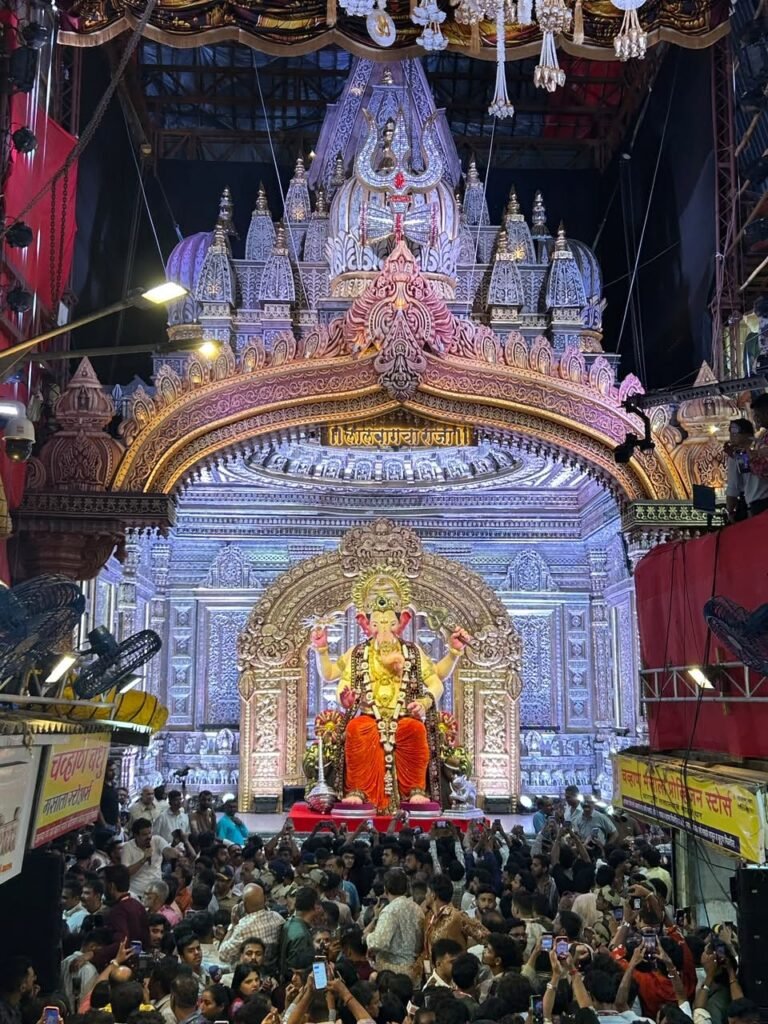
The most fascinating object in this urban transformation is the pandal itself. A pandal is architecture with an expiry date. It requires structure, circulation, lighting, electrical systems, entrances, exits, signage, crowd capacity, fire safety and visual identity, yet may stand for only a few days. Some reproduce temples, palaces or contemporary themes; others experiment with craft, recycled materials or social messages. Collectively, they form a temporary architectural layer over the permanent city. This suggests that festival planning deserves a more serious place within urban design.
Indian cities typically respond to large festivals through temporary management: traffic diversions, barricades, additional sanitation workers, immersion tanks, police deployment and emergency arrangements. Bengaluru, for instance, has used designated immersion facilities and hundreds of mobile immersion tanks; BBMP listed 489 mobile tank vehicles as part of its 2025 Ganesh immersion arrangements. Hyderabad has similarly explored dispersing immersion activity across multiple locations. These interventions point towards a larger possibility: moving from festival management to festival planning.
Cities that repeatedly host enormous cultural gatherings could incorporate flexible festival infrastructure into long-term planning. Selected public grounds could be designed with temporary electricity and water connections. Major procession corridors could have predetermined emergency-access strategies. Immersion facilities could be planned to separate ritual practice from ecologically sensitive water bodies. Waste-segregation points, public toilets and pedestrian holding areas could become modular systems capable of being activated during large events. Even temporary structures could be encouraged through design guidelines favouring reusable components, natural materials, accessibility, fire safety and circular construction. Such planning need not diminish the spontaneity or spiritual character of Ganesh Utsav. On the contrary, good planning can protect both.
The spiritual symbolism offers perhaps the strongest argument for environmental responsibility. Ganesh Visarjan embodies impermanence: a physical form is created, honoured and ultimately allowed to dissolve. The ritual reminds people that material form is temporary. A festival built around that philosophy should not leave behind materials that persist in an ecosystem long after the celebration has ended. The clay idol, in this sense, contains an urban lesson.
Ganesh Utsav should therefore not be viewed simply as a challenge of crowd control, nor should its environmental consequences be used to overlook its profound social and cultural contribution. It is simultaneously a spiritual observance, community institution, cultural economy, temporary architectural movement and major urban event.
Mumbai shows how a metropolis can reorganise itself around celebration. Pune demonstrates the relationship between tradition and historic urban fabric. Hyderabad illustrates the delicate intersection between faith and urban water bodies. Bengaluru’s immersion arrangements show how infrastructure can adapt to changing environmental expectations. Together, these cities suggest a broader principle for India’s urban future.
A culturally alive city cannot be planned as though festivals do not exist. Equally, cultural traditions cannot be sustained by ignoring the ecological limits of the city that hosts them.
The future of Ganesh Utsav therefore lies neither in restricting celebration nor in allowing unlimited expansion without planning. It lies in designing cities where faith, public space, mobility, ecology and community can coexist.
Perhaps that is the most appropriate contemporary interpretation of the festival itself: removing obstacles not only from individual lives, but from the relationship between culture and the city.
References
- Central Pollution Control Board (CPCB), Government of India
- Maharashtra Pollution Control Board (MPCB)
- Ministry of Tourism / Incredible India, Government of India
- Government of Telangana
- Telangana Police / Rachakonda Police
- Greater Bengaluru Mahanagara Palike (BBMP)
- Hyderabad District Administration / Government of Telangana
Also Read: A.K. Jain on Delhi’s Future, Urban Planning, Technology & Reform
Join our WhatsApp Channel for fastest updates: Join now