
New York | The world is off track to achieve Sustainable Development Goal 11 (SDG 11) on sustainable cities and communities, ten years after its adoption, according to the SDG 11 Global Report 2026, launched by UN-Habitat during the High-level Political Forum on Sustainable Development (HLPF).
Prepared with the United Nations Department of Economic and Social Affairs (UN DESA), UNDRR, WHO, UNODC, UNESCO, UNEP and other partners, the report presents the United Nations system’s joint assessment of progress towards achieving SDG 11.
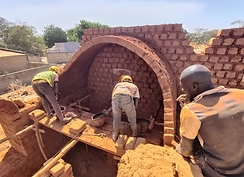
The report identifies the global housing crisis as one of the greatest barriers to sustainable urban development. Today, more than 3 billion people lack access to adequate housing, including over 1.1 billion living in informal settlements and slums.
“Delivering adequate housing and transforming slums and informal settlements is one of the most important tests of whether we are achieving SDG 11 and its vision of sustainable cities and communities. With only four years remaining until 2030 and the New Urban Agenda at its midpoint, incremental progress is not enough. We must act with urgency.”
— Anacláudia Rossbach, Executive Director of UN-Habitat, while presenting the report at a press briefing at United Nations Headquarters in New York.
“The report sends a clear and urgent message, which is that despite progress in areas such as public transport, waste management and urban policy, the world remains significantly off track in achieving SDG 11,” noted Ambassador Erastus Ekitela Lokaale, Permanent Representative of the Republic of Kenya to the United Nations. “The findings reinforce that housing is not only an enabler of SDG 11, but indeed all the other Sustainable Development Goals.”
“More than 3 billion people still live in inadequate housing, and over 1 billion people live in informal settlements. These are not simply statistics; they represent millions of families whose daily lives are shaped by exclusion and inequality,” observed Shirley Pryce, Jamaica Household Workers Union, GROOTS Jamaica, Huairou Commission and Member of the UN-Habitat Advisory Group on Gender Issues. She emphasized the need to integrate the needs of women and caregivers into urban planning and policymaking, noting that their priorities and lived experiences too often remain invisible.
The report concludes that progress on SDG 11 is possible, but it is neither fast enough nor equitable enough to achieve all the targets by 2030.
Important gains highlighted in the report
- Across 126 countries, the share of the urban population with convenient access to public transport increased from 53.2% in 2020 to 61.5% in 2025.
- Across 123 countries, land consumption is becoming more closely aligned with population growth than in previous decades, suggesting improvements in urban planning.
- Municipal solid waste collection now exceeds 90% in Australia and New Zealand, Western Asia and Northern Africa, Northern America and Europe, and Latin America and the Caribbean.
Key challenges
Despite these advances, the report notes that progress is being outpaced by the scale and speed of urbanization and growing inequalities within cities.
- 4 in 10 urban residents still lack convenient access to public transport.
- Disasters continue to have a devastating impact, affecting an average of 123 million people every year between 2015 and 2024, with the frequency of disasters continuing to rise.
- Housing affordability pressures are increasing worldwide, with half of all households spending more than 30% of their income on rent.
The report stresses that housing is not merely an outcome of sustainable development but its foundation. Prioritizing adequate housing and transforming informal settlements can accelerate progress across multiple Sustainable Development Goals, including poverty eradication, health, education, gender equality, climate resilience and economic opportunity.
Since 2020, monitoring of SDG 11 has improved. Today, 101 countries report more than half of the monitoring data across ten SDG 11 targets. However, major gaps remain, particularly in disaggregated data relating to women, children, persons with disabilities, people living in informal settlements and neighbourhood-level inequalities. The report calls for greater investment in statistics, geospatial information, Earth observation and other innovative technologies to support evidence-based decision-making and targeted public investment.
The report concludes that prioritizing adequate housing, transforming informal settlements and building urban resilience are the most effective ways to accelerate sustainable development. Investing in housing and advancing SDG 11 can catalyse progress across the Sustainable Development Goals and support implementation of the 2030 Agenda.
The SDG 11 Global Report 2026 will inform discussions at the High-level Political Forum on Sustainable Development and feed into the High-Level Meeting of the United Nations General Assembly on the implementation of the New Urban Agenda, scheduled for 16–17 July 2026.
UN-Habitat – Official Website
Also Read: ISOCARP Announces 62nd World Planning Congress 2027 in Wellington
Join our WhatsApp Channel for fastest updates: Join now