

New Delhi | India is building a standardised framework for future high-speed rail corridors as the country’s first bullet train project—the Mumbai–Ahmedabad High-Speed Rail (MAHSR) corridor—moves closer to completion. According to a backgrounder released by the Press Information Bureau (PIB), the experience gained from the flagship project will serve as the blueprint for upcoming bullet train corridors across the country.
The government stated that the standardisation strategy will focus on adopting proven engineering designs, construction methods, and operational practices to improve efficiency, reduce project costs, and accelerate the implementation of future high-speed rail networks. While foundations will be designed according to local soil conditions, key infrastructure components such as viaducts, tracks, station structures, signalling systems, and overhead electrification will follow common engineering standards.
Indigenous Manufacturing Gains Momentum
The initiative also supports the Make in India and Aatmanirbhar Bharat programmes by promoting domestic manufacturing of high-speed rail technology. The Integral Coach Factory (ICF), in collaboration with Bharat Earth Movers Limited (BEML), is currently developing indigenous train sets capable of operating at 280 kmph.
India is simultaneously strengthening its production ecosystem for specialised components, slab-track systems, construction equipment, and testing facilities. The recently inaugurated Aditya manufacturing complex in Bengaluru, along with research support from IITs and technology transfer through Japanese engineering practices, is expected to enhance India’s long-term capabilities in high-speed rail development.
Mumbai–Ahmedabad Bullet Train Project Nears Operational Stage
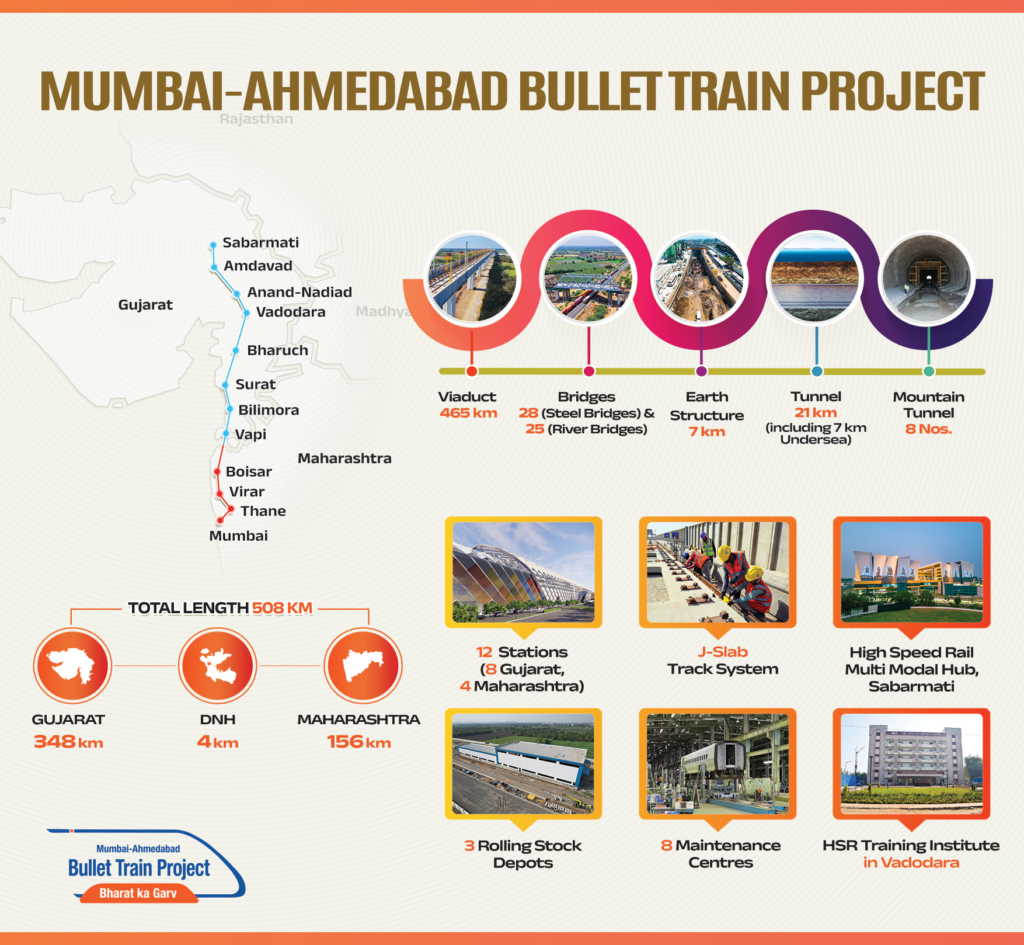
The 508-kilometre Mumbai–Ahmedabad High-Speed Rail corridor marks India’s first dedicated bullet train route and introduces Japanese Shinkansen technology and internationally recognised safety standards.
According to the PIB, the corridor will:
- Cover approximately 508 kilometres
- Include 12 stations
- Reduce travel time between Mumbai and Ahmedabad to 1 hour 58 minutes
- Operate at a design speed of 350 kmph and a maximum operational speed of 320 kmph
- Begin its first operational phase between Surat and Vapi, with commercial services expected to commence in August 2027.
The project incorporates advanced traction systems, ballastless J-Slab track technology, specialised overhead electrification, modern signalling systems, and dedicated rolling stock depots at Sabarmati, Surat, and Thane.
Seven Future High-Speed Rail Corridors Planned
Building on the Mumbai–Ahmedabad experience, India has identified seven additional high-speed rail corridors spanning nearly 4,000 kilometres, with an estimated investment of around ₹16 lakh crore.
The proposed corridors include:
- Delhi–Varanasi
- Varanasi–Patna–Siliguri
- Chennai–Bengaluru
- Bengaluru–Hyderabad
- Chennai–Hyderabad
- Mumbai–Pune
- Pune–Hyderabad
These corridors are expected to significantly reduce intercity travel times while strengthening regional connectivity and supporting long-term economic development.
Building a National High-Speed Rail Ecosystem
The PIB noted that the Mumbai–Ahmedabad High-Speed Rail project is not only India’s first bullet train corridor but also the foundation for a scalable national high-speed rail programme. By standardising infrastructure, expanding indigenous manufacturing, and developing technical expertise, India aims to create a replicable model that can support the rapid expansion of high-speed rail across the country. (PIB)
Join our WhatsApp Channel for fastest updates: Join now