

New Delhi: The Ministry of Jal Shakti organized a National Workshop on Research and Development (R&D) in Water, bringing together more than 500 stakeholders from government agencies, academic institutions, research organizations, industries, MSMEs, and startups to strengthen India’s water research and innovation ecosystem. The workshop focused on advancing water security and climate resilience through scientific research, technological innovation, and collaborative action.
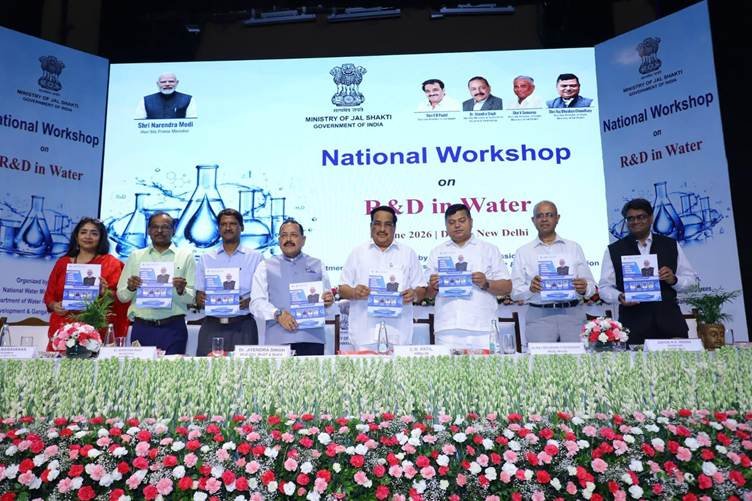
Union Minister for Jal Shakti C.R. Patil emphasized the importance of research, technology, and public participation in addressing emerging water challenges. He highlighted that over 315 R&D projects have been undertaken in the water sector, including 113 projects directly supported by the Ministry. The minister also announced the launch of the Jal Sanchay Jan Bhagidari: Catch the Rain (JSJB:CTR) Portal, aimed at promoting community-led water conservation across the country.
Minister of State (Independent Charge) for Science and Technology Dr. Jitendra Singh stressed the need for a “Whole-of-Government and Whole-of-Nation” approach involving academia, industry, startups, and MSMEs. He highlighted the launch of MAHA on Water (Mission for Advancement in High-Impact Areas for Water) and announced a joint research call by the Anusandhan National Research Foundation (ANRF) and the Ministry of Jal Shakti to encourage innovative solutions in water management and climate resilience.
A major highlight of the workshop was the signing of a Memorandum of Understanding between the Ministry of Jal Shakti and ISRO. The partnership will leverage satellite observations, remote sensing, and geospatial technologies to improve water resources planning, monitoring, and evidence-based decision-making.
The event also launched an Open Call for Startups and MSMEs under the Bharat Water Innovation Network (Bharat-WIN) to support the development and scaling of innovative technologies related to water conservation, efficiency, quality management, and climate-resilient water systems.
Technical sessions explored key national priorities including groundwater sustainability, flood and drought resilience, urban water security, river basin management, climate adaptation, artificial intelligence, and geospatial applications. The workshop concluded with a call for stronger collaboration among government, academia, industry, and communities to accelerate research-driven solutions and support the vision of a water-secure and climate-resilient India by 2047.
Also Read: Uttarakhand’s Valley of Flowers Opens to Tourists for 2026 Season
Join our WhatsApp Channel for fastest updates: Join now