

The passing of Prof. J.H. Ansari, former Director of the School of Planning and Architecture (SPA), marks a profound loss not only to the institution he led but to the entire landscape of planning education in India. A distinguished academician, planner, and institution builder, Prof. Ansari belonged to a generation of educators who played a crucial role in defining how urban planning is taught, understood, and practiced in the country. His contributions were not always visible in the form of grand physical projects, yet they were deeply embedded in the intellectual and professional fabric of Indian cities through the countless students he mentored and the systems he helped strengthen.
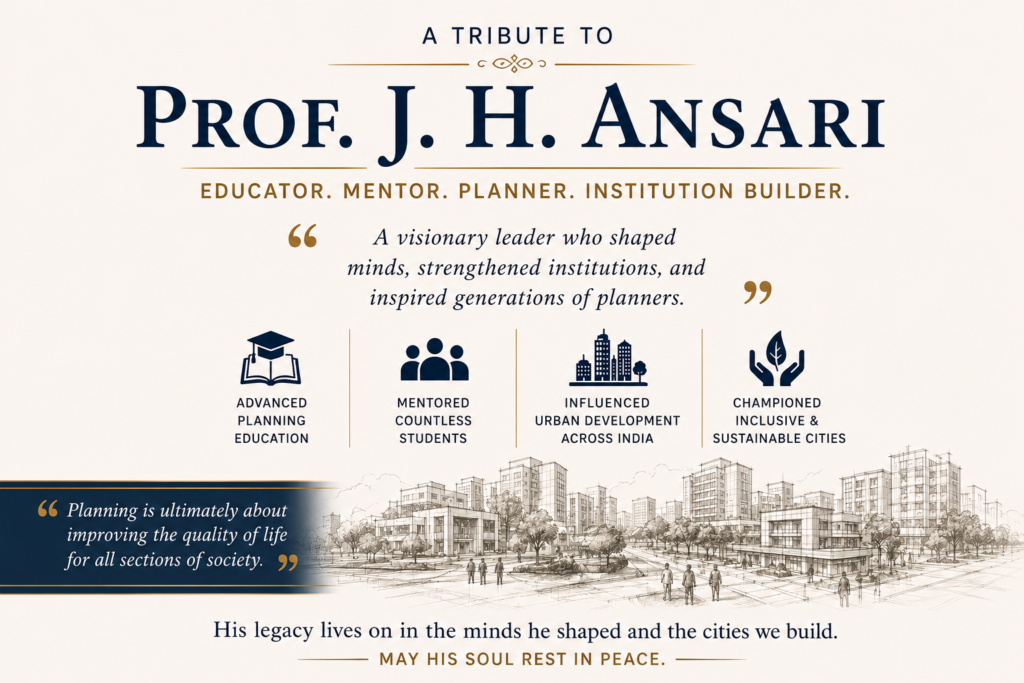
During his tenure at SPA, one of India’s premier institutions established in 1941 and later recognized as an Institution of National Importance, Prof. Ansari contributed significantly to advancing planning education at a time when India was witnessing rapid urbanization. By the early 2000s, India’s urban population had crossed nearly 28% of the total population, and cities were expanding at an unprecedented rate. In this context, his leadership focused on equipping future planners with the skills and sensitivity required to deal with complex urban challenges such as housing shortages, informal settlements, infrastructure deficits, and environmental degradation. He emphasized interdisciplinary learning, integrating architecture, planning, transport, environment, and socio-economic studies into a cohesive framework, ensuring that students were not trained in isolation but as holistic thinkers capable of addressing real-world urban issues.
Prof. Ansari strongly believed that planning education in India must be rooted in its own socio-cultural and economic realities. At a time when global models of planning were increasingly influencing academic curricula, he consistently advocated for a contextual approach—one that acknowledged the diversity, informality, and layered complexity of Indian cities. He encouraged critical engagement with issues such as equity, access to services, and inclusive development, reinforcing the idea that planning is ultimately about improving the quality of life for all sections of society. His academic approach helped shift the focus from purely physical planning to a more integrated understanding of cities as dynamic systems involving people, institutions, and environments.
As an educator and mentor, Prof. Ansari’s influence extended far beyond the classroom. Over the course of his career, he guided and mentored hundreds of students, many of whom have gone on to occupy key roles in government agencies, academic institutions, international organizations, and private practice. Institutions such as the Delhi Development Authority, the Town and Country Planning Organisation (TCPO), and various state planning departments today include professionals who have been shaped directly or indirectly by his teachings. This multiplier effect of knowledge and mentorship stands as one of his most significant contributions—an enduring legacy that continues to influence planning decisions across the country.
In addition to his academic leadership, Prof. Ansari contributed to the broader discourse on urban development through participation in seminars, advisory roles, and academic forums. His insights helped bridge the often-existing gap between theory and practice, ensuring that planning education remained relevant to the evolving needs of Indian cities. He recognized that with India projected to have nearly 40% of its population living in urban areas by 2030, the role of planners would become even more critical, and thus, the quality of planning education needed continuous strengthening.
What set Prof. Ansari apart was his personality—marked by humility, patience, and intellectual clarity. He was known for his ability to simplify complex planning concepts, encourage dialogue, and nurture independent thinking among students. Rather than imposing ideas, he guided discussions, allowing students to explore, question, and develop their own perspectives. His leadership style was understated yet impactful, fostering an environment of respect, curiosity, and academic excellence.
The legacy of Prof. J.H. Ansari can be understood across multiple dimensions. Institutionally, he strengthened SPA’s role as a leading center for planning education in India. Academically, he contributed to the evolution of a more contextual, inclusive, and interdisciplinary planning pedagogy. Professionally, he influenced a generation of planners whose work continues to shape cities and regions across the country. His contributions remind us that the true impact of an educator lies not just in what they teach, but in how they inspire others to think, question, and act.
For those who had the privilege of learning from or working with him, Prof. Ansari was more than an academic—he was a guide, a mentor, and a source of quiet inspiration. His presence in classrooms, discussions, and institutional spaces left a lasting imprint that continues to resonate through the work of his students and colleagues. Even in his absence, his ideas and values remain deeply relevant in a time when cities are facing increasing pressures of growth, inequality, and environmental stress.
The passing of Prof. J.H. Ansari is indeed a great loss to the planning fraternity, but his legacy endures in the minds he shaped and the institutions he strengthened. His work lives on in the planners he mentored, the knowledge he imparted, and the vision he upheld for more inclusive and sustainable cities.
May his soul rest in peace.
Also Read: In Memoriam: Prof. Vijay Garg and Ecologist Madhav Gadgil
Join our WhatsApp Channel for fastest updates: Join now