

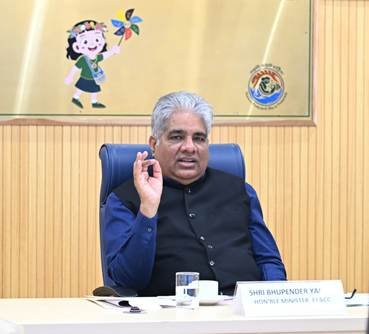
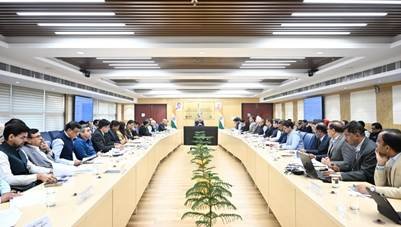
Union Environment Minister Bhupender Yadav chaired a high-level meeting to review the air quality situation in Delhi-NCR, directing all state and Union Territory authorities to accelerate the on-ground implementation of annual action plans for pollution management. The meeting, attended by Delhi’s Environment Minister Manjinder Singh Sirsa and senior officials from NCR states, focused on improving coordination and ensuring measurable progress across multiple sectors.
Source: Press Information Bureau (PIB)
Source: Press Information Bureau (PIB)
During the review, the Minister emphasized the need for strict and time-bound execution of action points across areas such as road development, dust control, construction and demolition waste management, emission compliance by industries, smart traffic systems, public transport enhancement, solid waste management, and greening initiatives. He instructed stakeholders to develop detailed annual action plans with monthly and weekly targets to enable proactive pollution control.
Key pollution sources were reviewed one by one. For industrial emissions, the Minister directed pollution control boards to ensure that all high-risk industries—about 2,254 units in categories such as metal, textiles, and food processing—install Online Continuous Emission Monitoring Systems (OCEMS) and Air Pollution Control Devices (APCD) by 31 December 2025. Units failing to comply may face closure. Officials also highlighted rising prices of pollution-control devices, which are being monitored to avoid delays in installation.
On road and dust management, NCR authorities were asked to fast-track pothole repairs and follow standard procedures for road construction, including end-to-end pavements and proper drainage. The Minister stressed the need for real-time monitoring through mobile applications and directed municipal bodies to deploy mechanical road sweepers more effectively.
Traffic congestion at 62 hotspots across Delhi was identified as an urgent priority. The meeting called for immediate implementation of smart traffic management solutions, removal of encroachments, curbing illegal parking, and deployment of special police units during peak hours. The government has also pushed for quicker progress on foot-over bridges and similar infrastructure to ease bottlenecks.
The Minister reviewed the status of Delhi’s public transport transition, noting that the electric bus fleet has expanded to around 3,400 vehicles and is expected to cross 5,000 by March next year. He also directed strict action against polluting commercial vehicles, with BS-III and older vehicles already barred from entering Delhi since 1 November 2025.
Greening of NCR was highlighted as a long-term priority. Authorities were asked to identify potential plantation sites, revive eco-clubs, and engage communities, especially youth, through green-warrior groups. Micro-level plans will be prepared this winter and implemented over the next five years. The Minister also recommended clearing encroachments from urban parks, wetlands, and water bodies to restore ecological balance.
The review brought together senior officials from the Ministry of Environment, the Commission for Air Quality Management (CAQM), CPCB, and municipal commissioners from NCR cities. The Minister reiterated that a whole-of-government and whole-of-society approach is essential to achieve visible improvement in Delhi-NCR’s air quality.
Also Read: Meghalaya’s First Block-Level Climate Vulnerability Assessment Finds 25 Blocks at High Risk