

World ‘Heading for Serious Escalation of Climate Risks and Damage’
New Delhi: Global greenhouse gas (GHG) emissions have surged to a record high of 57.7 gigatons of CO₂ equivalent in 2024, marking a 2.3% increase from the previous year, according to a new UN report released on Tuesday. The report warns that the world is on course for a “serious escalation of climate risks and damage” if urgent mitigation actions are not implemented.
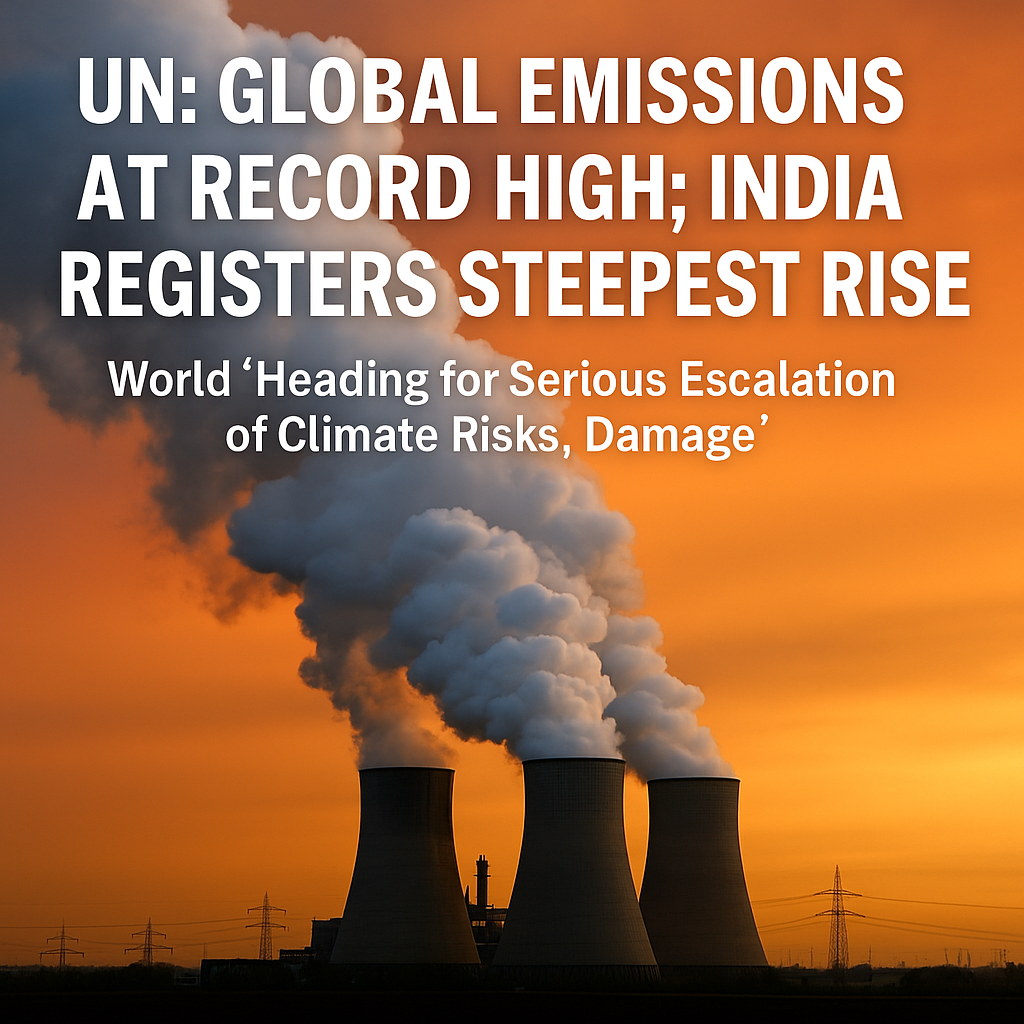
India recorded the highest absolute increase in emissions, followed by China, Russia, Indonesia, and the United States. Despite ongoing global efforts, emissions continue to climb, pushing the world closer to a dangerous warming threshold.
The report highlights that the average global temperature is expected to rise between 2.3°C and 2.5°C above pre-industrial levels by the end of this century—even if current climate pledges are fulfilled. Without more ambitious policies, global temperatures could overshoot 3°C, severely impacting ecosystems, food security, and economies.
Among the six largest emitters—China, the US, India, Russia, Indonesia, and the European Union—India and Indonesia registered the fastest year-on-year growth rates. Indonesia’s emissions grew by 4.6%, while India’s rose by 3.6%. In contrast, the European Union was the only major emitter to record a decline in emissions in 2024.
The report also noted that per capita emissions remain highly uneven: the US, Russia, China, and the EU emit an average of 6 tonnes of CO₂-equivalent per person, far higher than India and Indonesia. This imbalance underscores the differing historical responsibilities among nations.
UNEP Executive Director Inger Andersen cautioned that the world is not on track to meet the Paris Agreement targets of limiting warming to 1.5°C or 2°C. While some countries have made progress, global emissions must decline by 35–55% by 2035 to stay within safe limits.
“The rise of 2.3% in global GHG emissions this year is a stark reminder that we are moving in the wrong direction,” Andersen said. “Unless nations drastically strengthen their commitments, the window to secure a livable climate is closing rapidly.”
The findings come just ahead of the United Nations Climate Change Conference (COP30), scheduled to take place in Belém, Brazil, from November 11–21, where countries are expected to review progress and revise their national climate pledges.
Also Read: Celebrating World Cities Day 2025: Building People-Centred Smart Cities