

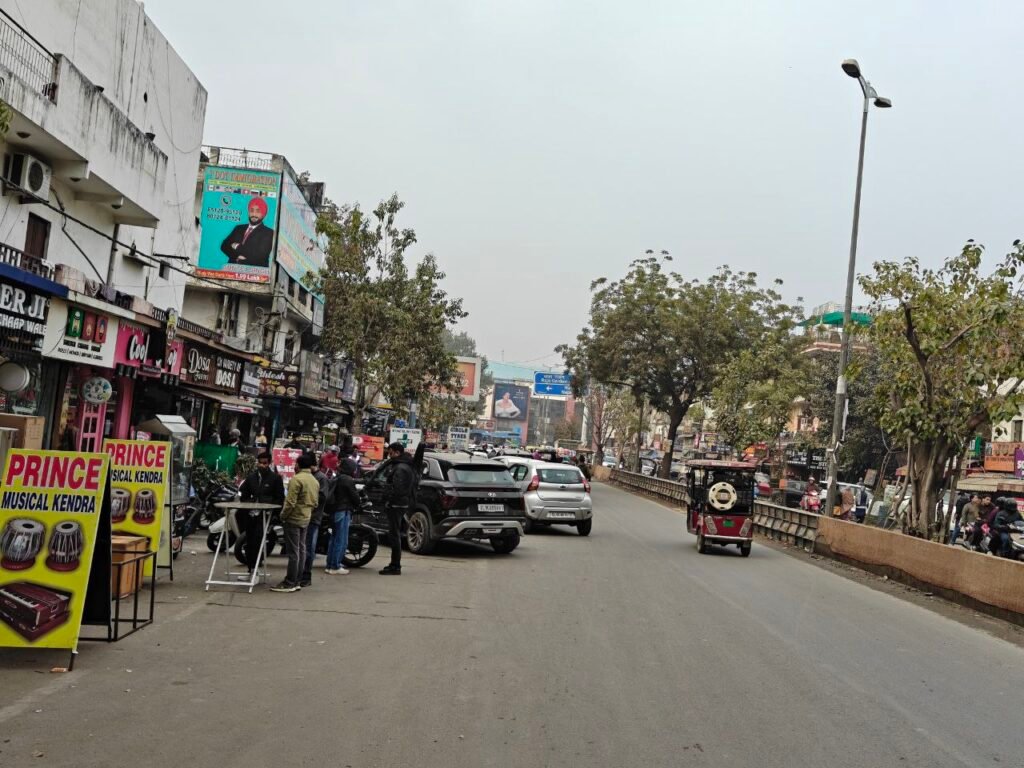
Stretching nearly 2 kilometres between Hari Nagar and Tilak Nagar, Jail Road is one of West Delhi’s most active and complex urban corridors. With a Right of Way (ROW) of approximately 45 metres, the street performs multiple roles simultaneously: a budget-friendly commercial high street, a cultural and religious spine, a commuter artery, and the threshold to dense residential neighbourhoods. It is a street that overperforms every day—often without the spatial support it needs.
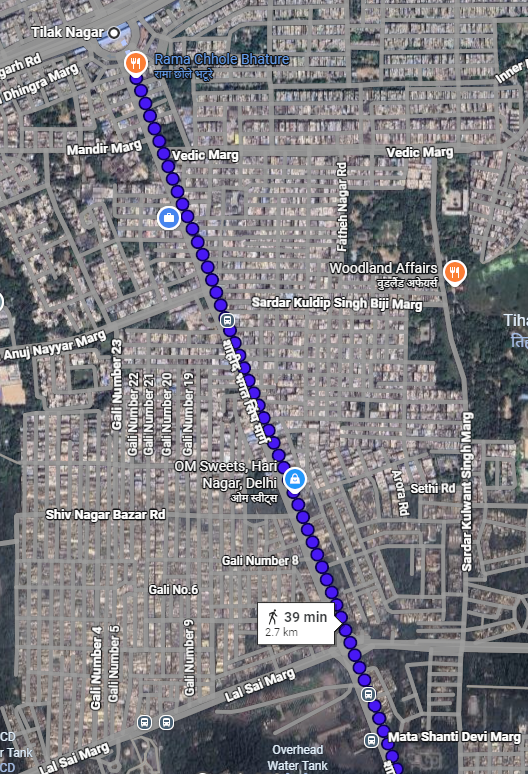
Widely known across the city as an affordable market hub, this stretch is particularly famous for furniture, mattresses, curtains, upholstery, and wedding-related shopping. A continuous ribbon of showrooms lines the main road, offering bedroom sets, sofas, wardrobes, drapery, décor items, and seasonal furnishings that cater largely to middle-income households. The market remains open six days a week, closing only on Wednesdays, and draws shoppers from across West and South-West Delhi. Its success is closely tied to strong connectivity—frequent buses, autos, e-rickshaws, and proximity to the Blue Line metro ensure a steady, all-day footfall, with evenings and weekends seeing peak pedestrian density.
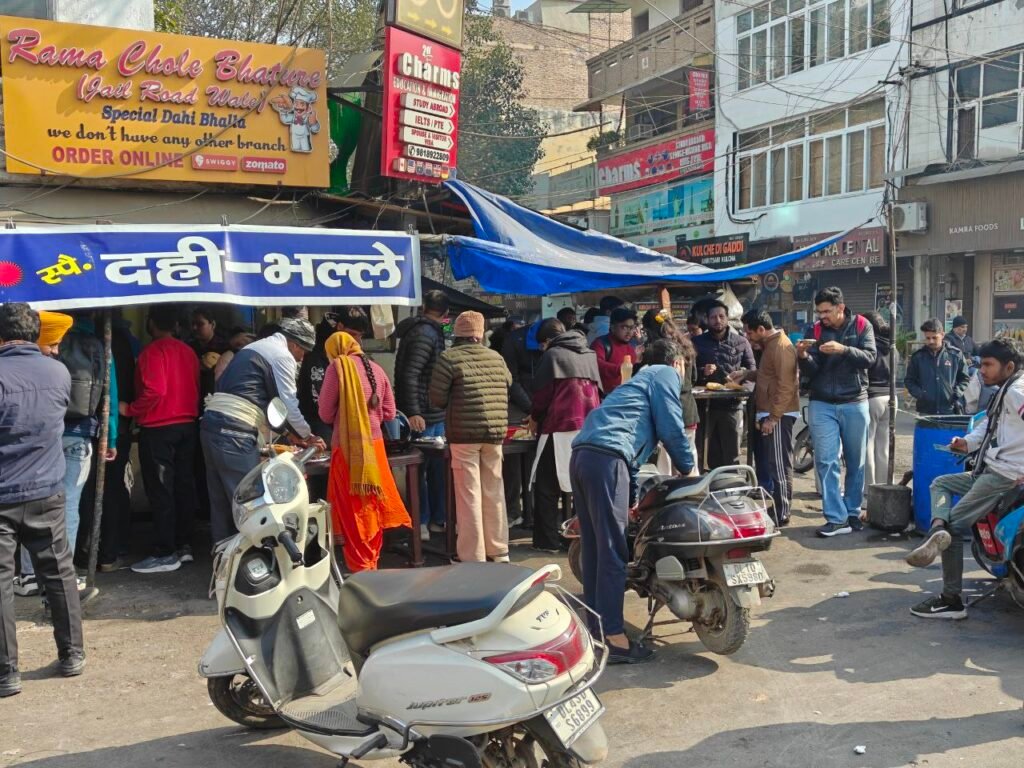
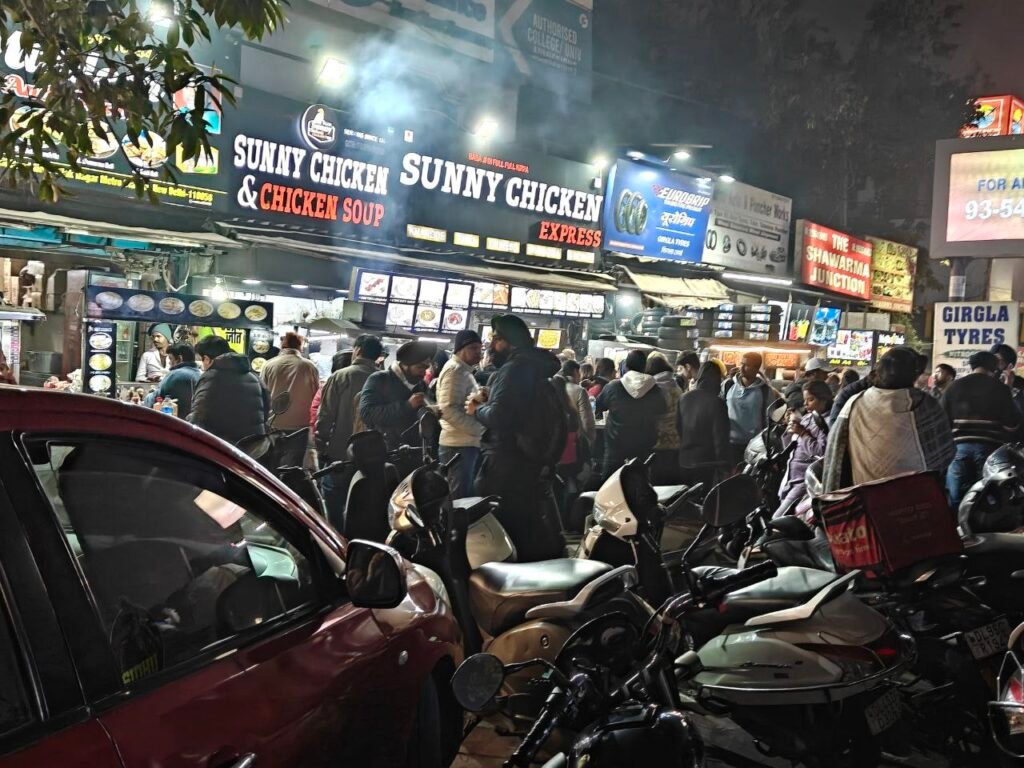
Interwoven with this furniture-and-home economy is a vibrant layer of everyday retail and food culture. Mobile phone outlets, instrument shops, ice-cream corners, and popular eateries such as Sunny Chicken, Ramaji Chole, Om Sweets, Dosa Fusion, and Wah Veer Ji animate the street edge. Banks, grocery stores, educational centres, branded and unbranded garment shops further reinforce Jail Road’s role as a daily-use market rather than a destination mall—functional, crowded, and deeply embedded in neighbourhood life.
Just one plot deep behind this commercial frontage, the urban grain shifts dramatically. The street gives way to high-density residential areas, largely comprising Sikh and Hindu middle-income families. Plot sizes typically range between 100 and 200 square yards, creating compact neighbourhoods that depend heavily on Jail Road for employment, shopping, education, and social interaction. In this sense, the corridor acts as both a marketplace and a communal front yard for the surrounding colonies.
The road’s strategic importance extends beyond commerce. It serves as a key connector linking Central and South Delhi with West Delhi, carries traffic towards the Hari Nagar Depot, and runs along the edge of the Tihar Jail precinct. This results in an intense mix of through traffic, local vehicles, loading and unloading activity, and pedestrian movement—often competing for the same limited surface.
A Street Under Spatial Stress
Despite its generous ROW on paper, Jail Road feels perpetually congested. The issue is not width alone, but lack of spatial organisation. Continuous pedestrian infrastructure is largely absent. Footpaths, where they exist, are frequently encroached upon by shop displays, signage, temporary counters, and parked two-wheelers. Furniture and mattress showrooms extend products onto the street edge to attract customers, while food outlets spill outward to accommodate demand. These encroachments are not incidental—they are part of the street’s informal economic logic, where visibility equals survival.
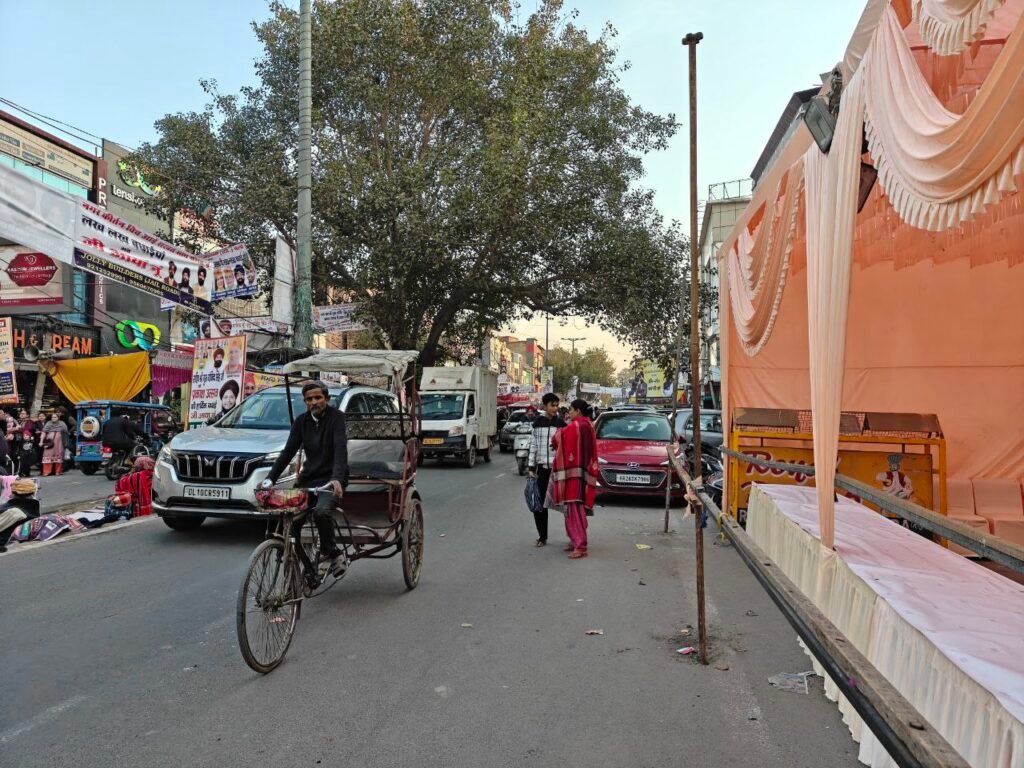
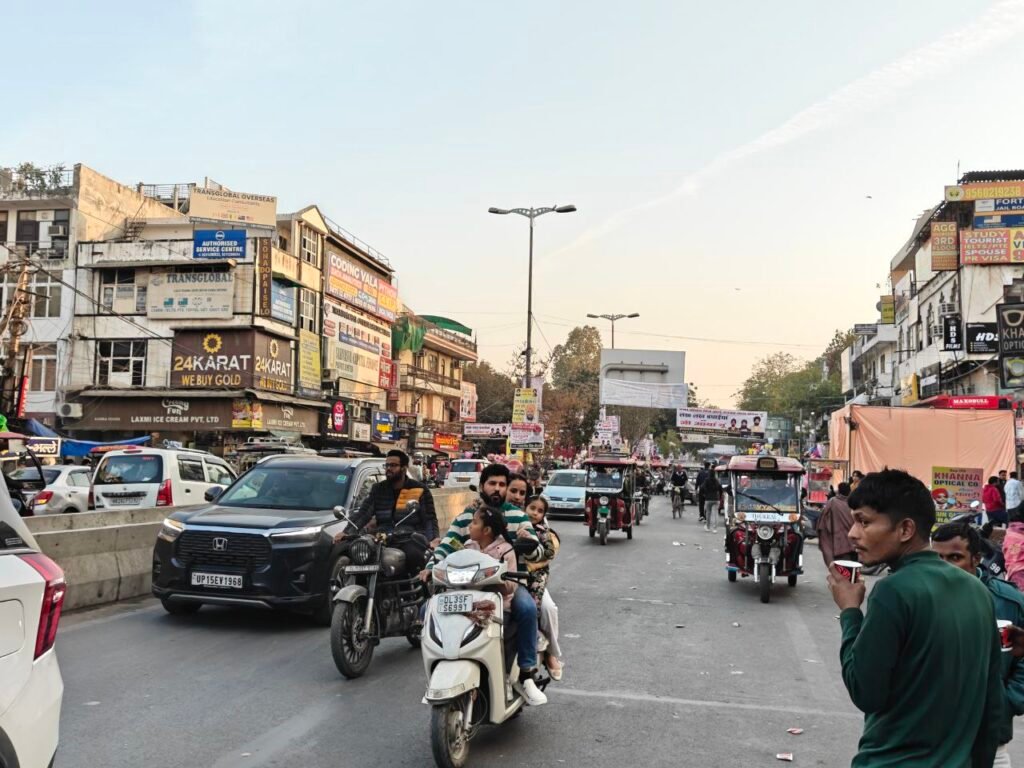
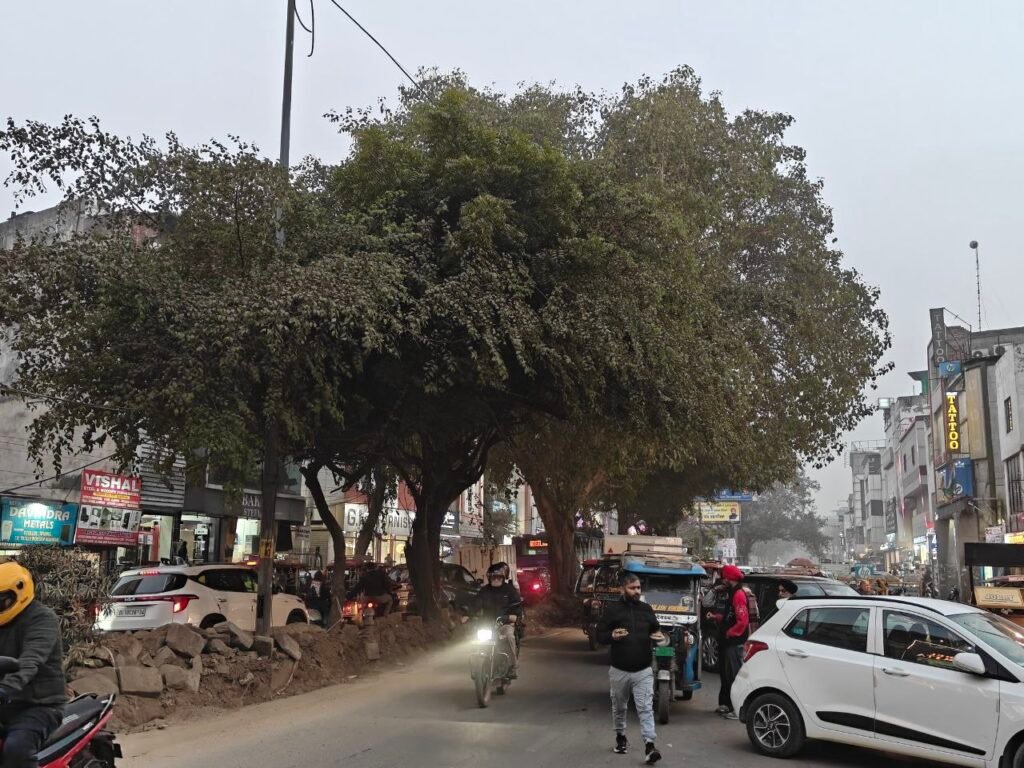
Parking remains entirely opportunistic. Cars, two-wheelers, delivery vehicles, and autos occupy any available edge, blurring the boundary between movement and pause. Pedestrians—shoppers, schoolchildren, elderly residents, and daily commuters—are pushed into the carriageway, turning routine activities into constant negotiations with traffic.
Culture as a Transformative Urban Force
On Tuesdays, and during major Sikh festivals, Jail Road undergoes a profound transformation. Devotees visiting the Gurudwara arrive in large numbers to fulfil vows, and religious occasions convert the street into a cultural event corridor. Nagar kirtans, langar distribution, and processions temporarily override traffic hierarchies. For these moments, the street prioritises community, faith, and generosity over vehicles.
These periodic transformations reveal a critical insight: Jail Road already functions as a shared street, capable of adapting to different users and meanings. What it lacks is design intent to support this coexistence safely and equitably on an everyday basis.
An Urban Design Opportunity
From an urban design perspective, Jail Road is not a failed street—it is an unfinished one. Its width allows for reimagining: continuous and shaded pedestrian paths, organised on-street parking bays, designated vending and spill-out zones, safer crossings near religious and transit nodes, and clearly defined loading areas for commercial activity. Rather than eliminating informality, design can structure it, giving legitimacy to street life while restoring safety and dignity to pedestrians.
Equally important is acknowledging the street’s cultural calendar. Flexible infrastructure—removable bollards, festival-ready open pockets, and adaptable carriageway sections—could allow Jail Road to seamlessly shift between a movement corridor and a community street.
Jail Road is a living archive of West Delhi’s urban life. It carries commuters, sustains livelihoods, supports dense neighbourhoods, and hosts faith-driven collective rituals—all within a single 2-kilometre stretch. To redesign it is not to sanitise it, but to recognise its layered complexity and give spatial form to the roles it already performs. With thoughtful intervention, Jail Road can evolve from a congested arterial road into a model of an inclusive, culturally responsive urban street.
Also Read: Heritage Streets of Amritsar: History, Urban Planning, and the Living Fabric of the Walled City