

Experts at World Habitat Day 2026 highlight regulatory reforms, public-private partnerships and planned workforce housing as key to making rental accommodation affordable, accessible and dignified.

India’s rapidly urbanising cities need housing solutions that extend beyond home ownership. For migrant workers, students, working women and other mobile populations, rental accommodation is often the most practical option. Yet, limited formal rental supply, high costs, regulatory uncertainty and a lack of trust between landlords and tenants continue to constrain the sector.
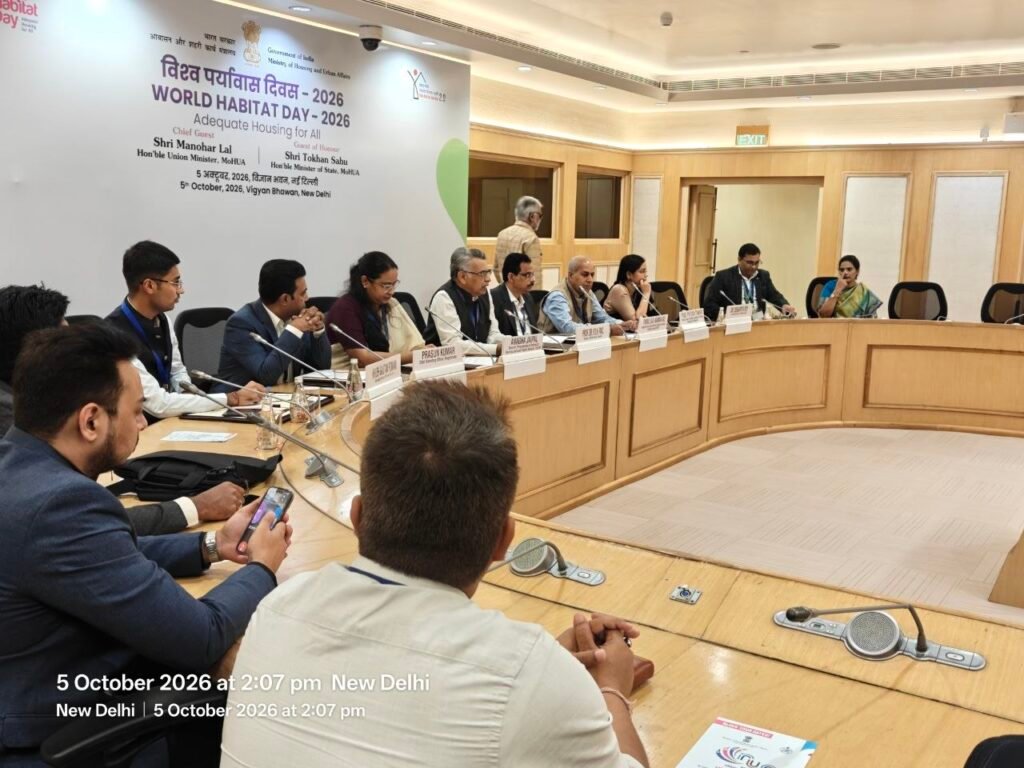
These challenges were discussed during the technical session, “Structural Challenges and Enabling Measures for Unlocking the Potential of Rental Housing,” organised as part of the Ministry of Housing and Urban Affairs’ (MoHUA) World Habitat Day 2026 celebrations on October 5. Held under the theme “Adequate Housing for All,” the session brought together researchers, policymakers, industry representatives and housing rights advocates to examine how India can build a more inclusive and efficient rental housing ecosystem.
The panel included Dr. Debarpita Roy, Lead Researcher at the Centre for Public Policy and Housing, National Institute of Urban Affairs (NIUA); S. A. Raman, Managing Director of the State Industries Promotion Corporation of Tamil Nadu (SIPCOT); Professor Piyush Tiwari of the University of Melbourne; Kusum Gautam Pomani, Director of SPR India; Anagar Jaypal, Director of the Housing and Land Rights Network (HLRN); and Prasoon Kumar, Chief Marketing Officer of Magicbricks. The session was moderated by Professor PSN Rao, who introduced the discussion by highlighting the largely informal nature of India’s rental market and the need for a more structured system.
An Ownership-Centric Housing System
Dr. Debarpita Roy highlighted the scale of India’s future housing requirements and the need to recognise rental housing as an essential component of urban development. An indicative estimate discussed during the session suggested that India could require approximately 74 million houses by 2047, with a substantial share potentially needed for rental purposes.
Despite this demand, housing policies and market practices have traditionally placed greater emphasis on ownership. Rental housing remains less developed in many cities, particularly for lower-income households, who often have limited access to secure and affordable accommodation near employment centres.
The discussion also pointed to a mismatch between housing availability and actual needs. Vacant housing can coexist with inadequate rental supply because properties may be unsuitable, unaffordable, poorly located or withheld from the rental market due to concerns about tenant disputes and property management.
Roy highlighted the importance of reliable data, stronger institutions and targeted policy interventions to understand demand and encourage the development of rental housing across income groups.
Regulatory Uncertainty and Lack of Trust
Professor Piyush Tiwari examined rental housing through an international perspective, drawing attention to the financial and regulatory factors that influence investment. He noted that lengthy approval procedures, uncertain rules and the fiscal treatment of rental income can discourage the development of professionally managed rental properties.
In India, informal arrangements and the absence of written rental agreements can leave both landlords and tenants vulnerable. Landlords may worry about recovering possession or dealing with disputes, while tenants may face insecure tenure, sudden rent changes or inadequate housing conditions.
The Model Tenancy Act, introduced in 2021, was discussed as an important step towards creating a more structured relationship between landlords and tenants. However, effective implementation across states remains critical. A legal framework can only improve market confidence when its provisions are adopted, understood and supported by accessible dispute-resolution mechanisms.
The session emphasised that reforms must balance the legitimate interests of property owners with tenants’ need for security, fair treatment and affordable accommodation. Clear contracts, predictable procedures and timely resolution of disputes could help bring more housing into the formal rental market.
Planned Housing for Industrial Workers
The experience of Tamil Nadu offered a practical example of how rental housing can be linked with employment and industrial development. S. A. Raman discussed the role of the State Industries Promotion Corporation of Tamil Nadu (SIPCOT) in facilitating worker accommodation near industrial areas.
One example is the facility developed with Foxconn at SIPCOT Industrial Park in Vallam Vadagal, Kancheepuram, designed to accommodate 18,720 women workers. The project illustrates how planned housing with supporting amenities can address the accommodation needs of a large industrial workforce.
Such initiatives can reduce the distance between homes and workplaces, ease commuting pressures and improve access to safer accommodation, particularly for women employed in manufacturing. They also demonstrate why housing should be considered part of industrial infrastructure rather than treated as a separate concern.
The discussion underlined the potential for governments, industrial operators and private developers to work together on similar projects. Replication, however, would require suitable land, reliable infrastructure, viable financing and long-term management arrangements.
Mobilising Private Investment
Kusum Gautam Pomani highlighted the role of private operators in expanding rental housing supply. Developers and investors need predictable policies, appropriate incentives and viable business models to commit capital to projects that may deliver returns over a longer period.
Long-term government land leases, including models discussed during the session, could help reduce upfront land costs and support professionally managed rental developments. However, investment models must account for construction costs, maintenance, occupancy levels and the ability of target households to pay.
Rental housing also requires a shift from a project-delivery approach to long-term asset management. Well-maintained buildings, transparent charges, safety provisions and responsive management are essential to sustaining occupancy and ensuring that housing remains suitable for residents.
Public-private partnerships could support this transition, provided that affordability obligations and service standards are clearly defined. Public support should help address market gaps without making housing financially inaccessible to the people it is intended to serve.
Technology and a More Transparent Market
Prasoon Kumar highlighted the potential of digital platforms to improve information access and trust in the rental market. Technology can help prospective tenants discover available properties, compare rents and locations, and access clearer information before entering into an agreement.
For landlords and property managers, digital systems can simplify listing, communication and routine management. Better information could also reduce the gap between the supply of vacant properties and the needs of people seeking accommodation.
However, digital platforms alone cannot resolve structural problems such as high rents, inadequate supply or insecure tenure. Their impact will depend on reliable listings, transparent pricing, safeguards against misleading information and wider access to digital services.
A more organised rental market would require technology to work alongside legal reform, professional property management and accessible grievance-redressal systems.
Housing as a Continuum of Options
Anagar Jaypal stressed the importance of viewing housing needs across a continuum, from emergency and transitional accommodation to hostels, affordable rentals and more permanent housing options. Different groups have different requirements, and a single housing model cannot address every situation.
For migrant workers, students and working women, safe and affordable rental accommodation near jobs, educational institutions and public transport can be particularly important. Housing programmes must therefore consider not only the number of units delivered but also location, access to services, safety and affordability.
The discussion reinforced the need to treat adequate housing as a question of dignity and inclusion. A house may be physically available, but it does not meet residents’ needs if it is unaffordable, inaccessible or disconnected from livelihood opportunities.
From Policy to Implementation
The session pointed towards a coordinated approach involving central and state governments, urban local bodies, researchers, financial institutions, developers and technology providers. Key priorities include simplifying approvals, improving rental data, strengthening tenancy frameworks, expanding planned worker housing and creating predictable conditions for private investment.
India’s rental housing challenge is not merely about constructing more units. It is about creating a system in which suitable homes are available where people need them, at prices they can afford, with reliable management and reasonable security for both tenants and landlords.
As cities continue to attract workers, students and new residents, rental housing will become increasingly important to urban mobility and economic growth. Turning this potential into reality will depend on consistent implementation, viable investment models and a clear commitment to affordable, safe and dignified housing.
TheAPN attended this event in person. The coverage distils the principal ideas and deliberations for the benefit of a wider public audience.
Join our WhatsApp Channel for fastest updates: Join now