

New Delhi: Shri Rajiv Gauba, Member of NITI Aayog, has called for comprehensive reforms in urban governance, planning and municipal financing, emphasising that cities must have greater autonomy and institutional capacity to address local needs. Speaking at the valedictory session of the 2nd National Urban Conclave, he stated that “We can’t run cities from state capitals” and stressed that empowered city governments are essential to achieving the vision of Viksit Bharat @ 2047.
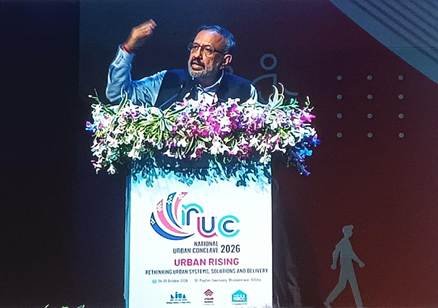
Highlighting India’s ongoing urban transition, Gauba noted that the country’s urban population is projected to increase from approximately 50 crore at present to 85 crore by 2050, with nearly half of the population expected to live in urban areas. He emphasised that meeting the growing demand for infrastructure, housing and basic services requires a fundamental shift in how cities are planned, governed and financed.
Describing cities as key centres of economic growth, where talent, capital and ideas converge, Gauba acknowledged the expansion of urban-sector investment through initiatives such as the Smart Cities Mission, AMRUT, Pradhan Mantri Awas Yojana, Swachh Bharat Mission and the Urban Livelihoods Mission. He noted that the budgetary outlay for the urban sector has increased tenfold, while approximately ₹3.7 lakh crore has been invested in metro rail and bus systems.
He also highlighted NITI Aayog’s Growth Hub initiative, including the ₹1 lakh crore Urban Challenge Fund announced in the Union Budget 2025–26 and an allocation of ₹5,000 crore each for seven city economic regions over five years.
Strengthening Municipal Governance and Finance
Gauba underscored the need to strengthen urban local bodies and improve citizen participation in municipal decision-making. Referring to the report Moving Towards Effective City Governance, jointly developed by NITI Aayog and the Ministry of Housing and Urban Affairs (MoHUA), he called for directly elected mayors with five-year terms, the introduction of a Mayor-in-Council system and timely municipal elections.
He urged states to devolve all 18 functions to urban local bodies in accordance with the 74th Constitutional Amendment, including master planning, water supply, fire services and traffic management. According to him, municipal governments must possess the authority and institutional capacity to respond effectively to local requirements.
Addressing municipal finances, Gauba highlighted the need to improve property tax collection and user-charge recovery. He also stressed that states must ensure adequate financial transfers to urban local bodies and regularly constitute State Finance Commissions to strengthen municipal revenue systems.
Planning Reforms and Affordable Housing
On urban planning, Gauba called for an overhaul of existing planning frameworks, particularly restrictive Floor Area Ratios (FAR) and building norms that limit land supply and increase costs for residential and commercial development.
He advocated mixed-use zoning, development around transit hubs and land pooling to improve land availability and reduce costs for housing and economic activities. These measures, he noted, are important for creating more accessible and economically productive urban environments.
Gauba also highlighted the need to expand affordable rental housing for migrant workers, industrial labourers, students and young professionals. He urged states to adopt the Model Tenancy Act to encourage greater availability of rental accommodation.
States Urged to Implement Reforms
Concluding his address, Gauba called on states to introduce new Municipal Acts to implement the proposed governance and planning reforms. He also urged MoHUA to link support under urban missions with the implementation of these reforms.
He emphasised that empowered city governments, stronger municipal finances and more responsive urban planning systems are essential to unlocking India’s urban growth potential and advancing the vision of Viksit States and Viksit Bharat.
Also Read: National Urban Conclave 2026 Concludes with Key Recommendations for Urban Governance and Planning
Join our WhatsApp Channel for fastest updates: Join now