Indian Railways has approved the construction of a 38.21-km new rail line between Mukutban in Adilabad and Gadchandur, under South Central Railway, at an estimated cost of ₹493 crore. The project is aimed at strengthening regional rail connectivity while improving the movement of passengers and freight across important industrial and mining areas of Maharashtra.
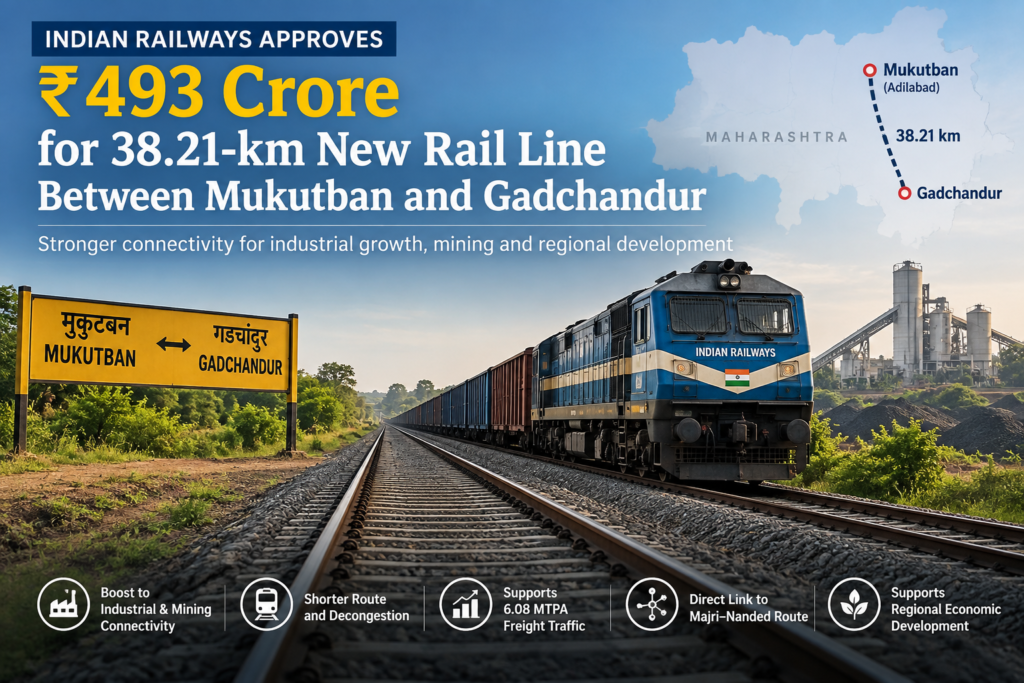
Boost to Industrial and Mining Connectivity
Mukutban in Yavatmal district and Gadchandur in Chandrapur district are significant industrial and mining centres, with several cement plants, coal mines operated by Western Coalfields Ltd. and nearby limestone mines.
The new rail line is expected to provide stronger rail connectivity to these industrial clusters and facilitate more efficient transportation of freight, including raw materials and finished industrial products.
Shorter Route and Decongestion of Existing Network
According to the project details, the new line will offer a shorter and more efficient rail route, reducing travel distance, transportation time and associated costs. It will also provide an alternative route to the existing Wardha–Manikgarh section, helping decongest the network and facilitate smoother freight movement.
The Detailed Project Report estimates that the corridor could support approximately 6.08 million tonnes per annum (MTPA) of freight traffic after commissioning. The project is also expected to facilitate the operation of two MEMU trains in each direction per day.
Connectivity to Major Destinations
The new rail line will establish direct connectivity between the coal and cement industrial cluster and the Majri–Nanded route. This is expected to shorten rail leads for coal, cement and RMSP traffic heading towards Jalna, Parbhani, Chhatrapati Sambhajinagar and other destinations in Maharashtra and Karnataka.
The anticipated freight basket includes coal and coke, cement, sponge iron, metal scrap, iron and steel, fertilisers and foodgrains, among other commodities.
Reducing Dependence on the Balharshah–Nagpur Route
The project is also intended to reduce dependence on the congested Balharshah–Nagpur High-Density Network (HDN) route. At the same time, it will improve rail connectivity in relatively less-connected areas of Yavatmal and Chandrapur districts.
By adding a new rail corridor, the project is expected to increase network capacity, support the movement of essential commodities and accommodate growing freight and passenger requirements. The enhanced connectivity is also expected to support industrial activity and regional economic development.
Also Read: Ganesh Utsav and the Indian City: When Faith Reshapes Urban Space
Join our WhatsApp Channel for fastest updates: Join now