

The Delhi Urban Shelter Improvement Board (DUSIB) has initiated a major rehabilitation plan to relocate 11 slum clusters across the capital to facilitate key infrastructure and redevelopment projects. According to government officials, around 2,236 households are expected to be shifted under the initiative, with eligible residents being allotted Economically Weaker Section (EWS) flats at Sawda Ghevra in northwest Delhi.
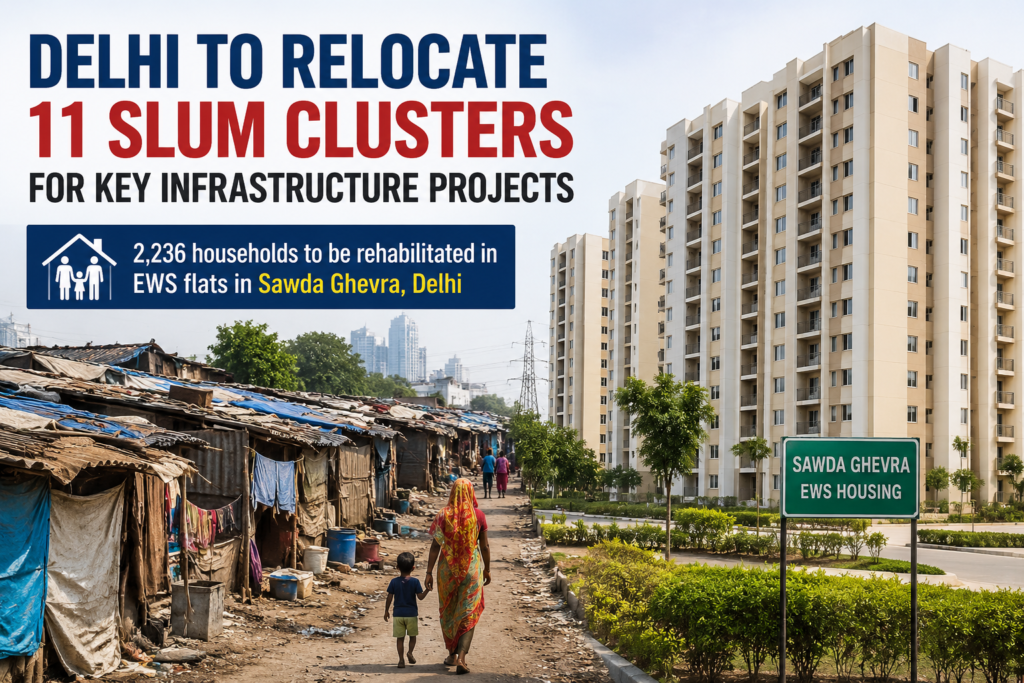
The identified clusters include settlements located at Tughlaqabad, Jahangirpuri, RK Puram, Maulana Azad Medical College campus, Lok Nayak Hospital, and camps near Race Course Road. Authorities stated that these locations are occupying land required for public projects and institutional development works.
Officials said the rehabilitation process will depend on the payment of relocation charges by the respective land-owning agencies. A substantial portion of the settlements are situated on land belonging to agencies such as the Land and Development Office (L&DO), Maulana Azad Medical College (MAMC), IIT Delhi, DMRC, MCD, and the Container Corporation of India. DUSIB has reportedly demanded ₹94 crore for rehabilitation linked to MAMC land and ₹23.15 crore for settlements on IIT Delhi land in RK Puram.
The development follows earlier approval for the rehabilitation of three slum clusters located near the Prime Minister’s residence area on Race Course Road. Around 717 EWS flats in Sawda Ghevra are being prepared for allotment under that project. Officials further informed that nearly 1,400 previously constructed JNNURM flats in Sawda Ghevra have now been made habitable after restoration efforts.
In addition to Sawda Ghevra, DUSIB is also repairing thousands of housing units in Sultanpuri, Dwarka Sector 16B, Jahangirpuri, and Bhalswa for future rehabilitation programmes.
However, the move has raised concerns among urban rights activists and social organisations. Experts working with economically weaker communities have criticised the relocation to faraway locations like Sawda Ghevra, arguing that it affects access to livelihoods, schools, and daily commuting. Activists also pointed out that earlier rehabilitation guidelines emphasised relocation within nearby areas to minimise social and economic disruption for affected families.
Also Read: MCD Grants Urban Status to 48 Villages, Boosting Planned Development Across Delhi
Join our WhatsApp Channel for fastest updates: Join now