

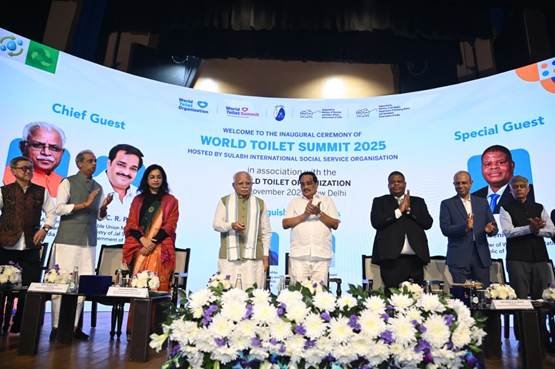
New Delhi: India marked World Toilet Day 2025 with the theme “Sanitation: Collective Responsibility for Dignity and Planet”, reflecting the nation’s commitment to integrating cleanliness, dignity, sustainability, and climate resilience into its sanitation agenda. The three-day World Toilet Summit 2025, jointly hosted by Sulabh International and the World Toilet Organization, began in New Delhi in the presence of Union Minister for Housing & Urban Affairs Shri Manohar Lal, Union Minister for Jal Shakti Shri C.R. Patil, and international delegates from 25 countries.
India’s Achievements in Sanitation
Since the launch of the Swachh Bharat Mission in 2014, India has achieved remarkable progress in sanitation. The country was declared Open Defecation Free (ODF) in 2019, following large-scale construction of household toilets that enhanced safety, health, and dignity—particularly for women and children.
The 2024 Joint Monitoring Programme (JMP) Report by WHO and UNICEF highlights that 55 million urban residents in India have gained access to safely managed sanitation facilities in just two years, contributing significantly to lower infant and under-five mortality rates.
SBM-U 2.0: A New Phase in Urban Sanitation
Under Swachh Bharat Mission–Urban (SBM-U 2.0), India has advanced from ODF to ODF++, focusing on safe sanitation and faecal sludge management. The mission prioritises the expansion of public toilet infrastructure in high-footfall and tourism areas, encouraging cities to develop “Aspirational Toilets” equipped with:
- Smart technology and user-friendly designs
- Accessible and inclusive facilities
- Gender-neutral and child-friendly features
- Environmentally sustainable systems
So far, 29,000 Aspirational Toilet seats have been approved under SBM-U 2.0.
Startups and innovators are also being integrated through initiatives like the Swachhata Startup Challenge and the Toilet Design Challenge, promoting climate-resilient and sustainable sanitation solutions. MoHUA has signed key MoUs with HUL and Sulabh International to scale PPP-based toilet development and maintenance.
World Toilet Summit 2025 Highlights
Speaking at the summit, Shri Manohar Lal emphasised global collaboration in driving sanitation improvements. “Cleanliness is not judged by a tidy home but by the condition of one’s toilet,” he said, urging accelerated wastewater treatment, behavioural change, and circular sanitation solutions.
Shri C.R. Patil highlighted the transformative impact of sanitation infrastructure on women’s dignity. He noted that 12 crore toilets built in rural India have prevented lakhs of child deaths caused by diarrhoeal diseases.
New National Initiatives Launched
To commemorate the day, MoHUA launched:
- “Toilet Paas Hai”
- “Main Saaf Hi Achha Hoon”
These year-long advocacy campaigns aim to promote responsible toilet use and hygiene behaviours. Additional advisories and training modules—including a specialised CT&PT Guide and child-focused Swachh Aadatein behavioural training—were also released.
Across the country, cities inaugurated new aspirational public toilets, including facilities in Indore and Lucknow, marking a collective step towards a cleaner, sustainable, and inclusive sanitation future.
Also Read: Waste to Wellness: India’s Sanitation Journey Strengthens Under Swachh Bharat Mission 2025