

Amid recurring incidents of urban flooding and landslides in several Indian cities during the monsoon, the Ministry of Housing and Urban Affairs (MoHUA) has clarified that the management of urban flooding, including the cleaning and desilting of drains, falls primarily under the jurisdiction of State Governments, Urban Local Bodies (ULBs), and Urban Development Authorities. The Central Government, it said, supports states through policy guidance, financial assistance, and technical interventions rather than direct implementation.
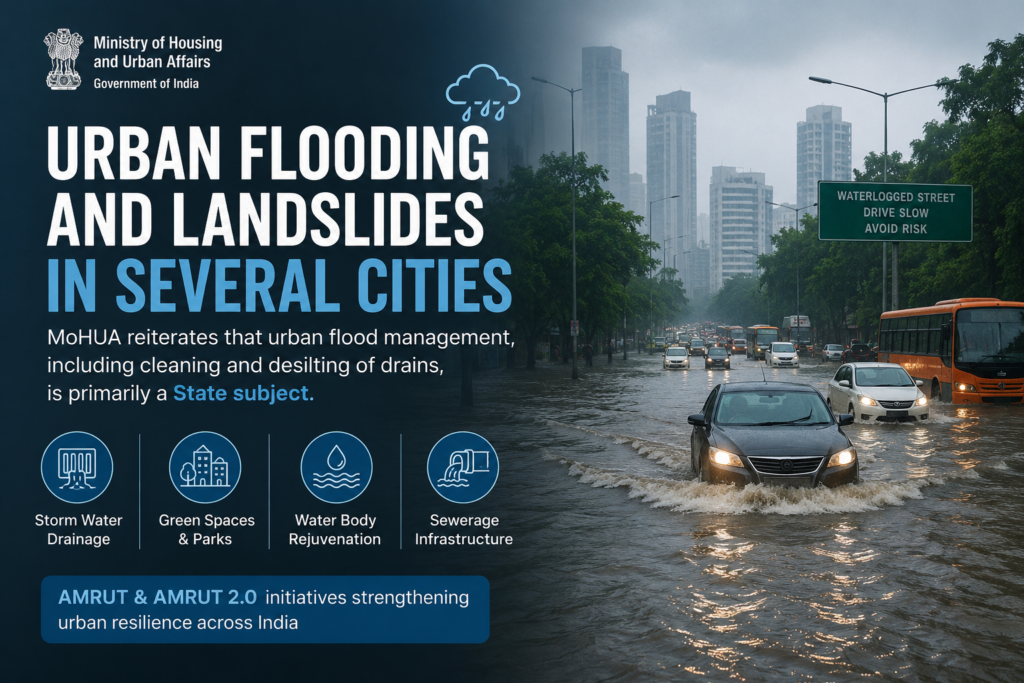
According to the Ministry, urban flooding is largely caused by high-intensity rainfall occurring within a short duration. However, the impact is often worsened by unplanned urban expansion, encroachment of natural water bodies, inadequate stormwater drainage systems, and insufficient sewer infrastructure. The Ministry also noted that pre-monsoon activities such as drain cleaning and desilting are the responsibility of local urban bodies, and data regarding funds allocated, released, or utilised for these activities is not maintained centrally.
To improve urban flood resilience, MoHUA has issued several policy documents and technical guidelines over the years. These include the Urban and Regional Development Plans Formulation and Implementation (URDPFI) Guidelines, 2014, the Standard Operating Procedure (SOP) for Urban Flooding, River-Centric Urban Planning Guidelines (2021), the Guidance Document on Creation of Rain Water Harvesting Parks, and the Manual on Storm Water Drainage System. These documents aim to strengthen urban planning, promote nature-based solutions, and improve stormwater management across Indian cities.
The Ministry highlighted the contribution of the Atal Mission for Rejuvenation and Urban Transformation (AMRUT) in addressing urban flooding. Since its launch in 2015, AMRUT has supported 838 stormwater drainage projects worth ₹3,022.39 crore across States and Union Territories. In addition, 2,522 green spaces and park projects worth ₹1,604.13 crore have been undertaken, resulting in the development of approximately 5,400 acres of permeable green spaces, which help improve rainwater absorption and reduce flooding risks.
Under AMRUT 2.0, the focus has expanded to include water body rejuvenation and the creation of additional green infrastructure. The Ministry stated that 2,951 water body rejuvenation projects worth ₹6,003.34 crore, covering around 1.21 lakh acres, and 1,649 green space and park projects worth ₹1,087.12 crore, covering approximately 12,750 acres, have been approved.
The Ministry also underscored the importance of improving sewerage infrastructure to support efficient stormwater evacuation. Under the original AMRUT programme, 888 sewerage and septage management projects have been implemented, creating nearly 22,539 kilometres of sewer network. Under AMRUT 2.0, States and Union Territories have undertaken 605 additional sewerage and septage management projects, covering 40,021 kilometres of sewer network.
The information was provided by Minister of State for Housing and Urban Affairs Shri Tokhan Sahu in a written reply in the Rajya Sabha, reiterating that while the Centre continues to strengthen the urban planning ecosystem through advisory and financial support, the day-to-day responsibility for flood prevention and drainage maintenance remains with State Governments and Urban Local Bodies.
Join our WhatsApp Channel for fastest updates: Join now