

The Union Minister for Environment, Forest and Climate Change, Bhupender Yadav, on Monday chaired a high-level review meeting to assess Delhi Air Pollution action plan for tackling air pollution, underlining the need for long-term, coordinated interventions across the National Capital Region (NCR) rather than short-term remedial measures. The meeting was part of the Centre’s annual review mechanism to evaluate progress and strengthen implementation of pollution control strategies.
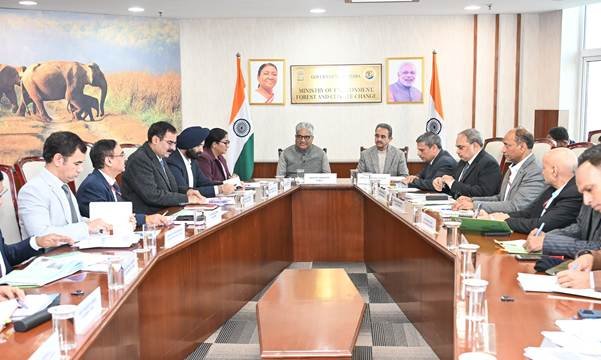
The review was attended by Delhi Chief Minister Rekha Gupta, Union Minister of State for Environment Kirti Vardhan Singh, Delhi Environment Minister Manjinder Singh Sirsa, and senior officials from the Ministry of Environment, Forest and Climate Change (MoEFCC) and the Government of NCT of Delhi.
During the meeting, the Union Minister recalled the enactment of a dedicated law in 2021 and the establishment of the Commission for Air Quality Management (CAQM) to address the region’s complex airshed dynamics. He noted that air pollution in Delhi-NCR is influenced by both anthropogenic activities and meteorological conditions, making sustained policy reforms essential for lasting improvement.
On vehicular emissions, the Minister emphasised smart traffic management at 62 identified congestion hotspots, strict action against polluting vehicles, and wider deployment of Automatic Number Plate Recognition (ANPR) systems at border entry points. Measures such as staggered office timings, incentives for electric vehicles, rapid expansion of charging infrastructure, congestion pricing, smart parking systems, and a uniform vehicle registration framework for NCR were discussed. Public participation and behavioural change were highlighted as critical enablers of these initiatives.
Reviewing industrial pollution control, officials informed that 227 of the 240 industrial estates in the NCR have transitioned to PNG. However, unplanned industrial activities outside designated estates remain a concern. The Minister directed strict enforcement against non-conforming units, including sealing where required. The Central Pollution Control Board has issued notices to 88 units that have not installed Online Continuous Emission Monitoring Systems (OCEMS), with closure actions scheduled to begin from 23 January 2026.
Also Read: Union Environment Minister Reviews Rajasthan and Punjab Action Plans to Curb Delhi-NCR Air Pollution
Construction and demolition (C&D) waste management was another key focus area, with directions issued for identifying dedicated C&D waste sites, restricting demolition activities during peak pollution periods, and ensuring scientific recycling through authorised agencies. A C&D waste processing plant at Tehkhand is expected to become operational within the year. Progress on flue gas desulphurisation (FGD) installations in thermal power plants within a 10 km radius of Delhi and mandatory crop residue co-firing was also reviewed.
To address road dust and PM10 pollution, the Minister called for end-to-end paving, large-scale plantation of local shrub species, and greening drives involving youth organisations. Over 3,300 km of roads in Delhi are planned for redevelopment in the coming year, integrating dust control and traffic management. Mechanised road sweeping machines operating without diesel, handheld vacuum systems for smaller roads, and stricter accountability for road maintenance were also proposed.
Strengthening public transport emerged as a central strategy, with accelerated expansion of the Delhi Metro and city bus services. Under the ongoing bus augmentation plan, orders have been placed for 3,350 electric buses, which will be integrated with the Metro network to improve last-mile connectivity. Pilot integration of e-autos, bike taxis, and feeder services at major Metro stations is planned by the end of January 2026.
The meeting also reviewed progress on legacy waste remediation at Okhla, Bhalswa, and Ghazipur landfill sites, along with plans to expand waste processing and waste-to-energy infrastructure. CAQM informed that a scientific source apportionment study has been initiated from January 2026 through institutions including TERI and IIT Delhi. Officials noted that, excluding the COVID-19 lockdown year, 2025 recorded the best air quality levels since 2018, reflecting steady improvement in NCR’s air quality.
The review concluded with a call for intensified public awareness campaigns and coordinated, target-based action by all NCR governments, with an expected 15–20 percent improvement in Air Quality Index levels by the end of the year.
Also Read: CAQM Inspects 142 Noida Roads; Majority Found with Low or No Visible Dust