

India records strong research performance, with 27 universities ranking among Asia’s top 50 for Papers per Faculty and 15 institutions sharing the top position in the Staff with PhD category.
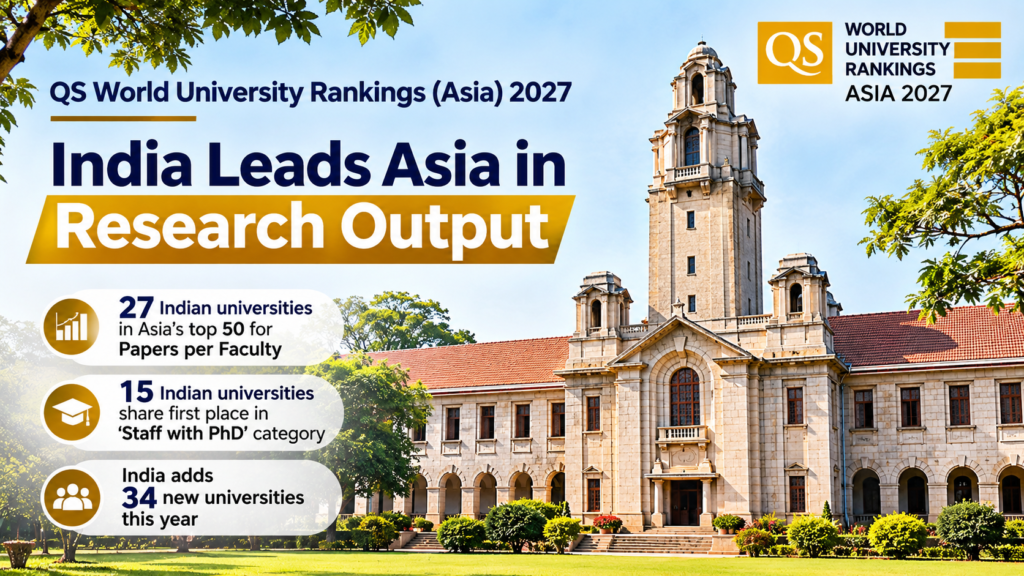
India has strengthened its position in Asia’s higher education and research landscape, emerging as the regional leader in research output per faculty member, according to the QS World University Rankings (Asia) 2027, released by Quacquarelli Symonds (QS) on November 3, 2026.
The latest rankings highlight India’s growing research capacity, with the country remaining Asia’s second most represented higher education system and adding 34 new institutions to this year’s list. India has also demonstrated strong performance in research productivity and the availability of doctoral-qualified academic staff.
Indian Universities Lead in Research Output
According to the QS report, India leads Asia in the number of universities performing strongly in the ‘Papers per Faculty’ indicator, which measures research publications relative to academic staff strength.
A total of 27 Indian universities feature among Asia’s top 50 in this category, including five institutions in the top 10. This is the highest representation by any higher education system in the region, followed by Mainland China with three universities in the top 10.
The five Indian institutions featured in Asia’s top 10 for Papers per Faculty are:
- Indian Institute of Science (IISc), Bengaluru – Rank 1 (Score: 100)
- Indian Institute of Technology Madras (IIT Madras) – Rank 3 (Score: 100)
- Indian Institute of Technology Delhi (IIT Delhi) – Rank 7 (Score: 100)
- Indian Institute of Technology Roorkee (IIT Roorkee) – Rank 8 (Score: 100)
- Indian Institute of Technology Ropar (IIT Ropar) – Rank 9 (Score: 100)
Strong Performance in Doctoral-Qualified Faculty
India has also demonstrated significant strength in the ‘Staff with PhD’ category, with 15 Indian universities sharing the first position. This number is more than double the total recorded by the next strongest-performing higher education system, Iran.
Furthermore, Indian institutions account for 47 of Asia’s top 100 universities in this indicator, a substantial increase from 16 institutions in 2018. The findings underline the growing capacity of Indian universities to develop advanced academic and research infrastructure.
Research Reforms and Institutional Support
The QS report attributes India’s growing research performance partly to policy initiatives aimed at strengthening the country’s higher education and research ecosystem.
The National Education Policy (NEP) 2020 placed research at the centre of higher education reforms. Additionally, the establishment of the Anusandhan National Research Foundation (ANRF) in 2024 has been aimed at expanding research capacity, connecting established and emerging institutions, and encouraging greater private-sector participation.
The report also highlights the ₹1 lakh crore research and development fund announced in 2025 as part of efforts to strengthen the country’s research and innovation ecosystem.
Research Impact Remains a Key Challenge
Despite India’s strong performance in research output per faculty member, the QS report identifies research impact as an area requiring further improvement.
India has only three universities among Asia’s top 50 in the ‘Citations per Paper’ category, an indicator that measures the citation impact of published research. This suggests that while Indian universities are increasing their research productivity, improving the global influence, visibility and academic impact of their research remains an important priority.
The QS World University Rankings (Asia) 2027 highlight India’s expanding research capabilities and growing institutional presence across the region. However, the findings also point towards the need to translate increased research output into greater academic impact and international recognition.
Also Read: India Today Rankings 2026: Top 5 Architecture Colleges in India Announced
Join our WhatsApp Channel for fastest updates: Join now