

About the author Ashok Kumar Jain, former Commissioner (Planning), Delhi Development Authority, is one of India’s most distinguished urban planners, architects, and policy thinkers whose work has significantly influenced the discourse on sustainable development, urban planning, and regional growth. With decades of professional experience in planning and governance, he has contributed extensively to shaping the urban vision of India through policy, research, and practice. He also served as a Member of the Committee of the Ministry of Housing and Urban Affairs on DDA 2015 and was associated with UN-Habitat from 2007 to 2012, reflecting his engagement with both national and global urban development initiatives.
His contributions to the field have been widely recognized through prestigious honours, including the Second Urban Professional Award presented at the World Urban Forum 2014, the IBC Lifetime Achievement Award 2024, the “Living Legend” recognition by the Indian Institute of Architects Northern Chapter in 2022, and the Lifetime Achievement Award by the Smart Habitat Foundation in 2022.
His books, Sustainable Rural Development and Agriculture and Mapping Delhi’s Past, Present and Future, reflect his deep understanding of the relationship between people, settlements, ecology, infrastructure, and governance. Through these works, A.K. Jain presents a comprehensive perspective on India’s developmental challenges and opportunities, combining historical understanding with forward-looking planning approaches. His writings continue to inspire architects, planners, policymakers, researchers, and students engaged in shaping inclusive and sustainable futures for cities and rural regions alike.
Sustainable Rural Development and Agriculture, Discovery Publishing House, New Delhi (2026)
P-304, ISBN 978-93-6224-221-1, Rs 4000/-
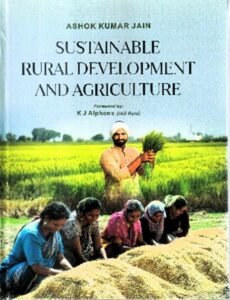
The book ‘Sustainable Rural Development and Agriculture’ in its 11 chapters covers Challenges of Rural Development, Sustainable and Climate Resilient Agriculture, Spatial Surveys, Mapping and Analytics. Rural Development Planning and Infrastructure, Rural Housing, Sustainable Energy, Sustainable Water Management, Biodiversity, Landscape and Urban Farming, Environmental Services, Conservation of Rural Heritage, and Disaster Resilience. A wide range of concepts have been explored in a simple language. The pragmatic examples provide reference points for understanding the nuts and bolts of the sustainable rural development and agriculture and how they will fit together.
As summed-up by K.J. Alphons in his Foreword, ‘Ashok Kumar Jain’s book juxtaposes the phenomenon and positionality of evidence, economy and ecology. It weaves commonalities strand by strand in what emerges as a rich array of interconnected themes under one cover. The author has integrated the diverse issues of rural development and agriculture According to A.K. Jain, the author, the livelihoods of rural population is a major issue as the average incomes of rural households vary from one-fourth to half of their urban counterparts comprehensively, concisely and clearly. The text has been lavishly illustrated that lightens its denseness and makes the reading easier and interesting’.
Mapping Delhi’s Past, Present and Future by Ashok Kumar Jain, Synergy Books India (2026)
ISBN: 978-93-92958-19-9, Rs. 3995/-, p. 365+xii
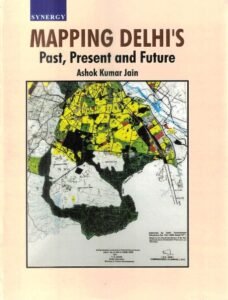
There are books that attempt to describe cities, and then there are those written by individuals who have, in very real terms, participated in shaping them. Mapping Delhi’s Past, Present and Future belongs to the latter.
In an age where urban discourse is often fragmented between theory and practice, Ashok Kumar Jain stands in a rare position as one of its architects. In his role as Commissioner Planning at the Delhi Development Authority, he has not observed the evolution of Delhi from a distance. He has worked within its constraints, contributed to its frameworks, and engaged directly with the decisions that influence how a city of such scale attempts to organize itself.
In its 15 chapters, the book documents some of the scattered maps of Delhi’s rich repository. Starting with the historic maps of Shahjahanabad and geometries of Imperial Delhi, it explores and documents the Rehabilitation Colonies, Post-Independence Delhi, Master Plans, Zonal Plans, Residential/ Housing Schemes, Unauthorised Colonies, Resettlement Colonies, Villages, Commercial Centres, Industrial areas, Landscape Plans, etc. With more than 360 maps, the book concludes with mapping the future of Delhi. Mapping Delhi’s Past, Present and Future is not simply a study of a city, but how we understand urban evolution where history, governance, and human aspirations intersect.
Join our WhatsApp Channel for fastest updates: Join now