

Land Pooling: A Promise that Punjab Couldn’t Deliver
At its core, the Land Pooling Policy (LPP) is simple to understand. Instead of the government forcibly acquiring farmland for urban development, it “pools” land from owners, develops it with roads, parks, and basic services, and then returns a smaller portion of that land to the original owners. The catch? The land returned is now much more valuable because it comes with infrastructure and legal approvals. This approach has worked in places like Ahmedabad, where it created well-serviced town planning schemes without lengthy disputes (Patel, 2014, Centre for Environmental Planning & Technology).
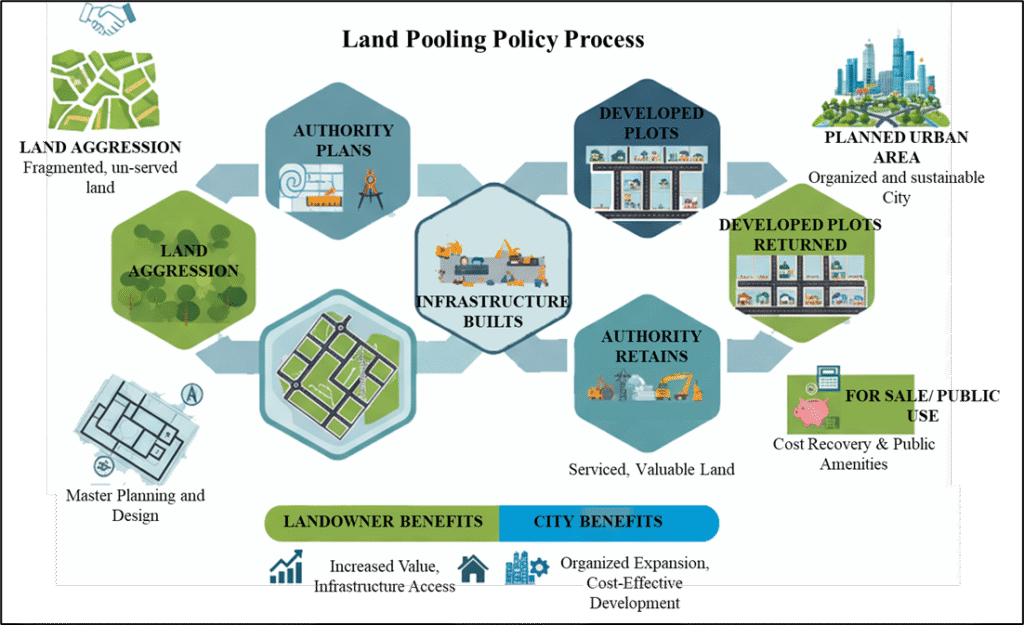
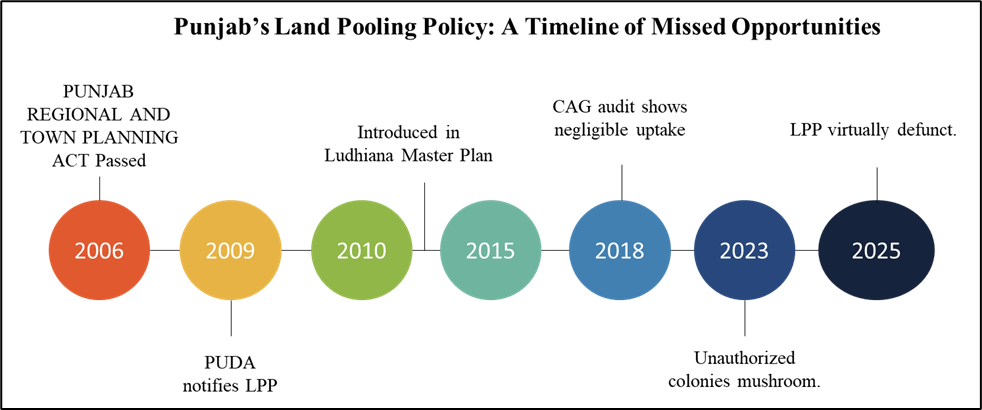
Punjab introduced LPP in the mid-2000s, under the Punjab Regional and Town Planning and Development Act, 2006, as a tool to implement statutory master plans. Officials hoped it would make urban expansion smoother by ensuring land for roads, green belts, and public amenities, while avoiding the farmer protests common in acquisition drives (PUDA Notification, 2009). But in Ludhiana, Punjab’s largest city and industrial hub, the story is starkly different. Despite being the flagship case for LPP, tiny land has actually been pooled. Farmers resisted, fearing delays or permanent loss, while developers bypassed the system to promote unauthorized colonies. The result? Key provisions of the Ludhiana Master Plan 2031 — arterial roads, public spaces, and regulated housing clusters — remain largely on paper (CAG Audit, 2018; Punjab Housing Dept., 2019).
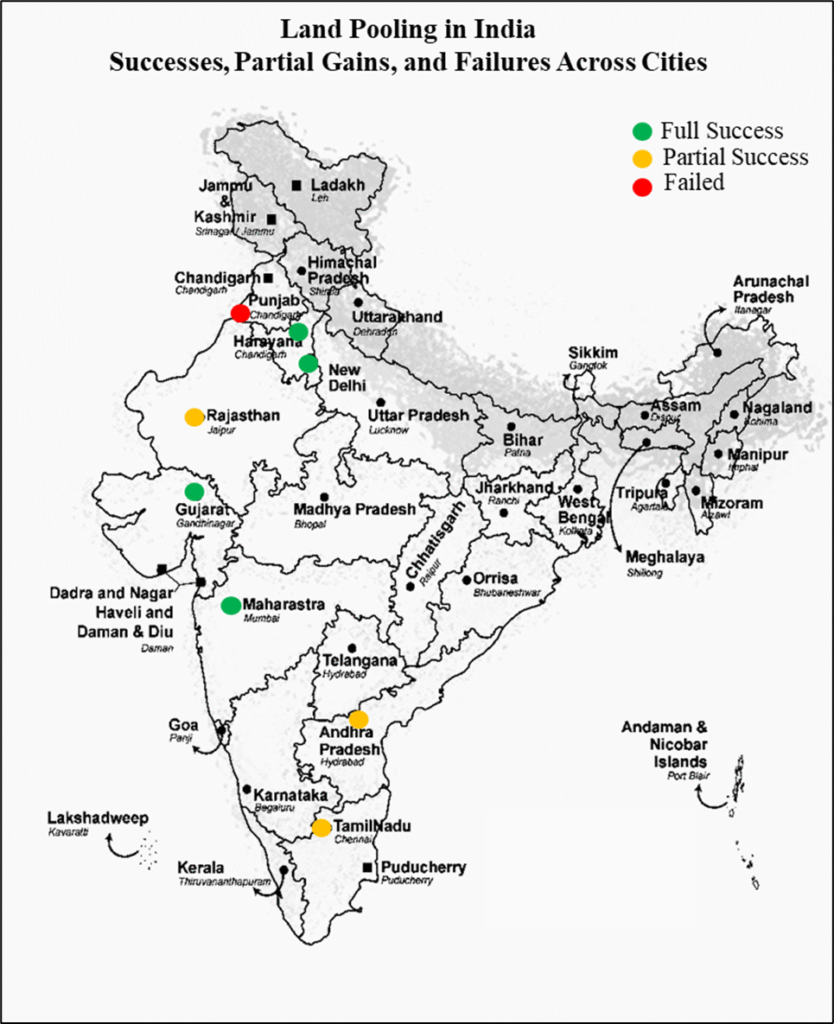
The contrast is striking: Ahmedabad’s land pooling is hailed internationally as a model of participatory planning; Delhi’s DDA policy has seen delays but remains partially operational after its 2018 reforms (DDA, 2018); whereas Punjab has failed to institutionalize trust and integrate LPP into its urban growth model.
The Promise of Land Pooling in Ludhiana: What Was on Offer
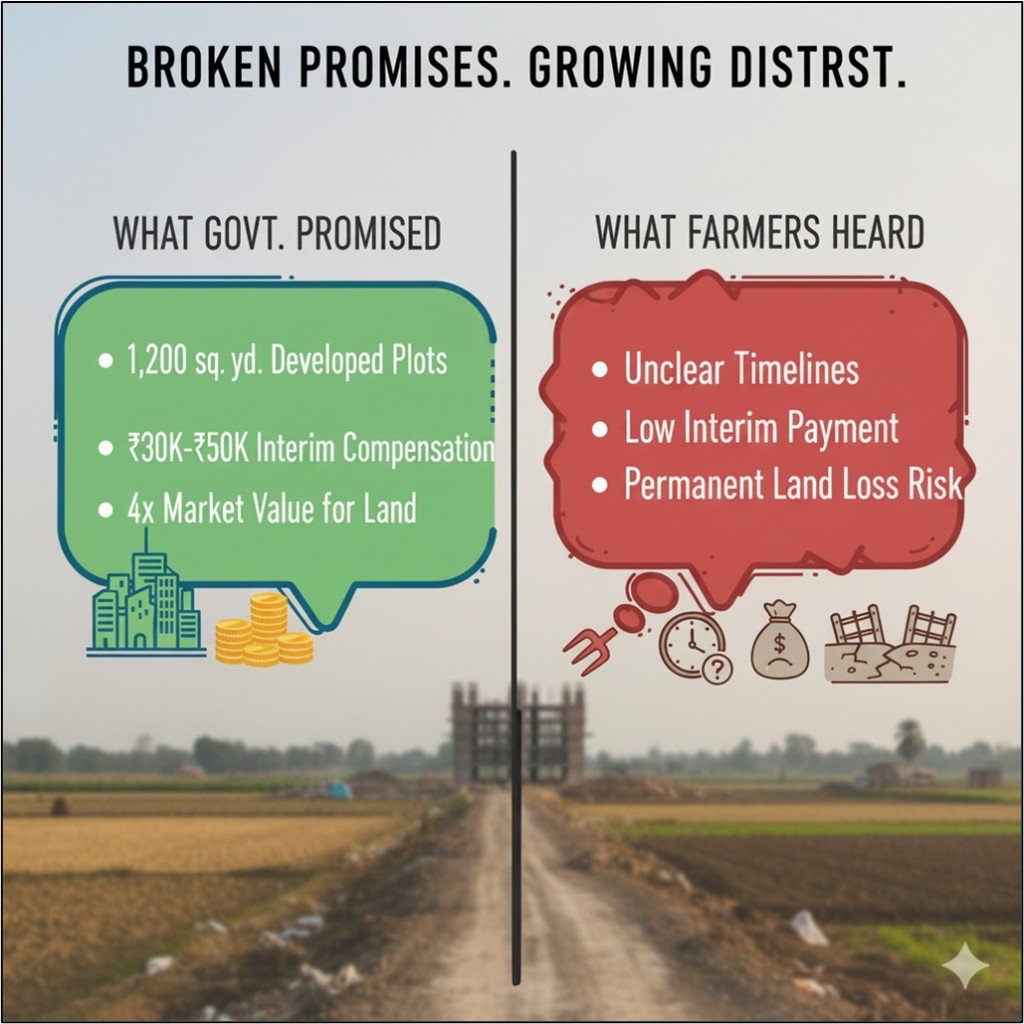
Punjab’s 2025 Land Pooling Policy was promoted as a participatory alternative to forced acquisition. Landowners pooling land voluntarily would receive 1,000-sq-yd residential and 200-sq-yd commercial plots per acre, fully serviced with water, sewerage, roads, and parks, potentially worth up to four times the collector rate (GLADA, 2025). To bridge the waiting period, the state promised ₹30,000 per acre annually for three years, later proposing ₹50,000 per acre annually and ₹1,00,000 per acre on possession, though implementation was uneven (The Times of India).
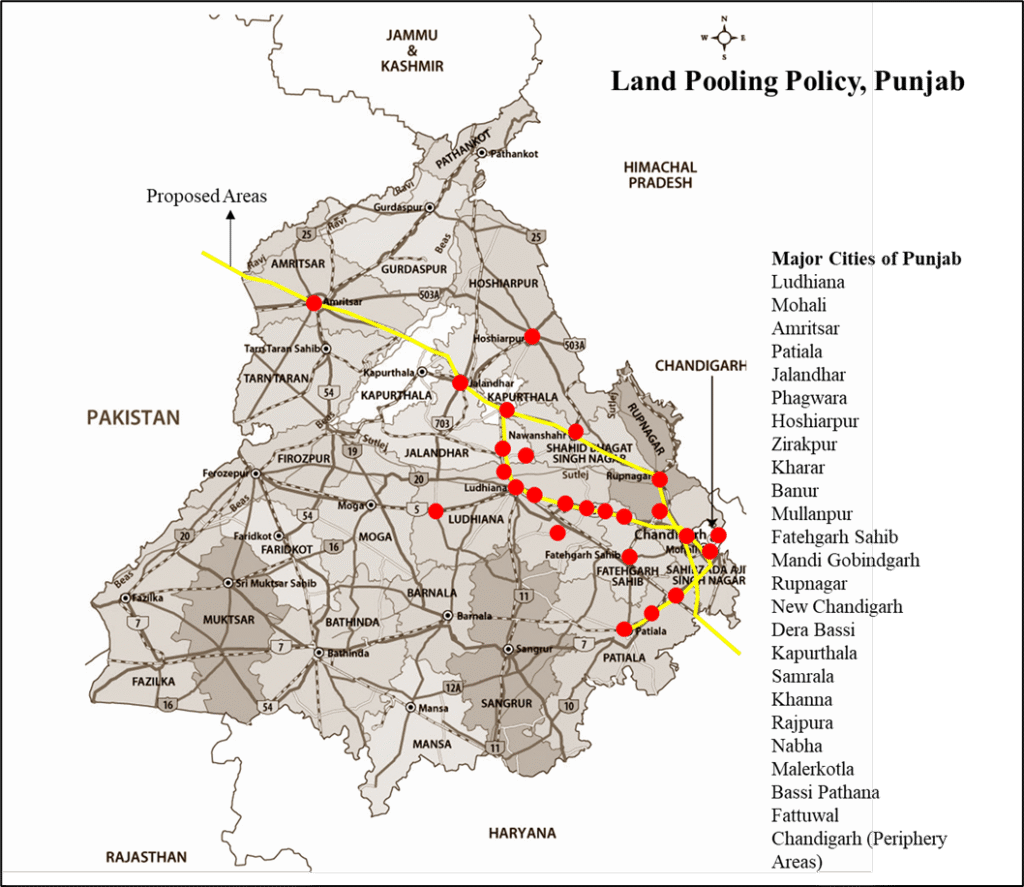
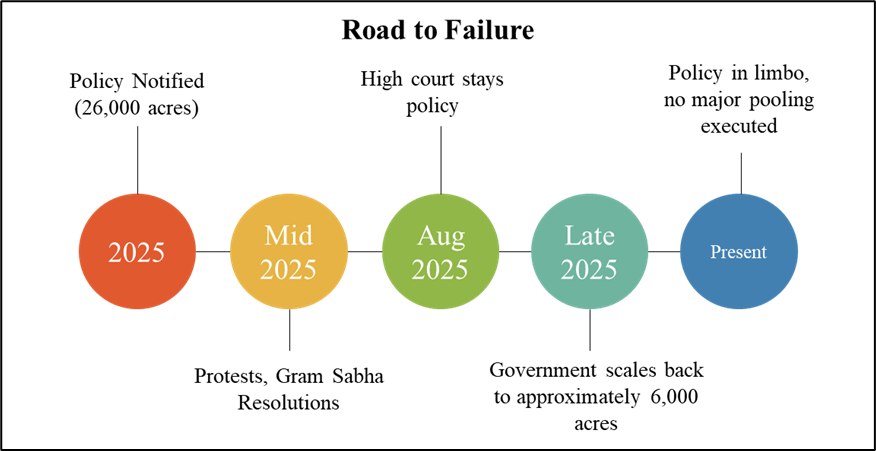
The policy’s scale was ambitious: 26,000 acres in Ludhiana alone were notified, aiming for seamless Master Plan 2031 execution, including roads, green belts, schools, and amenities. The goal was to turn landowners into stakeholders rather than adversaries.
However, cracks appeared. India Today noted unclear timelines for plot delivery, inadequate social and environmental assessments, and legal challenges. For farmers, even ₹30,000 per acre was low compared to agricultural yields, fostering distrust. Ludhiana’s experiment illustrates both the promise and fragility of land pooling—visionary in theory, yet challenged in practice.
| PROPOSED VILLAGES IN LUDHIANA | ||
| Ludhiana | 44 | Bagga Kalan, Noorpur Bet, Garha, Malakpur, Birmi, Basemi, Bhagala, Dakha, Issewal, Bhattian, Dakha, Gahour, Bhanohar, Threeke, Jhande, Laltoan, Badowal, Hasanpur, Pamali, Chhokra, Mansooran, Ratan, Laltoan Kalan, Khandoor, Ballowal, Narangwal, Jodhan, Sahijad, Kheri, Jhameri, Dolo Kalan/Sahijad, etc. |
| Total | 57 villages across 4 districts (Approx 24,311 acres), majority in Ludhiana | |

Also Read: Delhi’s First TOD Project at Karkardooma Nears Reality After a Decade
Ground Reality — Why Land Pooling Failed in Ludhiana
Punjab’s 2025 Land Pooling Policy aimed to offer a participatory alternative to acquisition, but few landowners trusted it, institutional capacity was weak, and private developers filled the vacuum with unauthorised colonies. Consent proved elusive: The Times of India and Indian Express reported 40–44 villages opposing pooling, with only 10–12 landowners participating early. Farmers feared permanent loss of ancestral land or indefinite delays receiving developed plots.
Institutional and financial gaps compounded distrust. The High Court stayed the policy after records showed the state needed ₹9,000 crore to develop 7,800 acres, raising doubts over servicing 26,000 acres. Missing timelines and studies further weakened credibility.
Delivery failures persisted: PUDA/GLADA had a history of ad-hoc regularisation, while private developers exploited delays, fragmenting land for quicker returns. By mid-2025, immediate pooling was scaled down to 6,000 acres, highlighting that low compensation, environmental concerns, and weak delivery risked turning the policy into a paper exercise (The Indian Express; The Tribune).
Voices from the Ground: Real Perspectives on Land Pooling in Ludhiana
Punjab’s 2025 Land Pooling Policy has stalled amid distrust and protests. Reports (Times of India; Indian Express) show 40–44 Ludhiana villages passed resolutions rejecting pooling, with only 10–12 landowners consenting. Farmers feared losing ancestral land and doubted the timely return of developed plots. Protests outside GLADA highlighted a deep trust deficit. Institutional concerns added weight: the Punjab and Haryana High Court stayed the policy, while the state admitted it needed ₹9,000 crore to develop 7,800 acres—with no clear funding plan. As sceptics noted, the gap between promise and capacity risks leaving only unauthorised colonies thriving.
Farmer Distrust
Harjit Singh of Malak village said, “We are being forced to give up our ancestral land for a promise that may never materialize.” Farmers from 32 of 44 affected Ludhiana villages share fears of losing control over their land and receiving inadequate compensation.
Urban Planning Concerns
Dr. Rajeev Kumar noted that the policy has fragmented development, leading to unauthorized colonies and encroachments, undermining the Master Plan’s green belts and housing clusters. Public action committee members argue that the draft Punjab Unified Building Rules 2025 could worsen congestion and other issues.
Residents’ Struggles
Akhara village residents spent over ₹2 lakh to repair a decade-old road, highlighting persistent gaps in basic infrastructure.
Unauthorized Colonies
Despite GLADA demolition drives in Ladian Kalan and Hussainpura, illegal settlements continue to grow, showing a gap between policy and reality.

These examples illustrate the challenges of implementing Ludhiana’s Land Pooling Policy—farmer distrust, diluted planning objectives, and unmet infrastructure needs.
Also Read: Meghalaya’s First Block-Level Climate Vulnerability Assessment Finds 25 Blocks at High Risk
Way Forward
Ludhiana’s land pooling highlights a core lesson: policies fail without strong execution, monitoring, and engagement. Punjab’s identity as the “land of agriculture” must anchor urban expansion. Farmland sustains livelihoods, regulates climate, and preserves green belts; unchecked conversion risks heat islands, ecological imbalance, and rural distress. Reforms should explore hybrid pooling–acquisition models, transparent compensation, phased infrastructure, and farmer participation. Urban growth must prioritize densification, vertical expansion, and infill in built-up areas over fertile land. Punjab’s challenge is also its opportunity: to craft an urbanization model where development coexists with agricultural sustainability, economic resilience, and environmental stewardship.
REFERRENCES
- Centre for Environmental Planning & Technology. (2014). Land pooling and participatory town planning schemes: Lessons from Ahmedabad. Ahmedabad: CEPT University.
- CAG Audit. (2018). Report on the implementation of urban development projects in Ludhiana. Chandigarh: Comptroller and Auditor General of India.
- DDA. (2018). Delhi Development Authority Land Pooling Policy Review. Delhi: DDA.
- GLADA. (2025). Land Pooling Policy notification and guidelines. Ludhiana: Greater Ludhiana Area Development Authority.
- Hindustan Times. (2023). NGT directs removal of constructions from the green belt in Ludhiana. Retrieved from https://www.hindustantimes.com
- Indian Express. (2023). Challenges in implementing the Ludhiana Master Plan 2031 and Land Pooling Policy. Retrieved from https://indianexpress.com
- JETIR. (2022). Satellite analysis of urban expansion in Ludhiana (2000–2020). Journal of Emerging Technologies and Innovative Research, 9(7), 45–56.
- Patel, R. (2014). Participatory town planning in Ahmedabad: A model for India. Ahmedabad: Centre for Environmental Planning & Technology.
- Punjab Housing Department. (2019). Annual report on urban housing and development schemes in Punjab. Chandigarh: Government of Punjab.
- PUDA Notification. (2009). Punjab Regional and Town Planning and Development Act, 2006: Land Pooling Implementation. Chandigarh: Punjab Urban Development Authority.
- The Pioneer. (2025). Ludhiana Land Pooling Policy: Farmers’ perspective and scheme details.
- The Times of India. (2023). Ludhiana’s unauthorized colonies and Land Pooling Policy updates. Retrieved from https://timesofindia.indiatimes.com
- The Times of India. (2025). Amendments and interim compensation in the Ludhiana Land Pooling0 Policy. Retrieved from https://timesofindia.indiatimes.com
- India Today. (2025). Ludhiana landowners skeptical about Land Pooling Policy timelines. Retrieved from https://www.indiatoday.in
- The Print. (2023). Delhi’s Land Pooling Policy: Partial success and lessons for other cities. Retrieved from https://theprint.in