

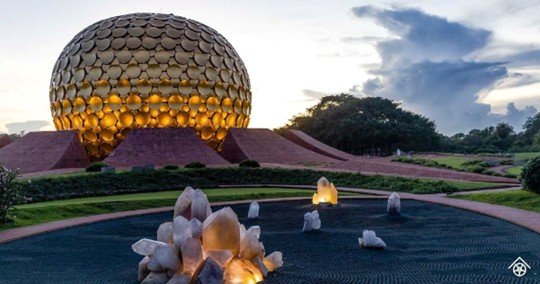
The Heart of Auroville
At the centre of Auroville, both geographically and philosophically, stands the Matrimandir—a structure that challenges conventional definitions of architecture. Neither a temple nor a monument, Matrimandir is conceived as a space for individual concentration and inner stillness. Official descriptions from Auroville define it as the Soul of the City, a place not meant for worship or ritual but for silent reflection. Its architecture does not seek attention through ornament or scale; instead, it invites introspection through restraint, balance, and quiet power.
A Vision Beyond Religion
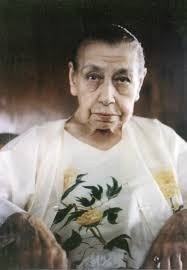
The conceptual foundation of Matrimandir was laid by Mirra Alfassa, known as The Mother, whose vision for Auroville centred on human unity and spiritual evolution beyond religious boundaries. She described Matrimandir as a place for individual concentration, explicitly rejecting religious symbolism, icons, or prescribed practices. This philosophical position profoundly shaped the architecture, ensuring that the building would communicate not through imagery or narrative, but through universal elements—geometry, light, material, and silence. The architectural translation of this vision was undertaken by French architect Roger Anger, working in close collaboration with Auroville residents. Rather than following a fixed blueprint, the project evolved organically over time, allowing architectural decisions to mature alongside collective understanding. Construction extended from 1971 to 2008, making Matrimandir a rare example of architecture shaped as much by patience and reflection as by design intent.
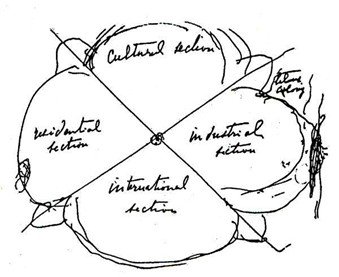
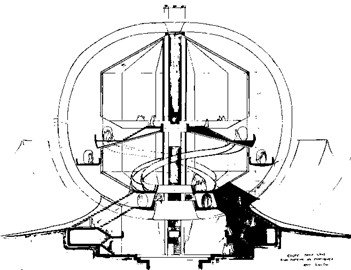
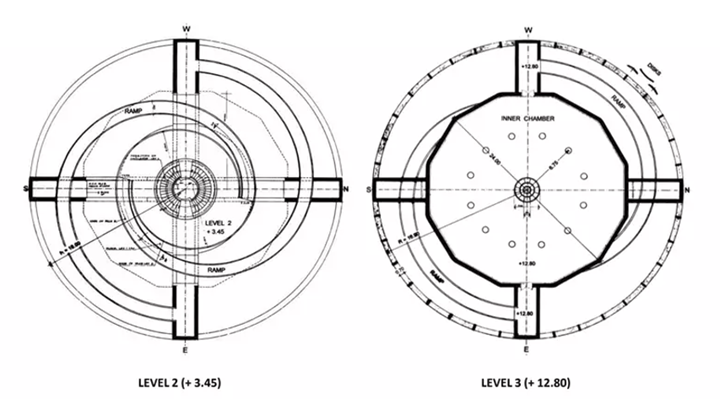
Early Sketches by Roger Anger | (Image Source: https://overmanfoundation.org/roger-anger-the-mothers-architect-the-great-unknown-by-paulette-hadnagy/)
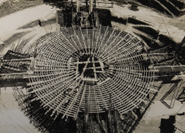
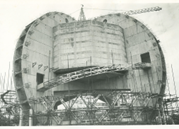
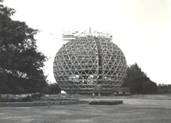
Early Construction Images | (Image Source: https://matrimandir.org/history/)

Geometry as Architectural Language
The defining architectural gesture of Matrimandir is its flattened spherical form, measuring approximately thirty-six metres in diameter and nearly thirty metres in height. The sphere was chosen deliberately for its symbolic neutrality and universality. Unlike domes or spires that suggest hierarchy or ascent, the sphere has no front or back, no directional emphasis, and no privileged viewpoint. It represents wholeness, unity, and continuity—ideas central to Auroville’s philosophy.
According to official architectural documentation, the structure is intended to appear as though it emerges from the earth itself. This gesture reinforces the idea that consciousness arises from material existence rather than being imposed from above. Structurally, the sphere is supported by four massive reinforced concrete pylons, carefully concealed within the form so that the geometry remains visually uninterrupted and pure.
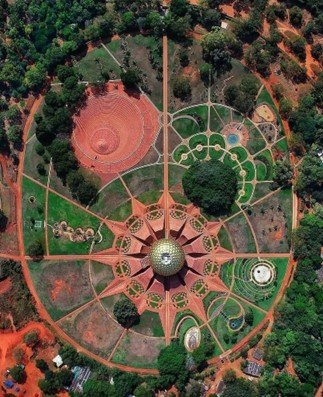
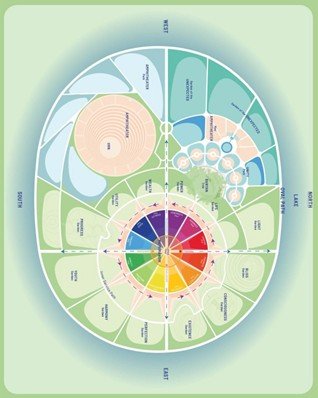
Site Layout and Conceptual Zoning | (Image Source: https://matrimandir.org/)
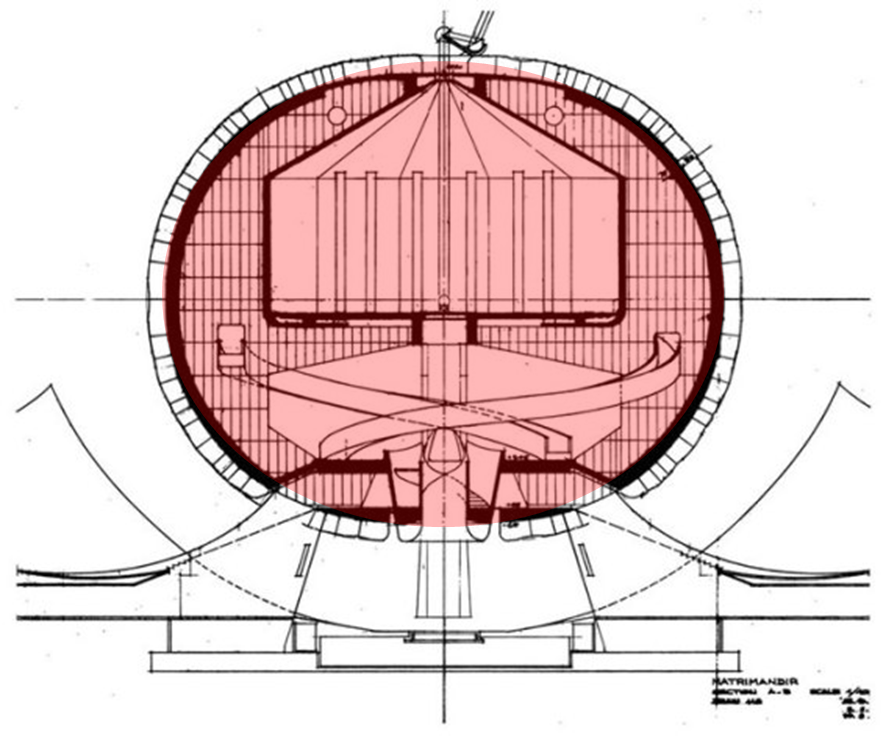
The Pillars and the Four Aspects of the Mother
In 1972, Mirra Alfassa, known as The Mother, gave profound symbolic meaning to the Matrimandir’s structural system. She named the four pairs of Pillars that support the structure after her four Aspects or Personalities, as described by Sri Aurobindo. These aspects represent fundamental cosmic forces through which the Divine Consciousness operates in the world.
Maheshwari, the aspect of calm wideness and sovereign wisdom, embodies tranquil benignity, inexhaustible compassion, and a majestic all-ruling greatness. She represents the vast, comprehensive intelligence that sees truth in its totality.
Mahakali expresses the force of dynamic power and transformative strength. She is the embodiment of irresistible will, warrior-like intensity, impetuous swiftness, and world-shaking energy, driving decisive change and fearless action.
Mahalakshmi manifests as beauty, harmony, and grace. She reveals herself through subtle rhythm, refined opulence, compelling attraction, and the deep secret of aesthetic perfection that brings balance and delight into existence.
Mahasaraswati, the fourth aspect, represents precision, knowledge, and perfection in execution. She is equipped with the capacity for careful, flawless work, quiet discipline, and exactitude, ensuring that divine intention is realised in material form. Structurally, these Pillars carry the immense weight of the Matrimandir; symbolically, they represent the spiritual forces that sustain and uplift human aspiration.
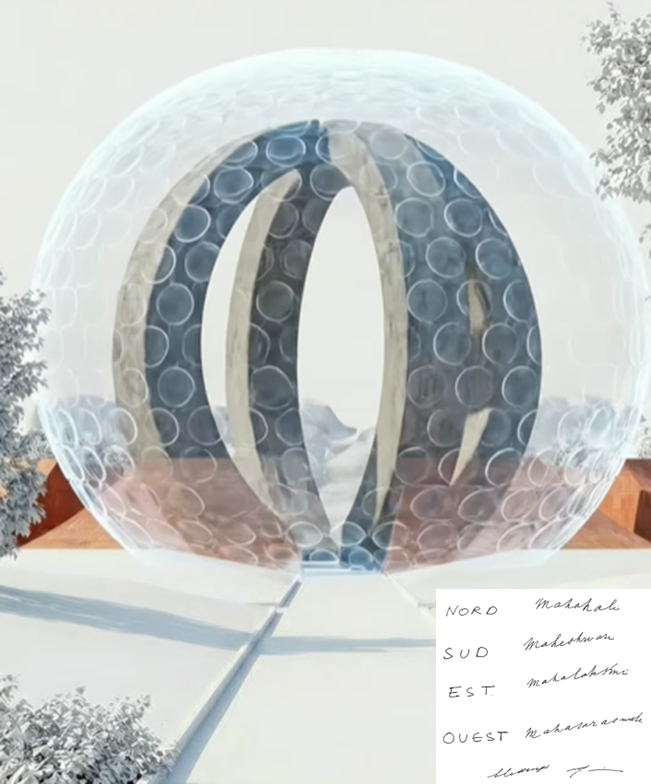
The Four Entrances and Their Symbolic Geometry
Above each of the four entrance doors, a golden shield has been installed, signifying protection and spiritual authority. Positioned in front of each shield is a large golden disc with four petals, at the centre of which a precise geometric form indicates the orientation and symbolic quality of the entrance. These geometries serve as visual markers, uniting direction, consciousness, and meaning.
The North entrance, associated with Mahakali, represents Strength and is marked by a red square, symbolising power, stability, and grounded force.
The South entrance, aligned with Maheshwari, signifies Wisdom and is identified by an orange hexagon, expressing balance, clarity, and expansive understanding.
The East entrance, dedicated to Mahalakshmi, embodies Harmony and is represented by a pink circle, a form without beginning or end, symbolising unity, beauty, and completeness.
The West entrance, linked to Mahasaraswati, stands for Perfection and is marked by a light blue triangle, representing precision, aspiration, and upward refinement.
Together, these entrances transform circulation into meaning. Movement through the Matrimandir is not arbitrary; it is aligned with cosmic directions, philosophical qualities, and inner states of being.
The Golden Skin and the Role of Light
Cladding the spherical form is Matrimandir’s most visually striking feature: its luminous golden surface. The exterior consists of over fourteen hundred circular discs finished with real gold leaf, mounted on stainless steel supports designed to endure Auroville’s tropical climate. This surface performs multiple roles simultaneously. Symbolically, gold represents the sun, aspiration, and illumination. Environmentally, its reflective quality reduces heat absorption. Experientially, it ensures that the building is never visually static.
As described on the official Auroville website, it is referred to as “The Physics of Silence”; sunlight transforms the structure throughout the day. The building reflects the sky, clouds, and changing light conditions, making natural phenomena integral to the architectural experience. In Matrimandir, light is not an accessory—it is a fundamental building material.
The Translucent Inner Skin and the Supramental Light
From the outside, the Matrimandir appears as a radiant golden sun, symbolising the Supramental Consciousness. However, the experience transforms completely upon entering the interior. Mirra Alfassa envisioned the inner space not as opaque or dazzling, but as a soft, translucent sphere suffused with a golden-pink light. To communicate this precise quality, she gave the architect a small swatch of her saree, indicating the exact hue she wished the interior to embody.
This colour corresponds to that of the hibiscus flower Hibiscus rosa‑sinensis, which the Mother named “Beauty of Supramental Love” and “Auroville”. Her comment on this flower—“It invites us to live at its height”—captures the essence of the interior atmosphere she sought to create: an environment that uplifts consciousness through subtle light rather than visual intensity.
To realise this vision architecturally, a highly specialised translucent inner skin was developed. A unique white fabric made of fibreglass woven with advanced precision was stretched across 756 triangular frames, fabricated from aluminium profiles specially extruded for this purpose. This geometric system creates a continuous yet delicate membrane that diffuses light evenly across the interior surface. Additionally, 668 circular portholes on the outer shell are fitted with coloured foil of the exact golden-pink hue, filtering incoming daylight during daytime hours. Together, these elements transform natural light into a gentle, enveloping glow, allowing the Matrimandir to appear inwardly as a luminous, living sphere—an architectural expression of Supramental aspiration.
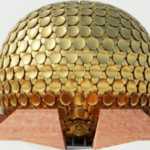

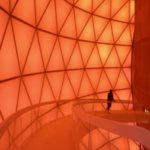
Outer Golden Skin and Inner translucent skin | (Image Source: https://matrimandir.org/)
The Petals
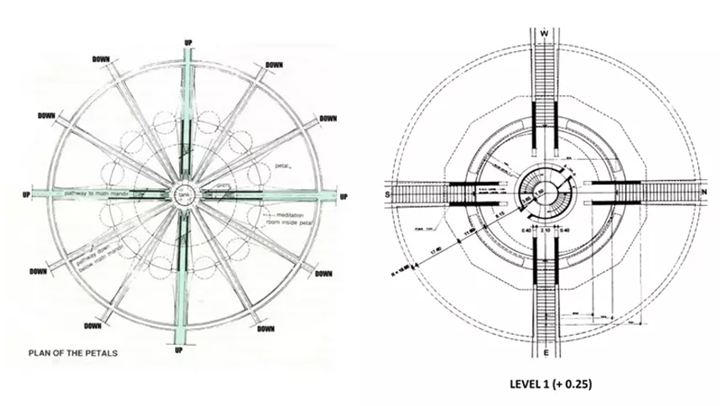
The twelve Petals encircling the Matrimandir correspond directly to the twelve petals of Mirra Alfassa’s symbol, forming an essential symbolic and spatial layer of the complex. Each Petal contains a small, intimate meditation room, and each of these rooms represents one of the twelve powers of the Universal Mother, intended as spaces for quiet reflection rather than congregational use. The Petals thus function not only as architectural elements but as extensions of the Mother’s philosophical vision, translating abstract spiritual qualities into built form.
The colours of the meditation rooms follow the chromatic order defined by Sri Aurobindo in 1934 for the Mother’s symbol. As he explained, the central circle represents the Divine Consciousness, while the four main petals stand for the four powers of the Mother—Maheshwari, Mahakali, Mahalakshmi, and Mahasaraswati. The twelve surrounding petals are expressed through a graduated spectrum arranged in three groups: the upper group moving from red through orange towards yellow, the next from yellow through green towards blue, and the third from blue through violet back towards red. These colours are not decorative but symbolic, expressing the progressive manifestation of consciousness.
Each of the twelve Petals embodies a specific power required for spiritual growth and collective work: Sincerity, Humility, Gratitude, Perseverance, Aspiration, Receptivity, Progress, Courage, Goodness, Generosity, Equality, and Peace. Together, the Petals create a continuous ring of meaning around the Matrimandir, reinforcing the idea that movement around the structure is also a journey through inner qualities, where architecture, colour, and consciousness are inseparably intertwined.
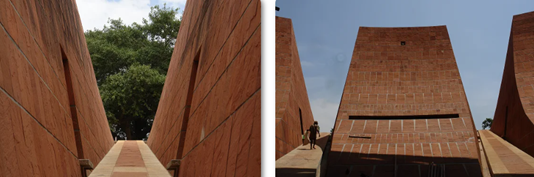
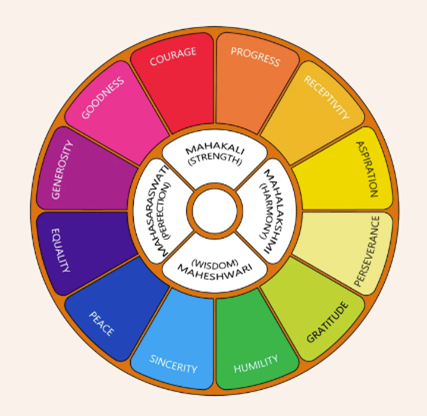
Outer Petals and Their Concept | (Image Source: https://matrimandir.org/)
The Inner Chamber: Space, Silence, and Precision
At the exact centre of the sphere lies the Inner Chamber, the most restrained and profound space within Matrimandir. Entirely clad in white marble, the chamber is free from ornament, imagery, or textual instruction. At its centre rests a large crystal globe, positioned with absolute precision.
A single beam of natural sunlight, guided by a heliostat system located above the structure, enters the chamber and illuminates the crystal. This alignment of solar movement and architectural geometry creates a moment where cosmic time intersects with human presence. According to Auroville’s official descriptions, the silence within the chamber is not incidental but carefully engineered through acoustic buffering, spatial proportion, and material choice. Here, emptiness is not absence—it is presence.
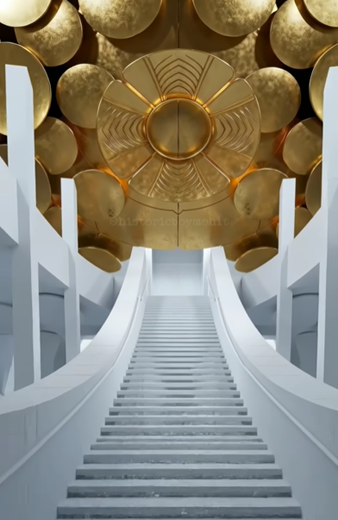
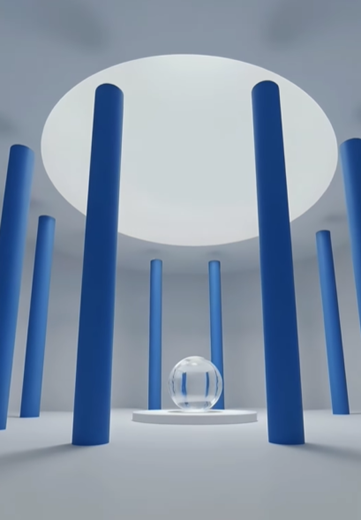
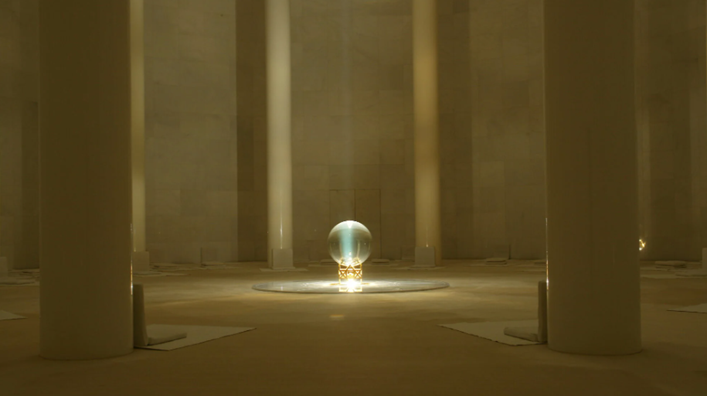
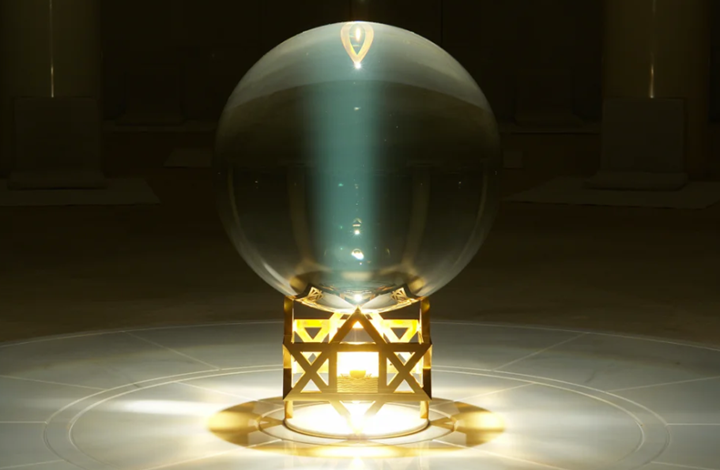
Inner Chamber showing Central Crystal Globe and 12 Floating Columns | (Image Source: matrimandir and Instagram.com)
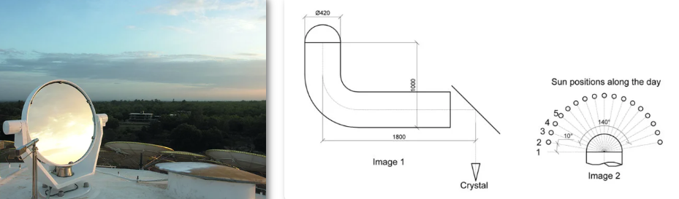
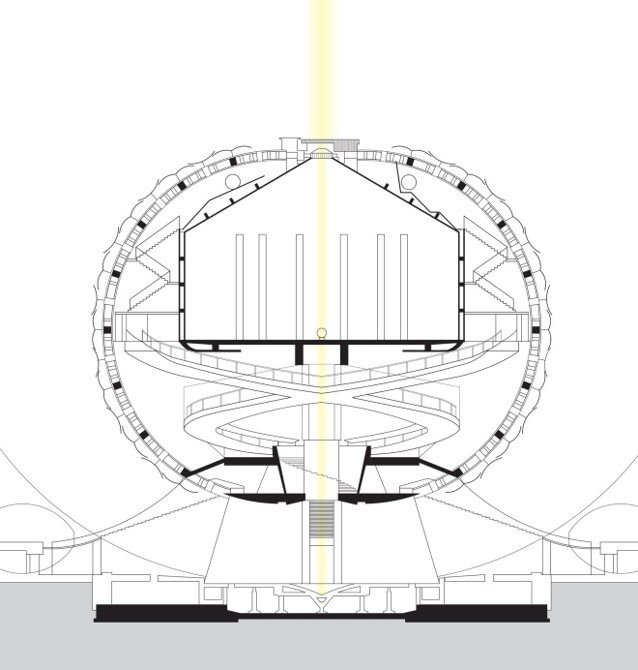
Working of a Heliostat to reflect the ray of light in the inner chamber | (Image Source: https: matrimandir.org/ and Slideshare.com)
The Twelve Gardens: Landscape as Conscious Architecture
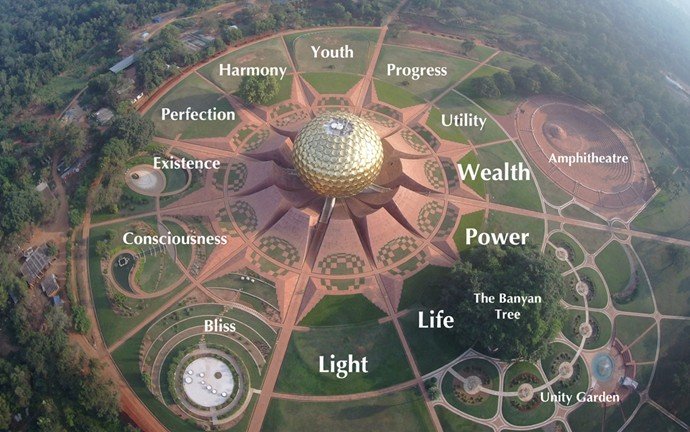
Encircling the golden sphere are twelve thematic gardens, each representing a specific quality of consciousness such as Peace, Harmony, Bliss, Consciousness, Life, and Perfection. As detailed on the official Matrimandir Gardens page, these landscapes are not ornamental additions but integral components of the architectural experience.
Each garden is designed using specific plant species, colour palettes, and spatial configurations that evoke its corresponding quality. Together, the gardens form a living mandala around the sphere, reinforcing Matrimandir’s role as the centre of both physical space and symbolic meaning. Movement through these gardens becomes a preparatory journey, guiding visitors from multiplicity toward unity.
Building Through Time and Collective Effort
One of Matrimandir’s most significant architectural lessons lies in its construction process. Built over nearly four decades, the project relied heavily on the participation of Auroville residents and volunteers. There was no commercial urgency or fixed deadline. Designs evolved, materials were tested and refined, and construction methods were adapted as understanding deepened.
In this sense, time itself became a design material. Matrimandir stands as a counterpoint to contemporary architectural practice driven by speed, efficiency, and market visibility, offering an alternative model rooted in patience, collaboration, and purpose.
Relevance in the Contemporary Built Environment
In an era dominated by iconic skylines and image-driven architecture, Matrimandir offers a radically different architectural narrative. It demonstrates that monumentality does not require scale, that technology need not be exhibited, and that spiritual experience can be facilitated without religious symbolism. For architects and planners, it raises a critical question: can architecture support inner life as meaningfully as it shapes external form?
Architecture That Resonates Rather Than Commands
Matrimandir is an architecture that does not command attention—it earns presence. Through geometry, light, silence, and restraint, it creates an environment where the individual becomes aware not of the building, but of oneself within it. In a world increasingly defined by noise and speed, Matrimandir stands as a powerful reminder that the most enduring architecture may be that which speaks the least, yet resonates the most.
References
- Auroville Foundation. (n.d.). The Matrimandir.
- Auroville Foundation. (n.d.). History of the Matrimandir.
- Auroville Foundation. (n.d.). The Matrimandir gardens.
- Auroville International Centre of Education. (n.d.). The Mother’s symbol and its meaning.
- Alfassa, M. (1979). Words of the Mother (Vol. 2). Sri Aurobindo Ashram Press.
- Aurobindo, S. (1997). The Mother. Sri Aurobindo Ashram Press.
- Kapstein, E. B. (2004). Architecture and spiritual aspiration: Auroville and the Matrimandir. Journal of South Asian Studies, 27(3), 365–382.
- Roger Anger Architectes. (n.d.). Architectural conception of the Matrimandir [Archival drawings and notes]. Auroville Archives.
- Sri Aurobindo Ashram. (n.d.). Flowers and their spiritual significance.
- UNESCO. (2005). Auroville: An international township for human unity. UNESCO Publishing.
- Instagram. (2024). Matrimandir experiential walkthrough [Video].