
The 9th National Naturopathy Day on November 18 highlights the role of natural healing, preventive healthcare and sustainable lifestyles under the theme ‘Prakrutik Chikitsa, Swasth Bharat’.
India is strengthening its naturopathy ecosystem through dedicated healthcare institutions, research initiatives, professional education and community-based programmes, as the country prepares to observe the 9th National Naturopathy Day on November 18, 2026.
This year’s theme, ‘Prakrutik Chikitsa, Swasth Bharat’, emphasises preventive healthcare, healthy eating, physical activity, yoga and stress management, with a particular focus on addressing obesity and lifestyle-related health concerns. The national observance will take place at the Central Research Institute of Yoga and Naturopathy (CRIYN), Nagamangala, Karnataka.
Naturopathy is a drug-free system of healthcare based on the principle that the human body has an inherent capacity to heal itself. It uses natural approaches such as diet regulation, fasting, hydrotherapy, mud therapy, massage and lifestyle modification. Rooted in the concept of harmony with nature, the system promotes healthier living through the five elements—earth, water, air, fire and ether.
National Naturopathy Day and Mahatma Gandhi’s Legacy
National Naturopathy Day commemorates Mahatma Gandhi’s contribution to promoting nature cure in India. On November 18, 1945, Gandhi became the Lifetime Chairman of the All India Nature Cure Foundation Trust in Pune and signed its deed. The Ministry of Ayush began observing this date annually as National Naturopathy Day in 2018.
Gandhi advocated simple living, balanced nutrition, physical activity and personal hygiene as essential components of good health. His association with nature cure continues to influence India’s approach towards natural and preventive healthcare.
Nisarg Gram: A Major Step in Naturopathy Infrastructure
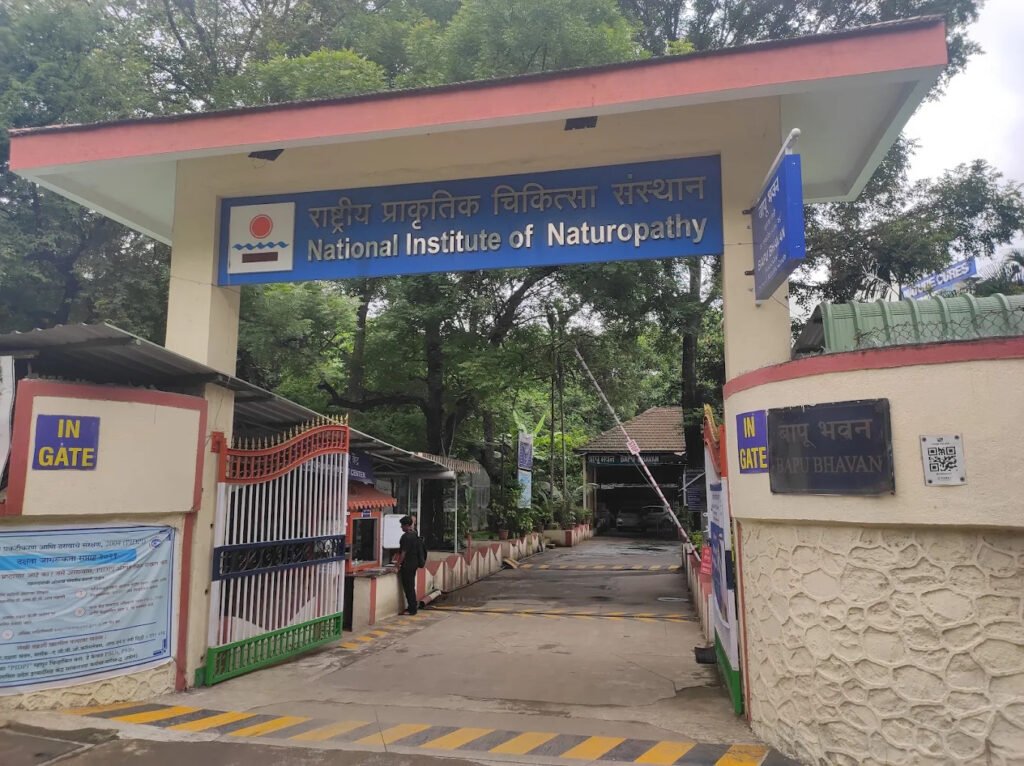
A significant development in India’s naturopathy infrastructure is Nisarg Gram, the new campus of the National Institute of Naturopathy (NIN), Pune, inaugurated by Prime Minister Narendra Modi on February 25, 2024.
Spread across 25 acres at Yewalewadi, Pune, and developed at a cost of ₹213.55 crore, the campus houses a 250-bedded naturopathy hospital, a research and extension centre, and a Naturopathy Medical College.
Its facilities include a yoga hall, Saatvik diet centre, hydrotherapy, magnetotherapy, chromotherapy, massage and physiotherapy services. The institution is also the first Central Government institution to offer the Bachelor of Naturopathy and Yogic Sciences (BNYS) programme.
For the academic session 2026–27, the college is offering 100 BNYS seats, with classes scheduled to commence on November 30, 2026.
Expanding Naturopathy Services in Tribal Communities
The government is also working to extend naturopathy and yoga services to tribal communities. With support from the Tribal Development Department of Maharashtra, NIN has established the Nisarg Arogya Sadhana Kendra at Gohe (Budruk), Ambegaon taluka, Pune district.
The centre has 20 beds, separate wards for men and women, a yoga hall and a diet centre. It aims to address community nutritional needs using locally available resources while providing natural healthcare services. It also functions as a training centre for tribal youth, with capacity to train 40 students annually through its Treatment Assistant Training Course.
In addition, a national capacity-building programme held in Hyderabad in November 2026 brought together approximately 1,500 traditional healers from nine States and Union Territories to strengthen their skills and participation in community-level healthcare initiatives.
Education, Professional Training and Research
Strengthening professional education is another important component of India’s naturopathy development. The BNYS programme offered at Nisarg Gram spans five-and-a-half years, comprising four-and-a-half years of academic and clinical training followed by a one-year compulsory residential internship.
According to the Ministry of Ayush backgrounder, as of April 1, 2024, India had 71 undergraduate naturopathy colleges with an admission capacity of 5,214 students and six postgraduate colleges with 144 seats. The country also had 5,083 registered naturopathy practitioners as of January 1, 2024.
The government has established the Central Council for Research in Yoga and Naturopathy (CCRYN), which has been engaged in research, promotion and development since 1978 and operates through 22 units across India. Research initiatives include studies on fasting methods, hydrotherapy, sun exposure and Type 2 diabetes, integrated yoga and naturopathy programmes, and naturopathy-based approaches to osteoarthritis.
The National Institute of Naturopathy also conducts short-term skill development courses in acupressure, naturopathy, naturopathy cooking, massage, fitness training and yoga.
Strengthening Healthcare Infrastructure Across India
Beyond Nisarg Gram, India has developed additional institutional infrastructure for yoga and naturopathy. Two 200-bedded Yoga and Naturopathy hospitals are operational at Jhajjar in Haryana and Nagamangala in Karnataka.
The CRIYN facility at Jhajjar, spread across 19 acres and developed at a cost of ₹63.88 crore, serves as an important centre for research and education. Foundation stones for two additional Central Research Institutes of Yoga and Naturopathy were laid in Khorda, Odisha, and Raipur, Chhattisgarh.
As of April 1, 2024, naturopathy services were available through 35 hospitals with a combined capacity of 1,663 beds and 95 dispensaries across the country.
Naturopathy and India’s Growing Wellness Tourism Sector
India’s traditional healthcare systems are also gaining attention internationally. The number of international patients visiting India for all types of healthcare increased from 1,82,945 in 2020 to 6,44,387 in 2024.
Yoga, Ayurveda and wellness-based therapies are contributing to India’s growing medical value tourism sector. To facilitate access to traditional healthcare systems, the government introduced a dedicated Ayush Visa on July 27, 2023, for foreign nationals seeking treatment under Ayush systems.
The proposed Regional Medical Value Tourism Hubs announced in the Union Budget 2026 are also expected to integrate advanced medical treatment with traditional therapies, wellness services and rehabilitation.
Towards a Healthier and More Sustainable India
The observance of the 9th National Naturopathy Day highlights the growing importance of preventive healthcare, research-based traditional systems and healthier lifestyles. With investments in hospitals, educational institutions, research facilities and community outreach programmes, India is working to strengthen the institutional framework for yoga and naturopathy.
Under the theme ‘Prakrutik Chikitsa, Swasth Bharat’, the focus remains on encouraging people to adopt balanced diets, regular physical activity, yoga and healthy living practices while strengthening the scientific foundation of naturopathy and its responsible integration with conventional healthcare.
Also Read: Prestige University, Indore: A Contemporary Interpretation of the Traditional Indian Stepwell
Join our WhatsApp Channel for fastest updates: Join now