

New Delhi: President of India Droupadi Murmu honoured the country’s cleanest cities at the Swachh Survekshan Awards 2025–26, held at Vigyan Bhawan, New Delhi. Organised by the Department of Urban Development under the Ministry of Housing and Urban Affairs (MoHUA), the awards recognised the achievements of urban local bodies in improving sanitation, solid waste management and urban cleanliness across the country.
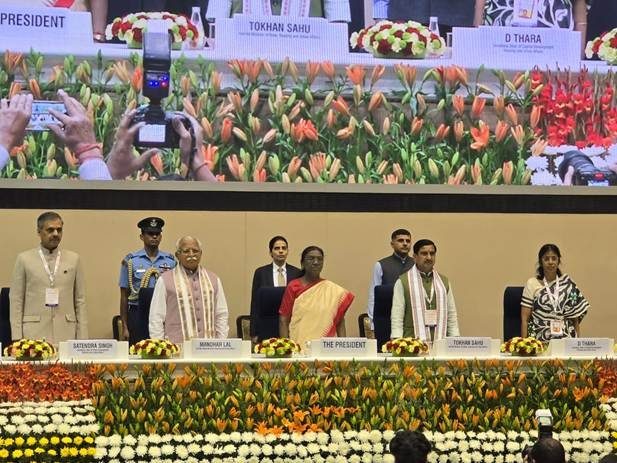
The ceremony was attended by Union Minister for Housing and Urban Affairs and Power Manohar Lal and Minister of State for Housing and Urban Affairs Tokhan Sahu. A total of 60 national awards were announced across various categories, including Swachh Shehar Jodi, Super Swachh League, population-based city rankings, Swachh River Front Town, Swachh Coastal Town, Clean Himalayan City and State First Swachh City.
Navi Mumbai, Surat and Vijayawada Lead Super Swachh League
Maharashtra’s Navi Mumbai, Gujarat’s Surat and Andhra Pradesh’s Vijayawada emerged as the top three cities in the Clean Cities of Super Swachh League category.
In the million-plus population category, Greater Visakhapatnam Municipal Corporation (GVMC), Jabalpur and Lucknow secured the top three positions, respectively.
The awards also recognised cities for collaborative efforts through the Swachh Shehar Jodi initiative. Ahmedabad–Sanand, Indore–Depalpur and Tirupati–Kuppam were declared the top three performing city pairs. Under this initiative, 70 mentor cities have been paired with 191 mentee cities to facilitate knowledge-sharing, exchange best practices and improve sanitation services in participating urban local bodies.
Recognition for Himalayan, Riverfront and Coastal Cities
The 2025–26 edition expanded its recognition framework to include dedicated categories for Himalayan cities, riverfront towns and coastal towns, acknowledging the environmental importance of these urban settlements.
In the Clean Himalayan City category, Rudrapur (Uttarakhand), Jammu and Shopian (Jammu & Kashmir) secured the top three positions.
For Swachh River Front Town, Rewa (Madhya Pradesh), Bilaspur (Chhattisgarh) and Varanasi (Uttar Pradesh) were ranked first, second and third, respectively.
In the Swachh Coastal Town category, Puri (Odisha) secured the first position, followed by Alappuzha (Kerala) and Ratnagiri (Maharashtra).
Additionally, the State First Swachh City Award recognised 30 top-performing cities across States and Union Territories.
Citizen Participation and Improvements in Urban Sanitation
Addressing the gathering, President Droupadi Murmu emphasised that cleanliness requires collective participation from citizens, local administrations and sanitation workers. She highlighted the importance of behavioural change, administrative accountability and continuous public engagement. She also stressed the need to introduce issues such as plastic waste management into school curricula.
Union Minister Manohar Lal highlighted the progress made under the Swachh Bharat Mission since 2014. According to the Ministry, urban waste processing has increased from 16% to 80%, while door-to-door waste collection coverage has grown from 44% to more than 96%. Remediation of legacy waste dumpsites has also freed nearly 11,000 acres of urban land for productive use.
The scale of Swachh Survekshan has expanded significantly, from 73 cities in 2016 to 4,751 cities in 2025–26. This year’s survey received feedback from approximately 2.70 crore citizens. More than 1,700 smaller cities improved their rankings, while over 350 cities recorded improvements of more than 500 positions.
The Minister also highlighted the PRAGATI-50 initiative, under which 50 cities will be developed as Model Clean Cities through technology-driven interventions and continuous monitoring.
Technology-Driven Assessment Across 43 Indicators
The 10th edition of Swachh Survekshan assessed Urban Local Bodies across 43 indicators covering 10 critical domains. These included waste segregation, collection and transportation, solid waste management, visible cleanliness, sanitation access, mechanised desludging, used water management, institutional strengthening, sanitation worker welfare, citizen feedback and grievance redressal.
More than 3,000 trained assessors conducted extensive on-ground evaluations across the country, supported by real-time GPS-enabled monitoring. The assessment process was carried out through a fully digital and transparent framework, incorporating evidence submission, verification and quality assurance.
The Swachh Survekshan Awards 2025–26 underline the growing importance of citizen participation, institutional accountability and technology in improving urban sanitation. Beyond city rankings, the initiative seeks to establish cleanliness as a sustained civic responsibility and strengthen the foundations of a Swachh and Viksit Bharat.
Also Read: India’s Ramsar Network Expands to 103 Wetlands, Strengthening Biodiversity and Climate Resilience
Join our WhatsApp Channel for fastest updates: Join now