

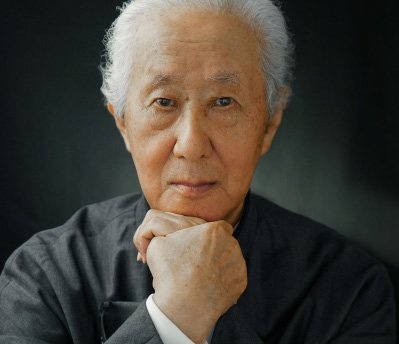
Arata Isozaki (1931–2022) occupies a distinctive place in the history of contemporary architecture. Over a career spanning more than six decades, he moved continuously between architecture, urbanism, theory, exhibition design, art and cultural criticism. Rather than developing a single recognisable architectural vocabulary and repeating it across projects, Isozaki treated every building as an opportunity to question the relationship between history, society, technology and space. His architecture evolved through contradictions—between East and West, tradition and modernity, permanence and change, construction and destruction. In 2019, this extraordinarily diverse contribution was recognised with the Pritzker Architecture Prize, whose jury described his work as resisting simple stylistic categorisation and praised his ability to engage with different cultural contexts.
Born in Ōita, Japan, in 1931, Isozaki came of age during one of the most destructive periods in modern history. His experience of post-war Japan profoundly influenced his understanding of architecture. As a young man, he witnessed cities reduced to ruins and saw first-hand how completely an urban environment could disappear. Instead of encountering architecture first as a collection of monuments and buildings, he encountered its absence—the empty space left by destruction. This experience became an important intellectual foundation for his later work. For Isozaki, architecture could never be separated from time, memory and the possibility of disappearance. His 1968 project Re-ruined Hiroshima, for example, used drawings and architectural imagery to imagine a city reconstructed through the language of ruins. The project demonstrated his interest in destruction not simply as an historical event, but as a condition through which architecture could be reconsidered.
Isozaki graduated from the University of Tokyo in 1954 and subsequently worked under Kenzo Tange, one of Japan’s most influential post-war architects. Tange’s approach to large-scale urbanism, infrastructure and modern Japanese architecture provided an important early influence, but Isozaki soon developed an independent intellectual position. In 1963, he established Arata Isozaki & Associates and began producing work that reflected the rapidly changing social and urban conditions of post-war Japan. The country was experiencing rapid economic development and unprecedented urban growth, and architects were increasingly asking whether conventional buildings and city plans were capable of accommodating such transformation. Isozaki became particularly interested in architecture that could anticipate change rather than simply respond to existing conditions.
One of his most significant speculative projects was City in the Air, developed during the 1960s for Tokyo’s Shinjuku district. The project imagined a vast elevated urban structure composed of infrastructural cores and layers of housing, offices and circulation suspended above the existing city. Although it was never constructed, the project became an important representation of Isozaki’s approach to speculative urbanism. Instead of accepting the city as a fixed physical arrangement, he imagined it as something capable of continual transformation. The project also demonstrated his belief that architectural drawings could operate as intellectual experiments. An unbuilt project could challenge established ideas about density, mobility, infrastructure and the future of the metropolis just as effectively as a completed building.
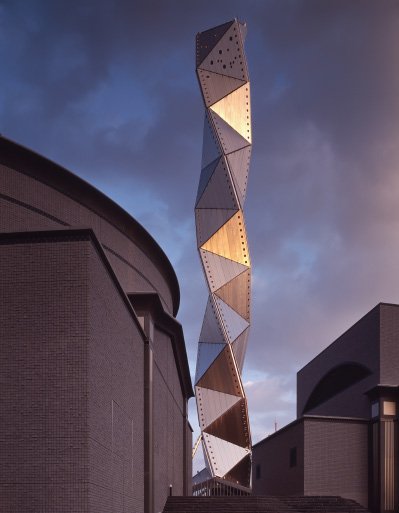
This resistance to a fixed style became one of the defining characteristics of his career. Isozaki once remarked that “Change became constant” and that, paradoxically, this became his own style. The statement provides an important key to understanding his work. At a time when many architects became identified with particular formal vocabularies, Isozaki remained willing to change direction. His Art Tower Mito in Japan, completed in 1990, used an expressive geometric tower as a civic landmark, while the Museum of Contemporary Art, Los Angeles, completed in 1986, demonstrated his ability to work within a very different cultural and urban environment. His buildings could therefore appear radically different while still belonging to the same intellectual practice.
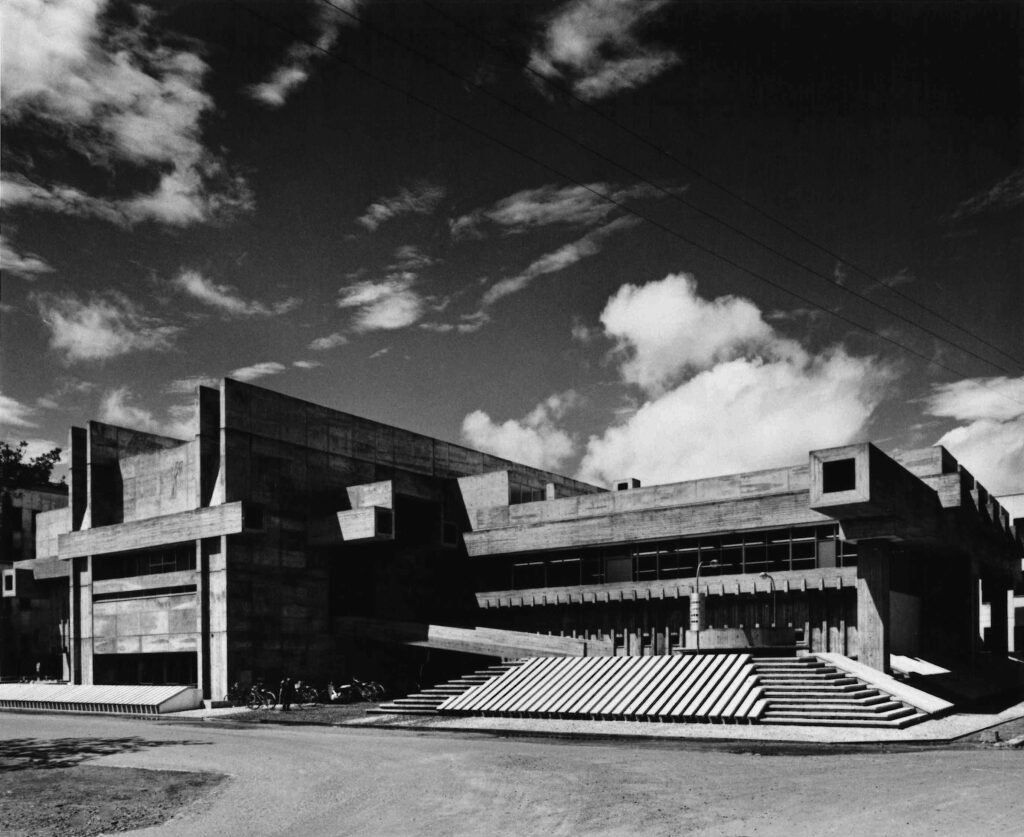
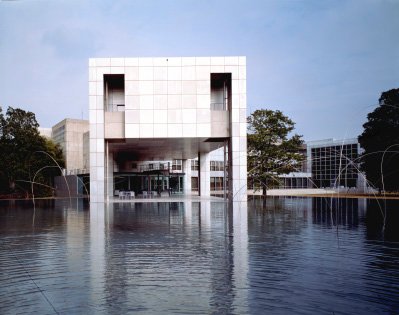
Isozaki’s built work developed through several architectural languages, making his career difficult to place within a single movement. His early buildings often reflected the structural clarity and monumental geometry associated with post-war modernism, while later projects incorporated historical references, classical geometry, technological imagery and more playful forms. The Ōita Prefectural Library, completed in 1966, expressed the weight and structural character of his early architecture, while the Museum of Modern Art, Gunma, completed in 1974, demonstrated his growing interest in modular geometry, grids and the relationship between architectural form and changing programmes. Rather than treating these differences as inconsistencies, Isozaki regarded transformation itself as a legitimate architectural principle.

A particularly important dimension of Isozaki’s thinking was his engagement with the Japanese concept of Ma. Often understood as an interval, pause or meaningful space between things, Ma offered Isozaki a way to reconsider the conventional Western understanding of architectural space. Space was not simply the volume enclosed by walls; the interval between objects, buildings and activities could also possess architectural significance. This idea allowed him to explore transitions, voids and relationships rather than concentrating exclusively on architectural objects. It also connected his contemporary architectural thinking with Japanese spatial traditions without reducing Japanese architecture to a collection of traditional forms.
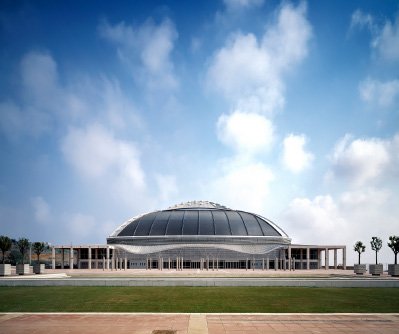

As Isozaki’s reputation grew, his architecture became increasingly international. His work expanded across Europe, North America and Asia, allowing him to explore architecture within very different cultural and geographical conditions. His Museum of Contemporary Art in Los Angeles was particularly significant because it marked an important stage in his international career and demonstrated his ability to engage with American architectural culture without simply reproducing either Japanese or Western conventions. His Palau Sant Jordi in Barcelona, constructed for the 1992 Olympic Games, responded to its hillside location while creating a major civic and sporting venue. Other major works included the Qatar National Convention Centre, Allianz Tower in Milan, CAFA Art Museum in Beijing and Shanghai Symphony Hall.
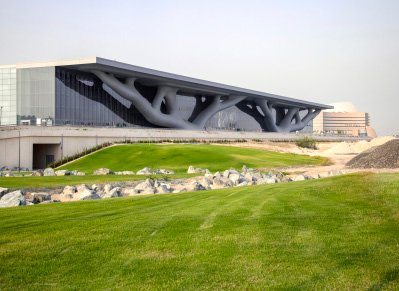
Isozaki’s international practice also challenged the idea that global architecture must be based on the universal repetition of a single architectural language. His buildings frequently responded to their individual cultural contexts while remaining unmistakably part of a broader intellectual investigation. He moved between countries and traditions not as an architect searching for a single identity, but as a designer interested in the possibilities created through cultural exchange. This quality was recognised by the Pritzker jury, which emphasised his ability to facilitate dialogue between different cultures and architectural traditions.
Beyond his buildings, Isozaki made an important contribution through exhibitions, writings, criticism and his support for younger architects. He understood architecture as a cultural discipline rather than simply a construction profession. His involvement in projects such as Nexus World Housing in Fukuoka brought together architects from different countries and generations, creating opportunities for international exchange within Japan. His influence therefore extended through the architectural community as much as through his completed buildings. He helped establish a model of the architect as an intellectual, curator, critic and cultural mediator.
The contradictions within Isozaki’s work are perhaps what make his architecture so compelling. He could be simultaneously interested in modernism and history, Japanese traditions and international culture, technology and memory, monumental structures and empty space. He did not attempt to resolve these oppositions into a single architectural formula. Instead, he allowed them to remain productive tensions. His architecture consequently resists easy classification, and this resistance is central to understanding his importance.
Isozaki died in 2022 at the age of 91, leaving behind a body of work that extends across more than six decades and includes cultural institutions, museums, libraries, sports facilities, offices, housing, urban proposals and speculative projects. Yet his legacy cannot be measured simply through the number of buildings he designed. His deeper contribution lies in the questions he brought into architectural practice. He demonstrated that an architect does not need to establish a permanent signature style; architecture can change according to place, history, programme and circumstance. For Isozaki, uncertainty was not something architecture had to eliminate. It could instead become the starting point for architectural thought.
Arata Isozaki’s career ultimately represents architecture as an ongoing conversation between different times, places and ideas. From the ruins of post-war Japan to the cultural institutions of cities across the world, he repeatedly questioned what architecture should mean in a changing society. His work reminds us that buildings are not isolated objects but participants in larger cultural, historical and urban processes. He did not build one definitive architecture; instead, he constructed a lifelong body of questions, allowing every project to search for its own answer. That intellectual openness, more than any particular form or style, remains one of the most enduring aspects of his legacy.
References
- The Pritzker Architecture Prize — Arata Isozaki
- The Museum of Modern Art — Arata Isozaki
- MoMA — Joint Core System / City in the Air
- MoMA — Re-ruined Hiroshima
- Architectural Record — Arata Isozaki (1931–2022)
- ArchDaily — Arata Isozaki: 20 Things to Know About the 2019 Pritzker Laureate
- ArchDaily — Arata Isozaki on “Ma,” the Japanese Concept of In-Between Space
Also Read: Álvaro Siza Vieira: The Quiet Radicalism of Architecture
Join our WhatsApp Channel for fastest updates: Join now