

New Delhi: The Pradhan Mantri Skilling and Employability Transformation through Upgraded ITIs (PM-SETU) scheme has completed one year, marking progress towards transforming India’s Government Industrial Training Institutes (ITIs) into modern, industry-aligned centres for vocational education and employment-oriented skills.
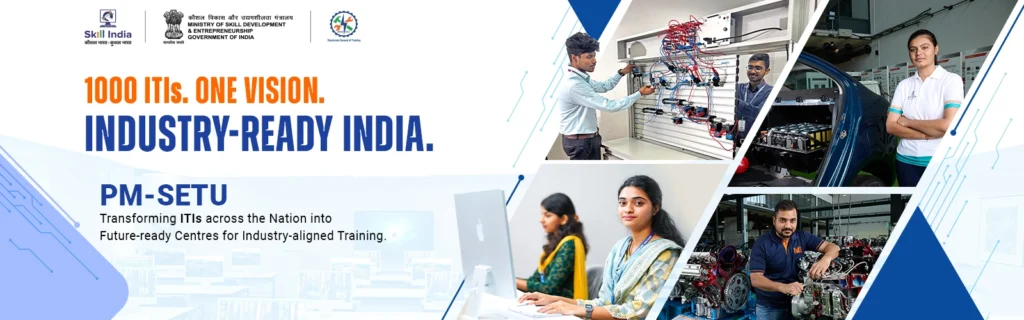
Launched on October 4, 2025, PM-SETU has a total outlay of ₹60,000 crore, comprising ₹30,000 crore from the Centre, ₹20,000 crore from the States and ₹10,000 crore from industry. The scheme focuses on modernising training infrastructure, strengthening industry participation and introducing courses aligned with emerging workforce requirements.
1,000 Government ITIs to be Upgraded
A key component of PM-SETU covers 1,000 Government ITIs, structured under a Hub-and-Spoke model comprising 200 Hub ITIs and 800 Spoke ITIs. Each Hub is connected with an average of four Spoke institutions, enabling students to access advanced infrastructure, modern trades, digital learning systems and incubation facilities.
The Hubs are envisaged to provide innovation centres, training-of-trainers facilities, production units and placement services, while Spokes expand access to these resources. The model also supports the introduction of smart classrooms, modern laboratories, digital content and industry-aligned courses.
The second component focuses on capacity augmentation of five National Skill Training Institutes (NSTIs) located in Bhubaneswar, Chennai, Hyderabad, Kanpur and Ludhiana, including sector-specific National Centres of Excellence and advanced training of trainers through international partnerships.
850 ITIs Identified in First Year
During its first year, PM-SETU has moved from institutional preparation towards implementation. 850 ITIs have been identified, including 172 Hub ITIs and 678 Spoke ITIs.
According to the PIB backgrounder, 36 States and Union Territories have identified clusters and created dedicated State budget heads, while 35 States and UTs have constituted State Steering Committees. In addition, 26 States and UTs have initiated the process of inviting industry participation.
The National Steering Committee has approved the transition of PM-SETU from its pilot phase to a nationwide rollout across all 200 identified ITI clusters, with implementation to be taken up according to industry readiness and institutional capacity.
₹3,446 Crore Investment Approved Across 14 ITI Clusters
Industry participation has emerged as a major feature of the scheme. Strategic Investment Plans (SIPs) for 14 ITI clusters across eight States and one Union Territory have been approved, involving a proposed investment of ₹3,446 crore.
The approved clusters span sectors including steel and metals, diversified manufacturing, healthcare and life sciences, pharmaceuticals and chemicals, infrastructure and construction, skill development, defence and electronics, automotive, facility management and other industries. The listed anchor industry partners include ArcelorMittal Nippon Steel India, Jindal Naveen Avsar Ltd., Apollo MedSkills, H.G. Infra Engineering, NSDC, ZEN Technologies, Belrise Industries and others.
The SPV model proposed under PM-SETU gives 51% ownership to the Anchor Industry Partner, with the Centre and State Governments holding 24.5% each. These SPVs are expected to guide cluster development and operations and propose interventions covering curriculum, training delivery, infrastructure and industry exposure.
32 New-Age Courses Introduced
PM-SETU is also expanding the range of vocational courses to address emerging technologies and occupations. The Directorate General of Training has introduced 32 new-age courses under the Craftsmen Training Scheme.
The courses cover areas including Artificial Intelligence, Cyber Security, Additive Manufacturing, Electric Vehicles, Semiconductor Technology, Robotics, Green Hydrogen, Drones, Internet of Things, Solar Energy, 5G and Software Testing. States can adopt these courses in ITIs under their administrative and financial control.
International Partnerships for Advanced Training
The scheme is also building international cooperation into advanced skilling. Partnerships have been established for NSTIs in different locations, including an MoU with Singapore for NSTI Chennai, France for NSTI Kanpur and Australia for NSTI Bhubaneswar. A Joint Declaration of Intent has also been exchanged with Germany for NSTI Hyderabad.
ITI Network Continues to Expand
The PM-SETU initiative builds on the wider expansion of India’s vocational training ecosystem. The number of ITIs, including Government and private institutions, has increased from 9,776 in 2014 to 13,888 in 2026, representing a 42% rise. Enrolment has also increased from 9.51 lakh in 2014–15 to 14.70 lakh in 2025–26, a rise of 54%.
With its emphasis on modern infrastructure, industry-led governance, emerging technologies and international expertise, PM-SETU is seeking to strengthen the pathway from vocational education to employment. Its first-year progress indicates a shift from planning and institutional preparation towards wider implementation across India’s ITI network.
Also Read: India Showcases Forest and Landscape Restoration Initiatives at COFO 28 in Rome
Join our WhatsApp Channel for fastest updates: Join now