
Workshop Conducted By: ITPI- Haryana Regional Chapter in collaboration with Centre for Science and Environment, New Delhi
Date: 25th August, 2026 Venue: ITPI- HRC, Sector- 2 , Panchkula
THEME
“Driving Clean Air in Haryana: Scaling Sustainable Transport and Dust-Free Infrastructure under HCAPSD (Haryana Clean Air Project for Sustainable Development)”
The Institute of Town Planners, India (ITPI), Haryana Regional Chapter, in collaboration with the Centre for Science and Environment (CSE), organised a high-level workshop on “Driving Clean Air in Haryana: Scaling Sustainable Transport and Dust-Free Infrastructure under HCAPSD (Haryana Clean Air Project for Sustainable Development)” on 25 August 2026.
The workshop brought together urban planners, transport experts, government representatives, environmental professionals and sectoral specialists to deliberate on two of Haryana’s most pressing urban challenges—vehicular emissions and dust generated from construction and demolition activities—and to identify practical pathways towards cleaner, healthier and more sustainable cities.
The programme commenced with the inaugural address by Mr. P.P. Singh, CTP–SMDA–FMDA, who emphasised the importance of coordinated planning and institutional action for addressing the growing environmental challenges faced by Haryana’s urban areas.
The context and theme of the workshop were set by Mr. Rajneesh, Programme Director – Sustainable Habitat, CSE, New Delhi, followed by a detailed presentation by Ms. Alumina Roychowdhury, CSE, New Delhi, on “Driving Clean Air Action in Haryana: Scaling Sustainable Transport and Clean Construction in the State.”
The discussion highlighted the increasing air-quality risks faced by Haryana as part of the Indo-Gangetic Plain, where urban centres are particularly vulnerable to high concentrations of particulate matter. The speakers highlighted the high levels of PM2.5 in urban Haryana and the seasonal changes in the sources contributing to pollution, particularly in Gurugram and Faridabad. The need to move towards zero-tailpipe-emission mobility, alongside cleaner construction practices, was identified as a critical component of Haryana’s clean-air strategy.
The workshop also brought attention to the emerging role of course-correction through science, data and evidence-based planning, particularly in sectors such as construction, transport and waste management. Discussions focused on Construction and Demolition (C&D) waste management, circularity in the transport sector, Extended Producer Responsibility (EPR) regulations, compliance obligations, institutional gaps and lessons from successful global and Indian practices.
A key message emerging from the discussions was the need for a zero-emission transition, supported by stronger policy frameworks, innovative financing and procurement models, improved institutional capacity and technology-driven monitoring systems. The speakers also discussed the current state of electric mobility in Haryana and other Indian states, the need to upscale the electric-bus market, develop efficient charging infrastructure and establish a robust EV battery recycling ecosystem.
Technical Session I: Scaling Clean Urban Mobility in Haryana
The first technical session focused on “Scaling Clean Urban Mobility in Haryana: Accelerating Electric Bus Deployment through Innovative Procurement and Operational Models, while Advancing Fleet Transition and Urban Freight Electrification.”
The session explored how Haryana can accelerate the transition towards electric public transport by learning from cities and states that have already undertaken large-scale electric-bus programmes.
Mr. Prabhakar Reddy, Chief Traffic Manager, Karnataka State Road Transport Corporation, shared lessons from Bangalore’s electric-bus operations and highlighted key considerations for developing Haryana’s deployment roadmap.
Mr. Shrinivas Rao, Former Deputy General Manager, Transport Engineering Division, BEST Undertaking, shared insights from BEST’s electric-bus operations, particularly on operational models, fleet management and the practical challenges associated with scaling e-bus systems.
The discussion was further enriched by Mr. Jayant Deshmukh, Bus Expert, who spoke about electric-bus maintenance and its implications for Haryana’s future e-bus deployment strategy. The session underlined that successful electrification requires more than simply replacing diesel buses—it demands adequate charging infrastructure, maintenance systems, trained manpower, operational planning and financially viable procurement models.
Ms. Kanika Rohilla, Consultant, pManifold, presented strategies for electrifying urban freight and reducing emissions, drawing lessons relevant to Haryana’s cities and highlighting the importance of addressing freight movement alongside passenger mobility.
Further insights into Haryana’s electric-bus programme were shared by Mr. Bansal, while the introductory address for the session was delivered by Mrs. Sangeeta Bagga, Principal CCA, Chandigarh.
Technical Session II: Building a Circular and Dust-Free C&D Waste Ecosystem
The second technical session shifted the focus from mobility to the equally critical challenge of Construction and Demolition waste management in Haryana.
Under the theme “Strengthening C&D Waste Management in Haryana: Advancing EPR-based Recycling, Institutional Reforms and Digital Systems for Collection, Tracking and Compliance,” experts discussed how Haryana can move from a conventional waste-disposal approach towards a circular C&D waste economy.
Mr. Krishnendu Datta, Head, C&D West Bengal, RE Sustainability, presented lessons from West Bengal on EPR and institutional reforms for strengthening C&D waste recycling.
Mr. Bejawada Raghuram, Director, SSREC, shared experiences from Telangana and highlighted the potential of EPR-based approaches to improve recycling and resource recovery from C&D waste.
The role of technology in transforming the sector was discussed by Mr. Anuj Maheshwari, Trace Engineering, who presented the potential of digital tools for collection, tracking, monitoring and compliance. The session emphasised that digital systems can help create greater accountability across the C&D waste chain, from generation and transportation to processing and end-use.
The deliberations highlighted the need for stronger institutional mechanisms, improved segregation and collection systems, enhanced recycling infrastructure, EPR-based responsibility mechanisms and digital tracking to create a more efficient and dust-free urban construction ecosystem.
CSE Launches Guidelines for Dust Mitigation
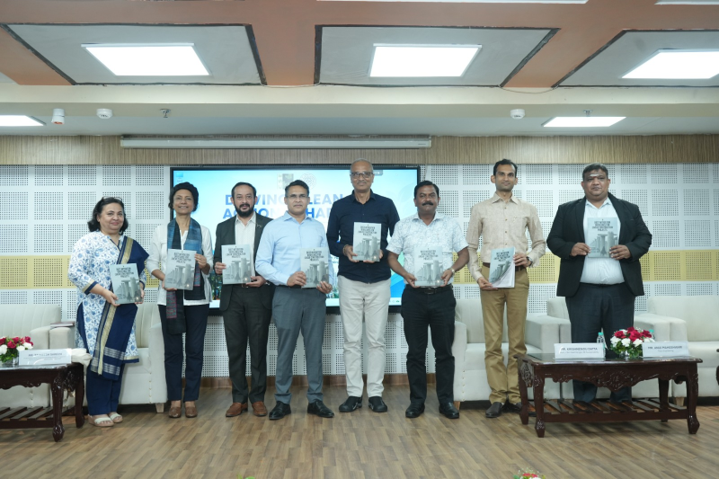
A key highlight of the workshop was the launch of CSE’s publication on Dust Mitigation Guidelines for Linear Construction Projects. The guidelines provide an important resource for improving dust-control practices during road and other linear infrastructure projects, which are significant contributors to urban dust pollution.
The launch reinforced the workshop’s central message that clean-air action must extend beyond vehicles and address the entire urban development cycle—from mobility and infrastructure construction to waste generation, recycling and resource recovery.
A Roadmap for Haryana’s Clean-Air Transition
The workshop concluded with a strong call for integrated, science-based and implementation-oriented action. The discussions emphasised that Haryana’s clean-air challenge cannot be addressed through isolated interventions. Sustainable mobility, electric public transport, urban freight electrification, dust-free construction, C&D waste recycling, EPR, digital monitoring and circular-economy practices must be pursued as interconnected components of the state’s urban development strategy.
The event provided a valuable platform for knowledge exchange between government, planners, transport professionals, environmental experts and industry stakeholders, while bringing successful experiences from Bengaluru, BEST, West Bengal, Telangana and other regions to the Haryana context.
The programme concluded with the vote of thanks delivered by Mr. Sanjay Kumar, Chairman, ITPI–HRC, who acknowledged the contributions of all speakers, experts, participating institutions and attendees towards advancing the clean-air agenda for Haryana.
The workshop was an important step toward building a shared vision for cleaner mobility, responsible construction, circular resource management, and healthier urban environments across Haryana.
Also Read: Prof. Avlokita Agrawal Selected for National Award to Teachers 2026 for Sustainable Architecture
Join our WhatsApp Channel for fastest updates: Join now