
Plan proposes transit-oriented growth, redevelopment of unauthorised colonies, Yamuna restoration and major expansion of affordable housing
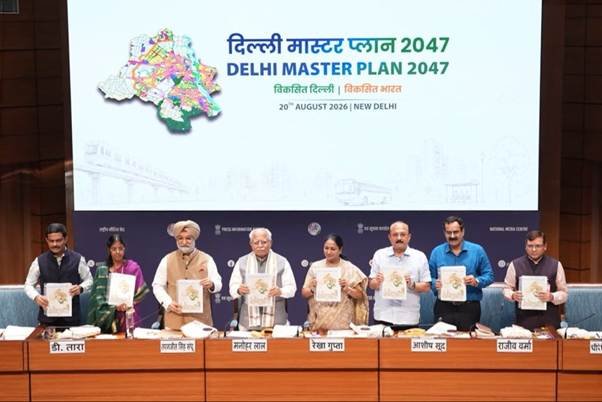
New Delhi: The Union government on 20 August, 2026 unveiled the Delhi Master Plan 2047 (MPD-2047), laying out a long-term roadmap to transform the national capital into an inclusive, sustainable, resilient and globally competitive city. The plan, unveiled by Union Minister for Housing and Urban Affairs and Power Manohar Lal in the presence of Delhi Lieutenant Governor Taranjit Singh Sandhu and Chief Minister Rekha Gupta, places housing, mobility, redevelopment and environmental restoration at the centre of Delhi’s future growth.
One of the plan’s most significant targets is the creation of around 40 lakh new affordable housing units. These include nearly 18 lakh affordable homes in Transit-Oriented Development (TOD) zones, around 12 lakh homes through land pooling, and housing provisions for more than 17 lakh residents of Jhuggi-Jhopri clusters. The plan also proposes reducing the minimum area requirement for redevelopment of existing group and government housing from 40,000 sq m to 3,000 sq m, potentially enabling around 7 lakh additional dwelling units.
600-km road network through land pooling
The Master Plan envisages nearly 200 sq km of planned urban expansion through the commissioning of the Land Pooling Policy, supported by an estimated 600-km road network. The Delhi Development Authority (DDA) will undertake infrastructure-first development, including upfront construction of 30-metre and wider roads.
A High-Density Corridor along UER-II has also been proposed, with FAR of up to 400, while multiple planning schemes will facilitate faster development of assembled land.
Transport-led urban growth
Transit-Oriented Development will form a key component of the city’s future growth strategy. The plan proposes multi-modal transit hubs integrating Metro, RRTS, buses, intermediate public transport, walking and cycling. A Unified Metropolitan Transport Authority has been proposed as a single authority for planning and development of an integrated transport system.
The plan also includes a Unified Parking Planning Framework and continued development of UER-I, UER-II and UER-III to strengthen intra-city and inter-state connectivity.
Yamuna restoration and green infrastructure
Environmental priorities feature prominently in MPD-2047, with plans to protect and ecologically restore nearly 1,700 hectares of the Yamuna floodplains through 13 major restoration projects. A 52-km cycle track is proposed along the floodplain.
The plan further promotes net-zero development, rooftop solar, rainwater harvesting, water recycling, waste-to-resource initiatives, urban forests, biodiversity parks and ecological corridors.
1,511 unauthorised colonies to get regularisation framework
In a major housing and property-security measure, residential buildings in 1,511 unauthorised colonies are proposed to be regularised on an “as is where is” basis, without requiring layout plans. The measure is expected to strengthen property ownership security for around 45 lakh residents.
The plan also proposes conservation of around 1,500 heritage assets, development of Narela as an education hub, and Dwarka as an international investment gateway. Regulatory reforms would reduce 133 use premises categories to 45, while online approvals and simplified processes are intended to improve the ease of doing business.
The Delhi Master Plan 2047 ultimately seeks to balance planned urban expansion with redevelopment of existing areas, improved connectivity, affordable housing, ecological restoration and heritage conservation, setting the planning framework for Delhi’s development towards 2047.
Join our WhatsApp Channel for fastest updates: Join now