
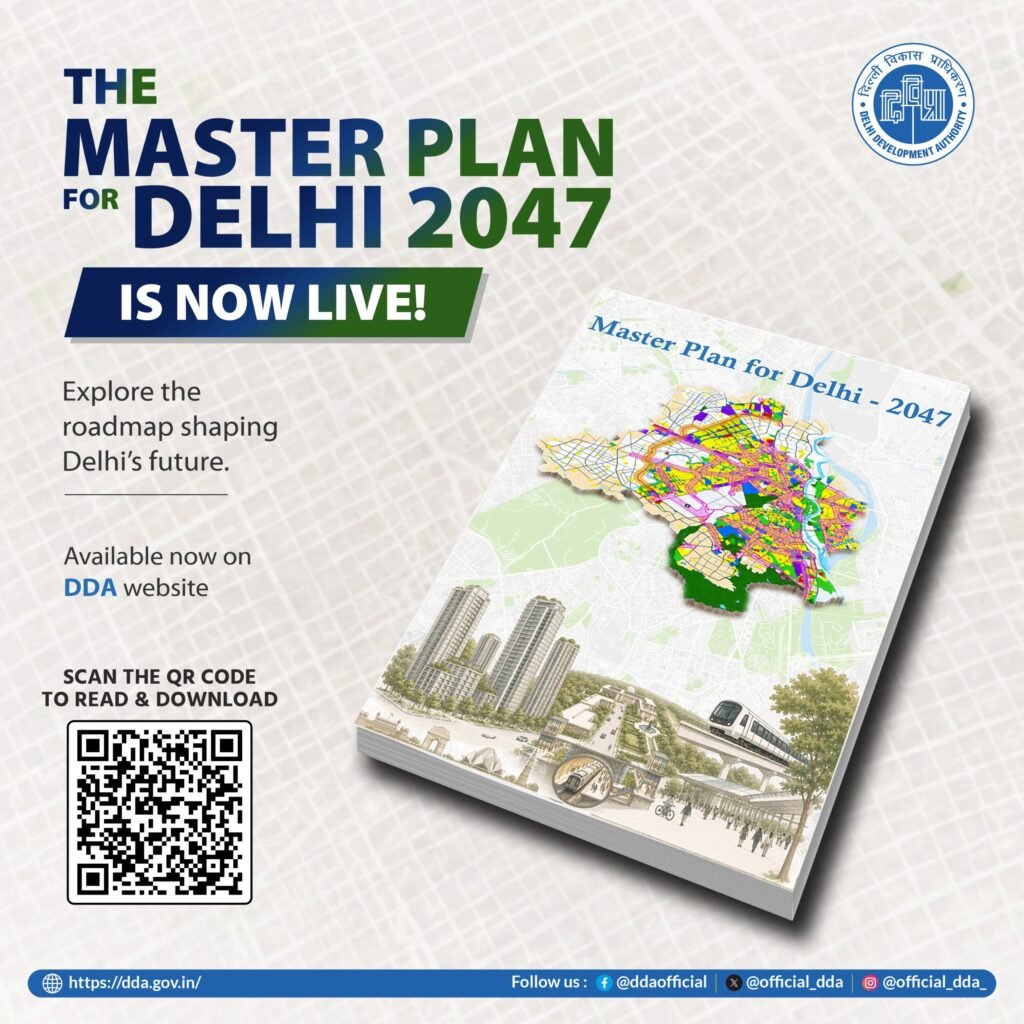
New Delhi: The Delhi Development Authority (DDA) has made the Master Plan for Delhi 2047 (MPD 2047) available, setting out a long-term roadmap for the spatial, economic, environmental and infrastructure development of the National Capital. The plan is aligned with the vision of Viksit Bharat 2047 and seeks to position Delhi as a more inclusive, sustainable, connected and globally competitive capital.
The plan was unveiled on August 20 in the presence of Union Minister for Housing and Urban Affairs Manohar Lal, Delhi Lieutenant Governor Taranjit Singh Sandhu, Delhi Chief Minister Rekha Gupta, Delhi minister Ashish Sood, DDA Vice Chairman N. Saravana Kumar and senior officials. According to the government, MPD 2047 provides a long-term framework for a city expected to accommodate nearly 3.2 crore people by 2047.
A major focus of the plan is housing. The roadmap envisages addressing the requirement for around 40 lakh additional homes, with housing development supported through land pooling, transit-oriented development and redevelopment of existing areas. The approach also seeks to expand housing choices across income groups, including smaller and affordable homes and rental housing for students, workers and other sections of the population.
Transit-oriented development (TOD) is identified as an important component of future urban growth, with development concentrated around public transport networks and major mobility corridors. The plan also places emphasis on improving connectivity through integrated transport infrastructure while encouraging walking and cycling networks to support more sustainable urban mobility.
Land pooling is another significant planning instrument under MPD 2047. The policy is intended to unlock land for planned urban development and create new housing and infrastructure in areas where fragmented land ownership has historically constrained development. The plan also introduces town-planning approaches intended to make land assembly and planned development more workable.
The environmental agenda forms a central pillar of the new master plan. MPD 2047 proposes the rejuvenation of the Yamuna floodplains, treatment of drains contributing to pollution and expansion of green and blue infrastructure. The DDA’s roadmap also highlights greener and healthier spaces, stronger ecological systems and improved resilience as key components of Delhi’s future urban structure.
The plan further identifies Dwarka and Narela as areas for new opportunities and planned growth. It envisages a more balanced spatial structure in which development is distributed across the city rather than remaining concentrated in established urban centres. Planned redevelopment and growth are intended to be accompanied by improved infrastructure, public amenities and connectivity.
Another important objective is to create a more vibrant and inclusive 24×7 city, supporting economic activity, employment and urban services beyond conventional working hours. The broader vision combines economic development with technological innovation, improved liveability and protection of Delhi’s historical and cultural heritage.
The housing strategy also addresses existing settlements. Earlier details of MPD 2047 indicated proposals for regeneration and improvement of unauthorised colonies, while notified JJ clusters could be considered for in-situ rehabilitation wherever feasible. The plan also promotes redevelopment and upgrading of existing housing areas to improve infrastructure, public amenities and overall quality of the built environment.
The release of MPD 2047 marks a significant stage in Delhi’s long-term planning process. The previous Master Plan, MPD 2021, was notified in 2007, making the new plan an important transition towards a planning framework extending to 2047.
The DDA has stated that the Master Plan for Delhi 2047 is now available for reading and download on its official website. The plan’s success, however, will ultimately depend on coordinated implementation, land assembly, infrastructure investment and effective cooperation among government agencies, local bodies, communities and private stakeholders.
Also Read: From Shahjahanabad to the Master Plan: A.K. Jain Reflects on the Evolution of Delhi’s Urban Planning
Join our WhatsApp Channel for fastest updates: Join now