

The Ministry of Jal Shakti has highlighted a series of technology-driven initiatives and community-based programmes aimed at strengthening water management, groundwater conservation, and climate resilience across the country. The details were shared by the Minister of State for Jal Shakti, Shri Raj Bhushan Choudhary, in a written reply in the Rajya Sabha.
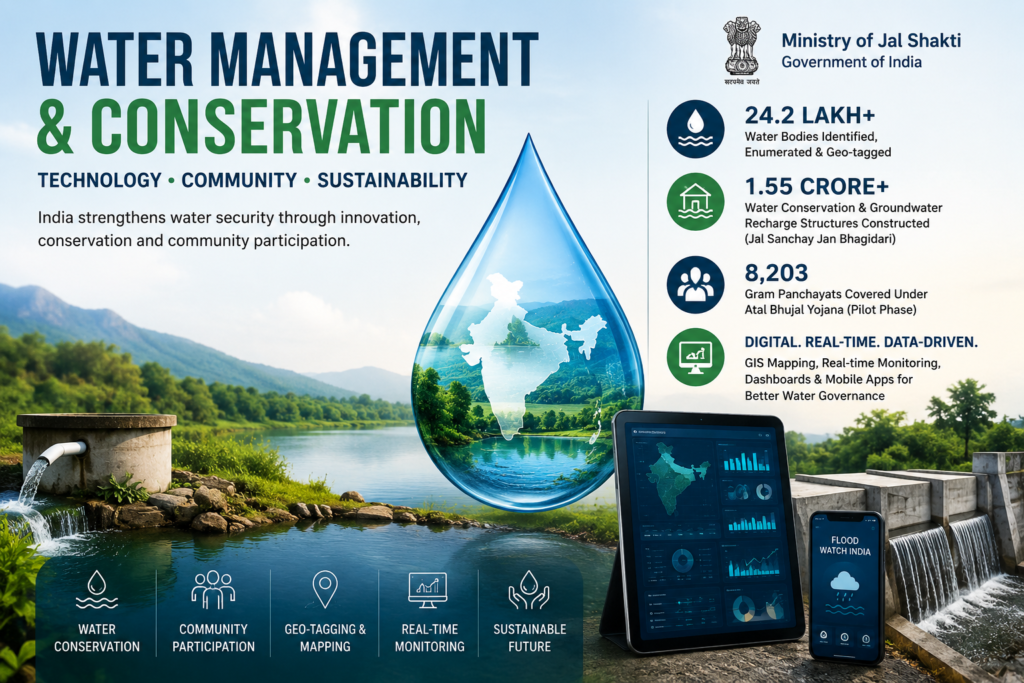
A key initiative, the Atal Bhujal Yojana, was implemented as a pilot programme from April 2020 to October 2025 across 8,203 water-stressed Gram Panchayats in 229 blocks spanning 80 districts in Gujarat, Haryana, Karnataka, Madhya Pradesh, Maharashtra, Rajasthan, and Uttar Pradesh. The scheme focused on community-led groundwater management, strengthening local institutions, and encouraging demand-side water conservation through convergence with Central and State schemes. The Ministry stated that lessons from the pilot have been shared with other States for wider adoption.
The government also reported significant progress in water conservation. A nationwide Water Body Census identified, enumerated, and geo-tagged over 24.2 lakh water bodies, while the Jal Sanchay Jan Bhagidari (JSJB) initiative has resulted in the construction of more than 1.55 crore water conservation and groundwater recharge structures, all of which have been geo-tagged and uploaded to the JSJB portal.
To improve water resource planning and monitoring, the Ministry is leveraging advanced technologies such as Remote Sensing (RS), Geographic Information Systems (GIS), digital dashboards, mobile applications, and artificial intelligence-supported data systems. Under the National Aquifer Mapping and Management Programme (NAQUIM), the country’s entire mappable area of nearly 25 lakh square kilometres has been scientifically mapped, with district-level aquifer management plans prepared for implementation by State governments.
The Ministry further noted that the Central Ground Water Board (CGWB) monitors groundwater levels through thousands of Digital Water Level Recorders (DWLRs) installed under the National Hydrology Project and Atal Bhujal Yojana. Platforms such as the India Groundwater Resource Estimation System (IN-GRES), the Jal Shakti Abhiyan: Catch the Rain dashboard, and the Flood Watch India mobile application support real-time monitoring, groundwater assessment, flood forecasting, and reservoir management.
Additional technology-enabled initiatives include geo-tagging of irrigation projects under the Pradhan Mantri Krishi Sinchayee Yojana (PMKSY), GIS-based monitoring of restored water bodies, the Water Information Management System (WIMS), and satellite-based monitoring in collaboration with BISAG-N and the Space Applications Centre, Ahmedabad. These digital tools are intended to improve transparency, evidence-based planning, and sustainable management of India’s water resources.
The Ministry reiterated that while water remains a State subject, the Central Government continues to provide technical and financial support to States through various schemes and technology-driven interventions to enhance long-term water security.
Join our WhatsApp Channel for fastest updates: Join now