

Noida, originally developed to ease population pressure on Delhi, has completed nearly five decades of rapid transformation into a major economic hub. Established in 1976 as a planned industrial township, the city has evolved into a self-sustaining urban centre driven by strong infrastructure, expanding industries, and rising global investments. Improved road networks, seamless metro connectivity, and the steady growth of manufacturing and IT sectors have enabled Noida to move beyond its identity as a satellite town and emerge as a key contributor to Uttar Pradesh’s economy.
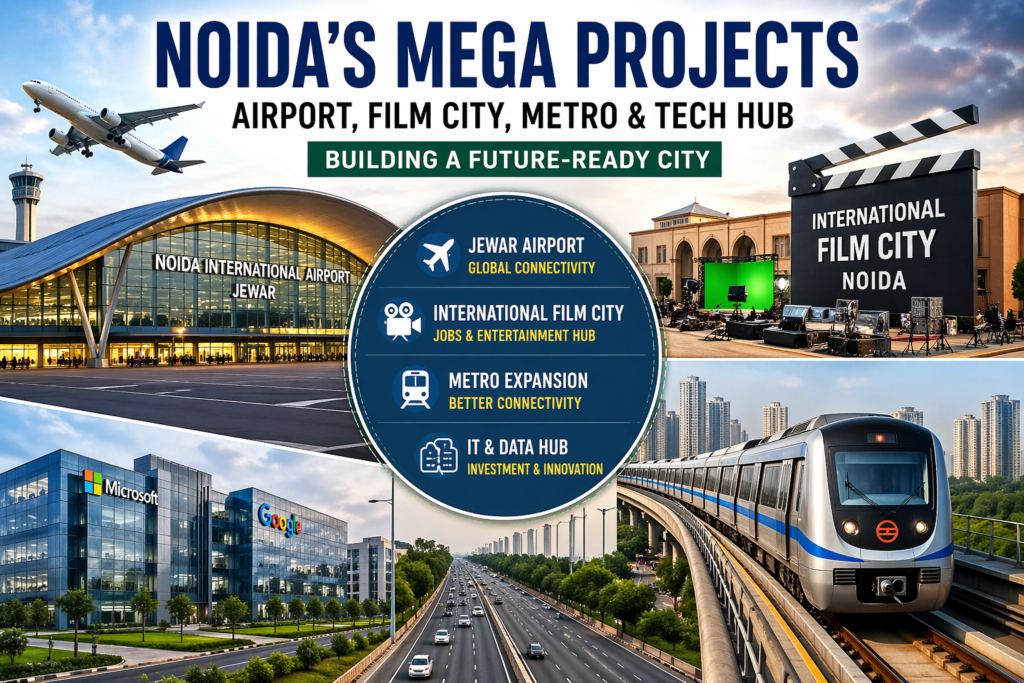
A major turning point in Noida’s growth trajectory is the development of the Noida International Airport at Jewar. Envisioned to reduce congestion at Indira Gandhi International Airport, the project has already seen the inauguration of its first phase, with commercial flight operations expected soon. Once fully operational, the airport will include multiple runways, passenger terminals, and cargo infrastructure, significantly enhancing regional and international connectivity while strengthening logistics and trade networks.
Parallel to this, the proposed International Film City in Sector 21 is set to transform Noida into a prominent media and entertainment hub. Spread across nearly 230 acres, the project will feature film studios, production facilities, and integrated media infrastructure. The Uttar Pradesh government estimates that it could generate around 50,000 direct jobs and create indirect opportunities for nearly seven lakh people, thereby boosting the regional economy and creative industries.
Urban mobility in the city is also poised for a major upgrade with the expansion of the Aqua Line Metro from Sector 142 to Botanical Garden. The extension will add eight new stations and create an important interchange with the Delhi Metro network, taking the total metro network length to over 61 km. This expansion is expected to significantly ease daily commuting, improve last-mile connectivity, and support the city’s growing population and urban spread.
Noida is also rapidly emerging as a digital and data infrastructure hub, attracting major global players such as Microsoft and Google, which are investing in data centres and advanced technological infrastructure. Complementing this growth, the state government’s Global Capability Centres (GCC) Policy aims to attract around 500 multinational companies, further accelerating job creation and strengthening the region’s position in the global technology landscape.
Adding to this infrastructure push is the proposed Delhi–Varanasi high-speed rail corridor, which will pass through Noida and connect major cities including Mathura, Agra, Kanpur, Lucknow, and Varanasi. Spanning approximately 865 km, the corridor is expected to significantly reduce travel time while its largely elevated design will help minimise land acquisition challenges and environmental impact.
As Noida continues to expand and modernise, these mega infrastructure projects underline its transition into a future-ready city. With enhanced connectivity, diversified economic opportunities, and sustained investment, Noida is poised to play an increasingly significant role in shaping India’s urban and economic landscape in the coming decades.
Source: HT
Also Read: Bharat Vandana Park in Dwarka Set for Phased Opening; Key Attractions to Open Soon