
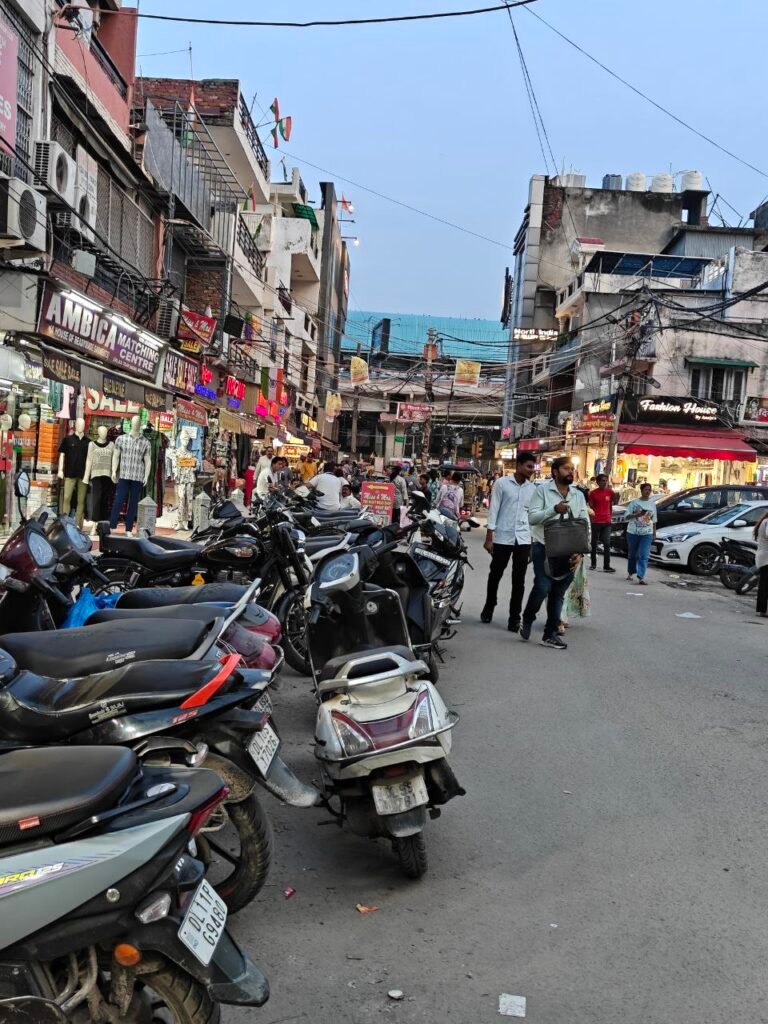
This street does not appear on master plans. It is not part of any grand urban vision. Yet, every single day, it carries the weight of a city’s life. By morning, shop shutters rise halfway. Scooters line both sides, narrowing what is meant to be a road. Vendors arrange clothes, snacks, plastic goods, water cans. People walk, slow down, negotiate space. Someone rides a two-wheeler straight through the middle, carefully avoiding pedestrians. No one is surprised. This is normal. This one street, like thousands across India’s mega cities, quietly explains where we are standing as we enter 2026.

A Street That Does Everything at Once
This street is not just a street. It is a market, a parking lot, a footpath, a social space, and a traffic corridor—all at the same time. There is no clear separation between walking and riding, between selling and passing through. People adjust instinctively. They step aside, slow down, squeeze past. The street works not because it is well-designed, but because people constantly adapt to its limitations. That adaptability is often praised as “Indian resilience.” But resilience should not replace planning.
What We Call Chaos Is Actually Demand
At first glance, the street looks chaotic. But look closer and a pattern emerges. Every parked scooter tells you that there is no designated parking. Every vendor tells you there is a need for livelihood close to home. Every pedestrian walking on the road tells you the footpath is missing or unusable. This street is not misused. It is overused—because the city has not provided alternatives.
In 2026, the lesson is clear: when cities fail to design for everyday needs, streets are forced to absorb everything.
Movement Without Safety
Children, elderly people, shoppers, two-wheelers—all share the same space. There are no markings, no crossings, no buffers. Safety depends entirely on eye contact and caution. Accidents are avoided not by infrastructure, but by mutual adjustment. This works—until it doesn’t. A city that relies on constant alertness instead of safe design puts the burden of survival on its people. Streets should protect the most vulnerable, not test their reflexes.
The Informal City Is the Real City
The street is alive because of informal activity. Small shops, temporary stalls, local vendors—this is what gives the area energy, affordability, and access. Yet, in many plans, this informality is treated as a problem to be removed, not a reality to be organised. If this street were suddenly “cleared,” livelihoods would disappear overnight. If it were planned thoughtfully—with vending zones, walking space, and managed traffic—it could work better for everyone. The future of cities in 2026 depends on whether we choose to erase informality or design with it.
What This One Street Asks From 2026
This street does not ask for flyovers or smart sensors.
It asks for small, practical things:
- Space to walk without fear
- Space to earn without eviction
- Space to park without blocking movement
- Shade, lighting, drainage, and dignity
None of these are expensive. They are simply ignored.
A Mirror to the City
This one street is not an exception. It is the rule. Across mega cities, similar streets quietly carry the pressure of population growth, weak enforcement, and planning & designing that focuses on projects instead of daily life. If we want to understand what kind of city we are becoming in 2026, we do not need grand data dashboards. We need to stand on a street like this—for one hour, one day, one year. It will tell us everything.
Also Read: A Child Born in 2026: What City Will They Inherit?
Editor’s Note: Urban futures are often discussed through big plans and bold announcements. But cities are actually built—and lived—one street at a time. As we step into 2026, the real question is not how fast our cities are growing, but whether our streets are being allowed to work with dignity, safety, and fairness for everyone who depends on them.